Manual cloud management is no longer a viable option for modern businesses. As infrastructure scales in complexity across multiple providers, the risk of misconfiguration, inconsistent environments, and runaway costs grows exponentially. Effective automation is the key to maintaining control, ensuring security, and unlocking efficiency. This guide cuts through the noise to showcase the essential cloud infrastructure automation tools your team needs to consider.
We will explore everything from foundational Infrastructure as Code (IaC) and configuration management to specialized tools for orchestration and cost optimization. Our goal is to provide the insights you need to build a robust, scalable, and cost effective cloud environment. To truly understand the power and benefits of cloud infrastructure automation, exploring practical Infrastructure as Code examples can provide valuable insights into accelerating delivery and improving consistency.
This comprehensive resource list is designed for direct comparison, helping you quickly identify the right solution for your specific needs. Each entry details concrete use cases, honest pros and cons, and critical integration notes, complete with screenshots and direct links to help your evaluation. We'll examine market leaders like Terraform and Ansible, cloud native solutions such as AWS CloudFormation, and specialized platforms including CLOUD TOGGLE for advanced scheduling and cost control. Get ready to streamline your operations and transform how you manage your cloud resources.
1. CLOUD TOGGLE
CLOUD TOGGLE is a focused, powerful automation tool designed for a single critical mission: eliminating wasted cloud spend. It achieves this by automatically scheduling the start and stop times for idle servers and virtual machines across AWS and Azure. This platform stands out as a top choice among cloud infrastructure automation tools for its exceptional simplicity and security, making cloud cost optimization accessible to non-technical team members without compromising control. Its core value is providing a direct, measurable return on investment by ensuring you only pay for compute resources when they are actively needed.
Key Differentiators and Use Cases
Unlike native cloud tools like AWS Instance Scheduler, which require significant technical setup and maintenance, CLOUD TOGGLE provides a polished, out-of-the-box experience. Its intuitive UI allows a FinOps manager, a project lead, or even an executive assistant to create and manage complex uptime schedules in minutes.
Key Advantage: The combination of an easy-to-use interface with granular Role-Based Access Control (RBAC) is CLOUD TOGGLE's standout feature. Teams can be granted permission to manage schedules for their specific projects without ever needing direct, high-level access to the underlying AWS or Azure accounts, significantly improving security posture.
Practical Use Cases:
- Development & Staging Environments: Automatically shut down non-production servers every evening and on weekends, a common source of significant cloud waste.
- Project-Based Teams: Grant project managers the ability to override schedules for late-night deployments or urgent testing without needing an on-call DevOps engineer.
- Managed Service Providers (MSPs): Efficiently manage and report on cost savings across multiple client cloud accounts from a single, centralized dashboard.
Pricing and Getting Started
CLOUD TOGGLE offers transparent, scalable pricing with a 30-day free trial. Plans start at $49/month for up to 15 servers, making it accessible for small teams and startups. Higher tiers support more servers and cloud connections, with custom enterprise plans available.
| Feature / Plan | Strengths | Limitations |
|---|---|---|
| Simplicity | The non-engineer-friendly UI dramatically reduces the barrier to entry for cloud cost management. | Lacks the deep, complex automation capabilities of a full Infrastructure as Code (IaC) tool. |
| Security | RBAC and team management allow for safe, delegated control over server uptime. | Limited to its specific function; does not manage broader security policies or configurations. |
| Cloud Support | Strong, native support for AWS and Azure, the two largest public cloud providers. | No current support for Google Cloud Platform (GCP), which could be a dealbreaker for multi-cloud teams using GCP. |
| Implementation | SaaS model means quick setup with minimal configuration compared to self-hosted native solutions. | Requires granting permissions to a third-party service, which may need internal security review. |
Website: https://cloudtoggle.com
2. HashiCorp Terraform (HCP Terraform – SaaS and self-managed)
HashiCorp Terraform has established itself as the industry standard for declarative infrastructure as code (IaC). Its core strength lies in its provider-based model, which enables developers to manage a vast array of services from major cloud providers like AWS, Azure, and GCP to SaaS platforms and on-premises resources using a single, unified workflow. This makes it an essential tool for teams operating in multi-cloud or hybrid environments.
The open-source Terraform CLI is the engine, but the real power for collaborative teams is unlocked with HCP Terraform, a SaaS platform providing a centralized control plane. HCP Terraform enhances the core IaC experience with features critical for production environments. It offers remote state management, secure variable storage, and a collaborative run environment that shows proposed infrastructure changes before they are applied.
Key Features and Use Cases
- Multi-Cloud Provisioning: A single configuration file can define resources across different clouds, preventing vendor lock-in and simplifying management. For instance, you could provision a VPC in AWS, a virtual network in Azure, and a DNS record in Cloudflare all within one
terraform applycommand. - Collaboration and Governance: HCP Terraform provides workspaces to isolate environments (e.g., dev, staging, prod) and integrates with version control systems like Git. Its policy-as-code framework (Sentinel) allows FinOps and security teams to enforce cost, security, and compliance rules before infrastructure is deployed.
- Pricing: The open-source CLI is free. HCP Terraform offers a generous free tier for small teams, with paid tiers (Standard, Plus, Enterprise) adding advanced governance, concurrency, and enterprise support features.
| Feature | Highlight |
|---|---|
| Coverage | The broadest provider ecosystem in the IaC space, including official and community-supported plugins. |
| Collaboration | Remote state locking, version control integration, and detailed run history for team workflows. |
| Governance | Policy as Code (Sentinel) and Role-Based Access Controls (RBAC) in paid tiers. |
| Community | Extensive public module registry simplifies reuse of common infrastructure patterns. |
Website: https://www.hashicorp.com/products/terraform
3. OpenTofu (CNCF project)
OpenTofu is a community-driven, open-source fork of Terraform that operates under the governance of the Cloud Native Computing Foundation (CNCF). It emerged as a fully open-source alternative, ensuring that the core of this popular IaC tool remains community-led and free from vendor-driven licensing changes. For teams committed to open-source software, OpenTofu provides a familiar workflow while adding new, community-requested features, making it one of the most promising cloud infrastructure automation tools available.
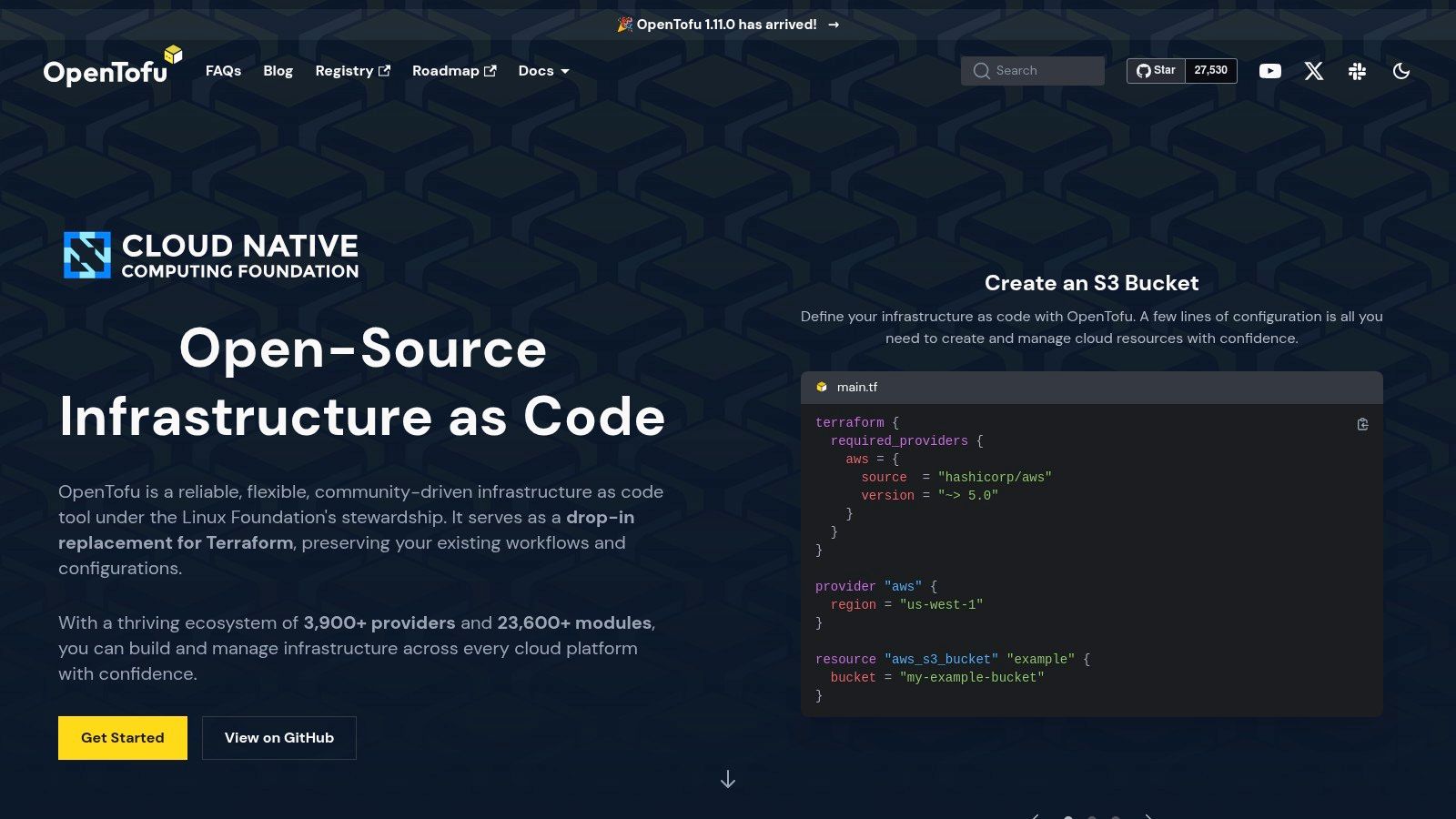
The project maintains backward compatibility with Terraform versions 1.5.x and below, meaning existing modules and provider configurations work seamlessly. Its primary distinction is its governance model and the rapid pace of feature development. New capabilities like client-side state encryption and more flexible resource targeting (-exclude blocks) are implemented directly based on community feedback. Third-party platforms like Spacelift and Env0 offer commercial SaaS management layers, providing options for enterprise-grade collaboration and governance.
Key Features and Use Cases
- Drop-in Replacement: Teams can switch from Terraform to OpenTofu with minimal friction. This is ideal for organizations wanting to avoid potential license restrictions while retaining their existing IaC investments and skills.
- Enhanced Security and Control: Built-in client-side state encryption allows teams to secure sensitive state file data before it ever leaves the local machine. This provides an extra layer of security not natively available in open-source Terraform.
- Community-Driven Development: As a CNCF project, its roadmap is transparent and driven by user contributions. This makes it a great choice for teams who want to have a direct impact on the evolution of their core infrastructure tools.
- Pricing: OpenTofu is completely free and open-source (MPL-2.0). Commercial support and SaaS platforms are available from third-party vendors.
| Feature | Highlight |
|---|---|
| Governance | Fully open-source and managed by the CNCF, ensuring it remains a community-driven project. |
| Compatibility | Drop-in replacement for Terraform, compatible with existing modules, providers, and state files. |
| Feature Velocity | Rapidly incorporates community-requested features like client-side encryption and advanced looping. |
| Ecosystem | Growing support from third-party CI/CD and management platforms that provide SaaS capabilities. |
Website: https://opentofu.org/
4. Pulumi (Pulumi Cloud + open-source CLI)
Pulumi differentiates itself in the infrastructure as code (IaC) landscape by empowering developers to use familiar, general-purpose programming languages. Instead of learning a domain-specific language like HCL, teams can define and manage cloud resources using TypeScript, Python, Go, C#, Java, or even YAML. This approach allows for the use of loops, functions, and classes, making it a natural fit for complex, dynamic infrastructure and developer-heavy organizations.
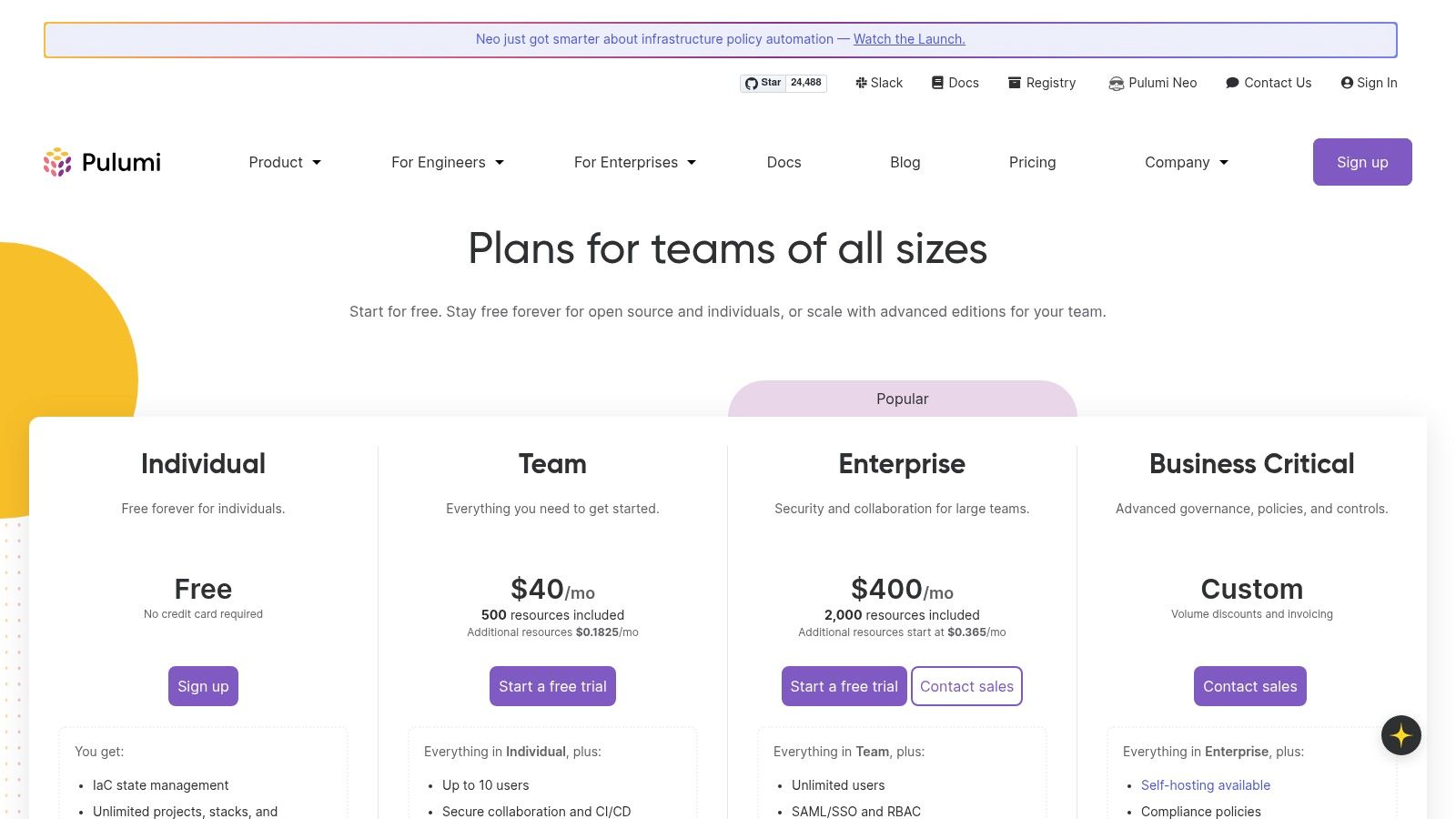
The open-source Pulumi CLI handles the provisioning, but its capabilities are significantly extended by Pulumi Cloud, a SaaS platform for state management, CI/CD integration, and governance. Pulumi Cloud offers managed secrets, role-based access control (RBAC), and policy-as-code to ensure infrastructure deployments are secure and compliant. It is one of the more developer-centric cloud infrastructure automation tools available.
Key Features and Use Cases
- Real Programming Languages: Define infrastructure using logic, abstractions, and software engineering best practices. For example, a Python script could programmatically generate configurations for dozens of similar microservices, a task that is more cumbersome in declarative DSLs.
- Integrated Testing and CI/CD: Since infrastructure is defined in standard code, teams can write unit and integration tests for their infrastructure using familiar testing frameworks. The Automation API allows you to embed the Pulumi engine directly into your application code for programmatic control.
- Pricing: The open-source CLI and individual developer tier (Pulumi Cloud Community Edition) are free. Paid tiers (Team, Business, Enterprise) add collaboration features, advanced policy, and enterprise-grade support, often with per-resource pricing models.
| Feature | Highlight |
|---|---|
| Coverage | Broad support for over 100 cloud and SaaS providers, including AWS, Azure, GCP, and Kubernetes. |
| Collaboration | Managed state, audit logs, and deep integrations with version control systems like GitHub and GitLab. |
| Governance | Policy as Code (CrossGuard) allows rules to be written in the same language as the infrastructure. |
| Developer Experience | Rich IDE support, code completion, and the ability to use existing language-specific tooling. |
Website: https://www.pulumi.com/pricing/
5. AWS CloudFormation
For teams deeply embedded in the Amazon Web Services ecosystem, AWS CloudFormation is the native infrastructure as code (IaC) service. It allows developers to model, provision, and manage AWS and select third-party resources using declarative templates written in YAML or JSON. Its primary advantage is its seamless integration with the entire suite of AWS services, ensuring new features and services are often supported from day one.
CloudFormation stands out as a core cloud infrastructure automation tool by providing a reliable and predictable way to manage resources. Features like change sets allow teams to preview the impact of template modifications before execution, reducing the risk of unintended disruptions. Drift detection helps identify any manual changes made to the infrastructure outside of CloudFormation, ensuring the environment remains in its desired state. This makes it an excellent choice for organizations prioritizing stability and governance within a single cloud provider.
Key Features and Use Cases
- AWS-Native Resource Management: Automate the provisioning of anything from a simple S3 bucket to a complex serverless application with Lambda and API Gateway. The tight integration ensures predictable behavior and access to the latest AWS capabilities.
- Multi-Account and Region Deployments: Using StackSets, a single CloudFormation template can be deployed across multiple AWS accounts and regions simultaneously. This is ideal for establishing baseline security configurations, deploying shared resources, or managing disaster recovery environments.
- Pricing: There is no additional charge for using CloudFormation to manage AWS resources. You only pay for the underlying AWS services provisioned by your stacks, making it a cost-effective option for AWS-centric teams.
| Feature | Highlight |
|---|---|
| Coverage | Unparalleled, first-party support for all AWS services. Registry extends support to third-party tools. |
| Collaboration | Change sets offer a preview-and-approve workflow, while drift detection maintains state integrity. |
| Governance | StackSets enable centralized management and enforcement of infrastructure standards across an organization. |
| Community | Extensive AWS documentation, tutorials, and a public registry for reusable modules and resource types. |
Website: https://aws.amazon.com/cloudformation/
6. AWS Cloud Development Kit (AWS CDK)
The AWS Cloud Development Kit (CDK) is an open-source framework that revolutionizes how developers define AWS infrastructure. Instead of using YAML or JSON, teams can leverage familiar programming languages like TypeScript, Python, and Java to model their cloud resources. The CDK code is then synthesized into a standard AWS CloudFormation template for deployment, combining the expressiveness of a general-purpose language with the reliability of CloudFormation’s provisioning engine.
This approach makes it a standout among cloud infrastructure automation tools for teams deeply invested in the AWS ecosystem. It offers higher-level abstractions, called Constructs, which encapsulate AWS best practices and reduce boilerplate code significantly. A single construct can represent a complex architecture, like a fully configured VPC or a Fargate service with a load balancer, making infrastructure code more concise and reusable.
Key Features and Use Cases
- Developer-First Abstractions: Use programming logic, loops, and conditions to define infrastructure dynamically. This is ideal for creating reusable patterns and complex, multi-service architectures without repetitive configuration files.
- Built-in CI/CD Patterns: The CDK includes
CDK Pipelines, a high-level construct that simplifies creating robust, multi-account, and multi-region deployment pipelines using AWS CodePipeline. This automates the entire release process from source commit to production deployment. - Pricing: The AWS CDK framework itself is open-source and free to use. You only pay for the AWS resources provisioned by the CDK-generated CloudFormation templates, with no additional charges for using the framework.
| Feature | Highlight |
|---|---|
| Coverage | Deep and comprehensive support for AWS services, often with day-one support for new features. |
| Collaboration | Integrates natively with Git and standard developer workflows; code can be shared as libraries. |
| Governance | Leverage programming language features to enforce organizational standards and create guardrails. |
| Community | A rapidly growing ecosystem of open-source constructs available at Construct Hub for common patterns. |
Website: https://aws.amazon.com/cdk/
7. AWS Marketplace (Infrastructure as Code category)
While not a tool itself, AWS Marketplace serves as a critical procurement and discovery hub for a wide range of cloud infrastructure automation tools. It functions as a digital catalog where organizations can find, buy, deploy, and manage third-party software and services, including many leading Infrastructure as Code (IaC) solutions. The key advantage is its deep integration with the AWS ecosystem, allowing teams to consolidate billing, streamline procurement, and leverage existing enterprise agreements directly through their AWS account.
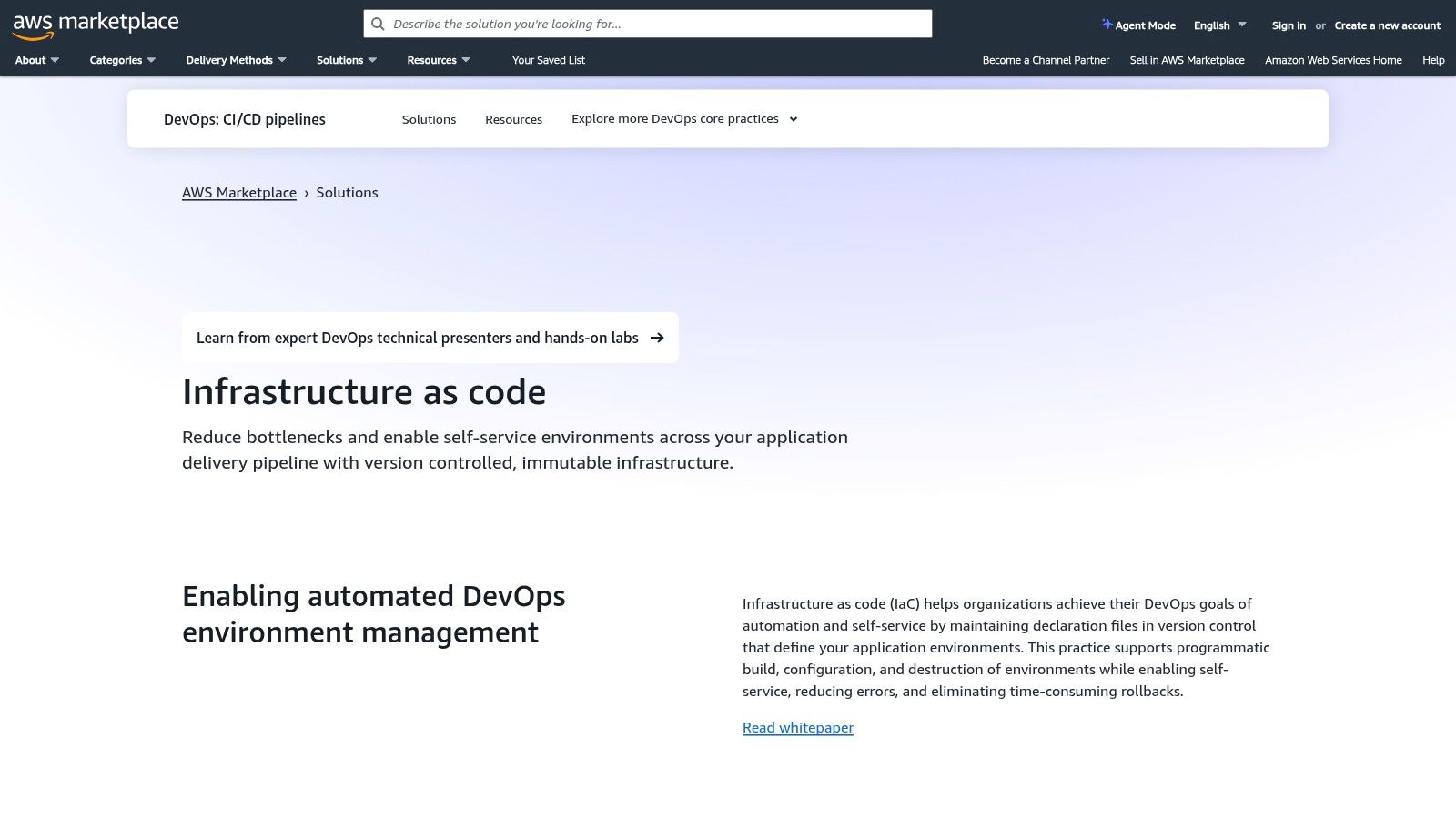
This centralized approach simplifies vendor management for FinOps and procurement teams. Instead of managing separate contracts and payment methods for each tool, purchases are added to the monthly AWS bill. The platform supports various delivery models, from SaaS subscriptions and professional services to Amazon Machine Images (AMIs) pre-configured with popular IaC tools, enabling rapid deployment and testing of new technologies within an established governance framework.
Key Features and Use Cases
- Centralized Procurement: Find and purchase IaC platforms, security scanners, and CI/CD tools, with all charges consolidated into your AWS invoice. This simplifies budget tracking and vendor management significantly.
- Flexible Deployment Models: Deploy solutions via SaaS subscriptions, AMIs, or engage professional services for implementation. This allows teams to choose the model that best fits their operational needs and technical capabilities.
- Enterprise Governance: Utilize private offers for custom pricing and terms negotiated directly with vendors. This aligns software purchasing with existing enterprise procurement policies and AWS Enterprise Discount Programs (EDP).
| Feature | Highlight |
|---|---|
| Procurement | Streamlined purchasing and consolidated billing directly through an existing AWS account. |
| Variety | Wide selection of IaC tools, services, and pre-built AMIs from hundreds of independent vendors. |
| Governance | Supports private offers, custom terms, and integration with AWS cost management tools. |
| Vetting | Listings must meet AWS security and operational standards, but quality and support can still vary. |
Website: https://aws.amazon.com/marketplace/solutions/devops/infrastructure-as-code
8. Microsoft Azure Marketplace (Terraform/IaC offers and services)
While not a standalone tool, the Microsoft Azure Marketplace serves as a crucial procurement and deployment hub for organizations deeply integrated into the Azure ecosystem. It acts as a centralized platform where teams can discover, purchase, and deploy a wide range of third-party cloud infrastructure automation tools, including pre-configured virtual machine images with Terraform, consulting services, and SaaS solutions. This simplifies the procurement process by consolidating billing through an existing Azure agreement.
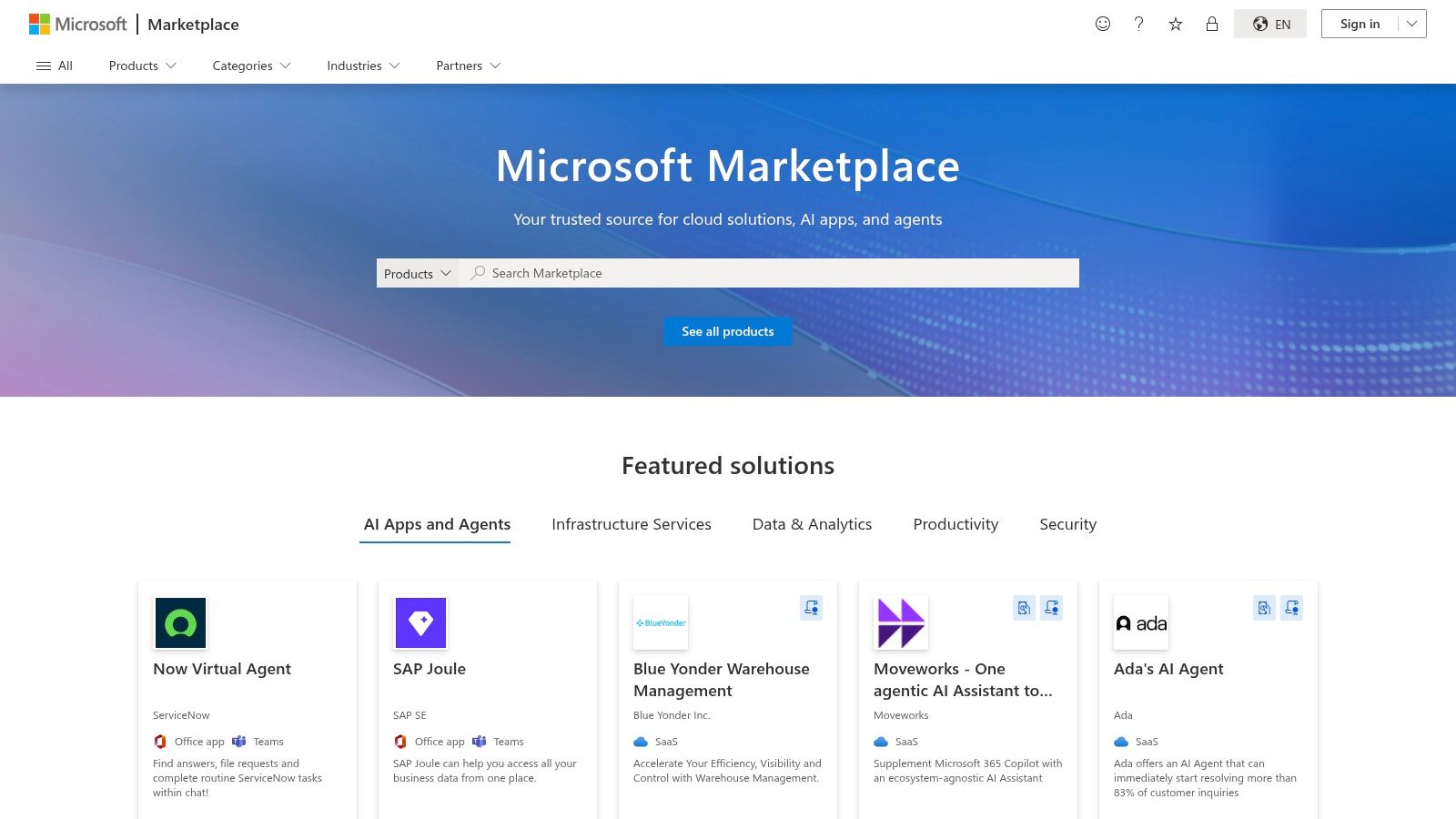
For Microsoft-centric organizations, this approach streamlines vendor management and ensures that deployed tools adhere to internal governance and security policies managed through Azure. The ability to leverage private offers allows enterprises to negotiate custom pricing and terms directly with vendors, which is a significant advantage for large scale deployments. It bridges the gap between discovering powerful automation solutions and integrating them seamlessly into an established enterprise procurement workflow.
Key Features and Use Cases
- Centralized Procurement: Allows businesses to purchase and manage subscriptions for various IaC and automation tools using their existing Microsoft Azure Enterprise Agreement, simplifying billing and vendor management.
- One-Click Deployment: Many offerings, such as Terraform virtual machine images, can be deployed directly into an Azure subscription from the marketplace interface, reducing setup time and configuration complexity.
- Access to Consulting and Managed Services: Beyond software, the marketplace lists certified partners offering professional services for implementing and managing cloud infrastructure automation tools, helping teams that lack in-house expertise.
| Feature | Highlight |
|---|---|
| Integration | Natively integrates with Azure billing, subscriptions, and RBAC for seamless management. |
| Procurement | Supports enterprise procurement workflows, including private offers for negotiated terms and pricing. |
| Variety | Offers a mix of SaaS, VM images, and professional services related to infrastructure automation. |
| Governance | Simplifies compliance by bringing third-party tool acquisition under centralized Azure governance. |
Website: https://azuremarketplace.microsoft.com/
9. Google Cloud Marketplace (incl. Private Catalog Terraform support)
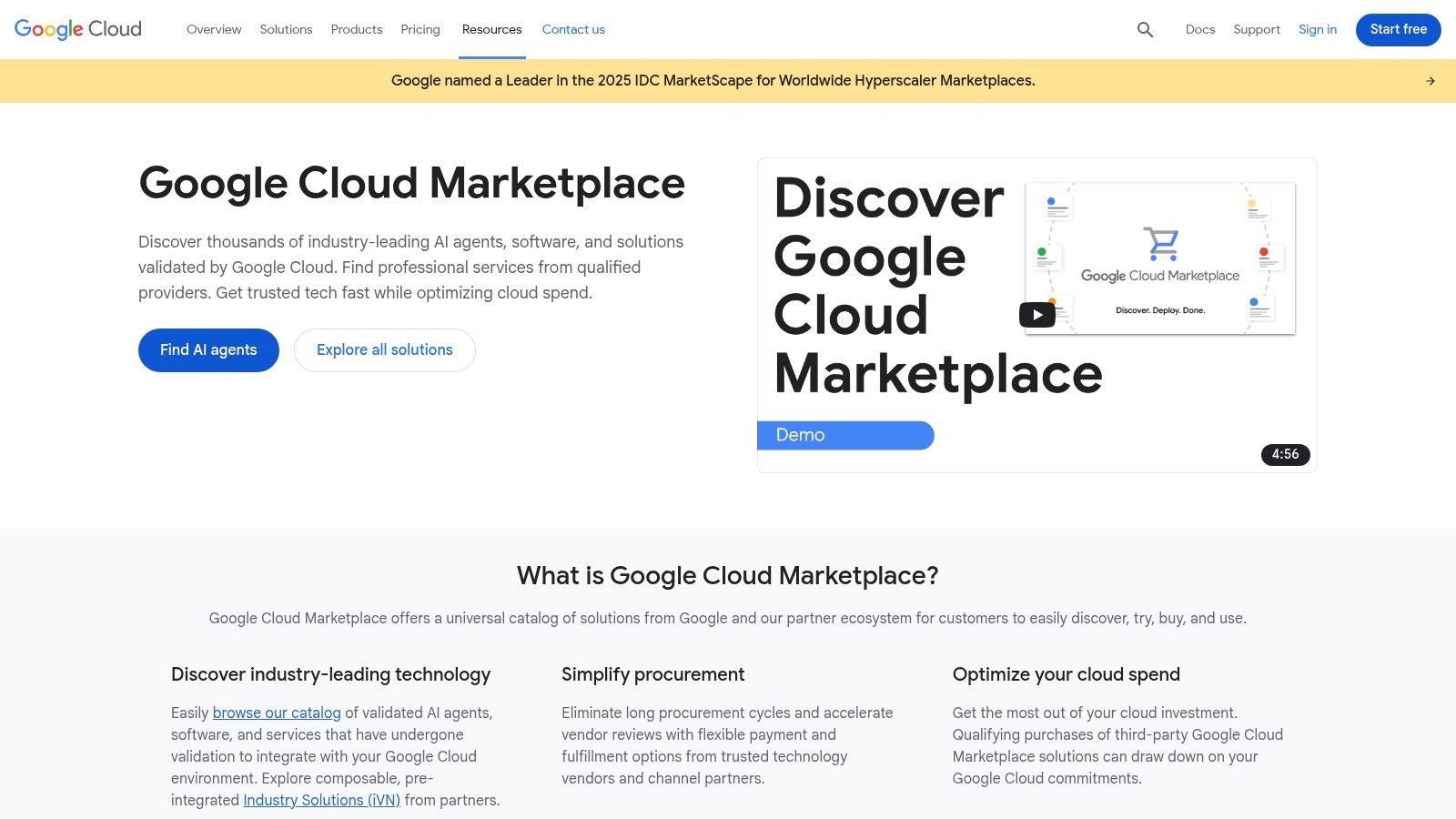
Google Cloud Marketplace serves as a curated catalog for deploying third-party vendor solutions and pre-approved internal blueprints directly onto Google Cloud Platform (GCP). While it offers one-click deployments for many applications, its power as a cloud infrastructure automation tool is fully realized through its integration with Terraform. Organizations can create a Private Catalog of approved, version-controlled Terraform configurations, enabling teams to self-serve infrastructure in a governed and repeatable manner.
This approach combines the declarative power of Terraform with the centralized control of a cloud marketplace. Instead of running terraform apply locally, developers can deploy complex, multi-resource architectures through a simple UI, with all configurations managed and sanctioned by a central platform team. Google Cloud’s Infrastructure Manager further enhances this by providing a managed service to run and maintain the state of these Terraform deployments, abstracting away the operational overhead.
Key Features and Use Cases
- Governed Self-Service: Platform teams can package entire application stacks (e.g., a GKE cluster with monitoring and logging agents) as a single Terraform solution in the Private Catalog. This allows application teams to deploy compliant infrastructure without needing deep Terraform expertise.
- Centralized Terraform Management: By using Infrastructure Manager, the lifecycle of Terraform-managed resources is handled by Google Cloud. This simplifies state management, provides deployment visibility, and ensures consistency across projects.
- Pricing: Using the Marketplace and Private Catalog features is free. Costs are incurred from the underlying GCP resources deployed and any licensing fees associated with third-party software from the Marketplace.
| Feature | Highlight |
|---|---|
| Coverage | Focused entirely on the Google Cloud ecosystem, offering both first-party and third-party solutions. |
| Collaboration | Private Catalog enables sharing and reuse of standardized infrastructure patterns across the organization. |
| Governance | Enforces organizational standards by limiting deployments to pre-approved and tested Terraform modules. |
| User Experience | Simplifies deployment for end-users, reducing the need for local CLI tools and configuration. |
Website: https://cloud.google.com/marketplace/
10. Red Hat Ansible Automation Platform
Red Hat Ansible Automation Platform elevates the popular open-source Ansible engine into a full-fledged enterprise solution. It is designed for organizations that need to orchestrate complex, multi-tier workflows across hybrid cloud and on-premises environments. The platform provides a centralized framework for executing, managing, and analyzing automation at scale, making it one of the most robust cloud infrastructure automation tools for mature IT operations.

The core value lies in its bundled components: Automation Controller (formerly Tower) provides a graphical UI and REST API for managing deployments, Automation Hub serves as a repository for certified and supported content (Collections), and integrated analytics offer insights into automation performance. This combination transforms Ansible from a command-line tool into a governed, collaborative platform suitable for regulated industries and large-scale enterprises. For a deeper dive, you can explore Ansible's role in multi-cloud management.
Key Features and Use Cases
- Complex Orchestration: Use the Workflow Visualizer to chain multiple playbooks together, creating sophisticated deployment pipelines that can provision infrastructure, configure applications, and perform post-deployment validation. This is ideal for tasks like application lifecycle management.
- Centralized Governance and Control: Implement Role-Based Access Controls (RBAC) to grant specific teams or users permission to run certain automation jobs on designated infrastructure. This ensures security and compliance by limiting access and providing a full audit trail.
- Pricing: Ansible Automation Platform is sold via subscription, typically based on the number of managed nodes. It is available directly from Red Hat or through major cloud marketplaces like AWS and Azure, simplifying procurement and billing for cloud-native teams.
| Feature | Highlight |
|---|---|
| Coverage | Extensive ecosystem with certified and community collections for network, security, cloud, and more. |
| Collaboration | Centralized Automation Controller with job scheduling, credentials management, and workflow templates. |
| Governance | Robust RBAC, audit trails, and integration with enterprise identity systems like LDAP and SAML. |
| Community | Built on the vast open-source Ansible community, with an added layer of enterprise support and content. |
Website: https://www.redhat.com/en/technologies/management/ansible/pricing
11. Puppet Enterprise
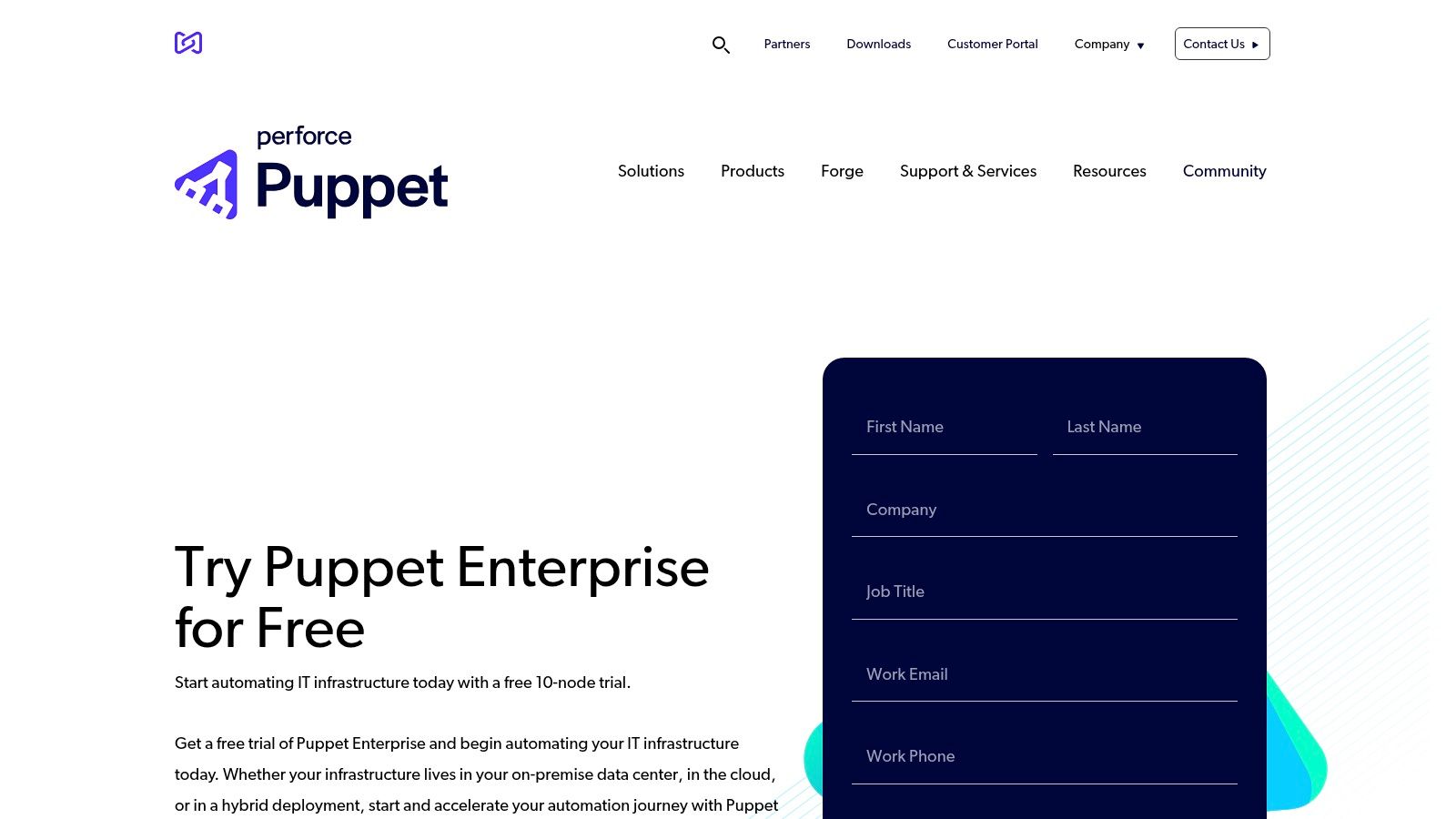
Puppet Enterprise is a veteran in the configuration management space, providing a model-driven approach to infrastructure automation. It focuses on maintaining a desired state, ensuring that servers and applications are configured correctly and consistently over their entire lifecycle. Unlike purely declarative tools, Puppet uses its own domain-specific language (DSL) to define the state of resources, which is then enforced by an agent running on each managed node. This makes it a powerful choice for organizations with strict compliance and governance requirements.
Puppet Enterprise excels in large, complex, and heterogeneous environments where operational control is paramount. It provides robust orchestration, policy enforcement, and detailed reporting, giving operations teams deep visibility and control over their infrastructure. This operations-centric model is a key differentiator from template-based Infrastructure as Code tools, focusing more on continuous management rather than just initial provisioning.
Key Features and Use Cases
- Desired State Enforcement: Continuously monitors and corrects configuration drift on thousands of nodes, ensuring systems remain compliant with defined policies. This is critical for regulated industries like finance and healthcare where configuration consistency is audited.
- Orchestration and Automation: Puppet orchestrator allows for controlled, ordered rollouts of changes across infrastructure tiers, such as updating a database before restarting the web application that depends on it. It integrates with CI/CD pipelines to automate the entire software delivery lifecycle.
- Pricing: A free trial is available for up to 10 nodes. Commercial licenses are required for larger environments and are priced per node, with a bursting allowance to handle temporary spikes in usage without penalty.
| Feature | Highlight |
|---|---|
| Coverage | Extensive support for major operating systems (Windows, Linux, Unix) and cloud or on-premises environments. |
| Collaboration | Code management features integrate with Git for version control of Puppet code and infrastructure changes. |
| Governance | Strong compliance features, detailed reporting, and Role-Based Access Controls for secure management. |
| Community | The Puppet Forge offers thousands of pre-built modules for managing common technologies and platforms. |
Website: https://www.puppet.com/products/puppet-enterprise/free-trial
12. Spacelift (IaC delivery and governance platform)
Spacelift is a specialized CI/CD platform built specifically for infrastructure as code, offering a sophisticated control plane for managing Terraform, OpenTofu, Pulumi, and Kubernetes workflows. It abstracts away the complexity of building a DIY IaC pipeline by providing managed state storage, private worker pools, and a collaborative environment for teams. This focus makes it a powerful alternative to generic CI/CD tools that require extensive customization for infrastructure delivery.
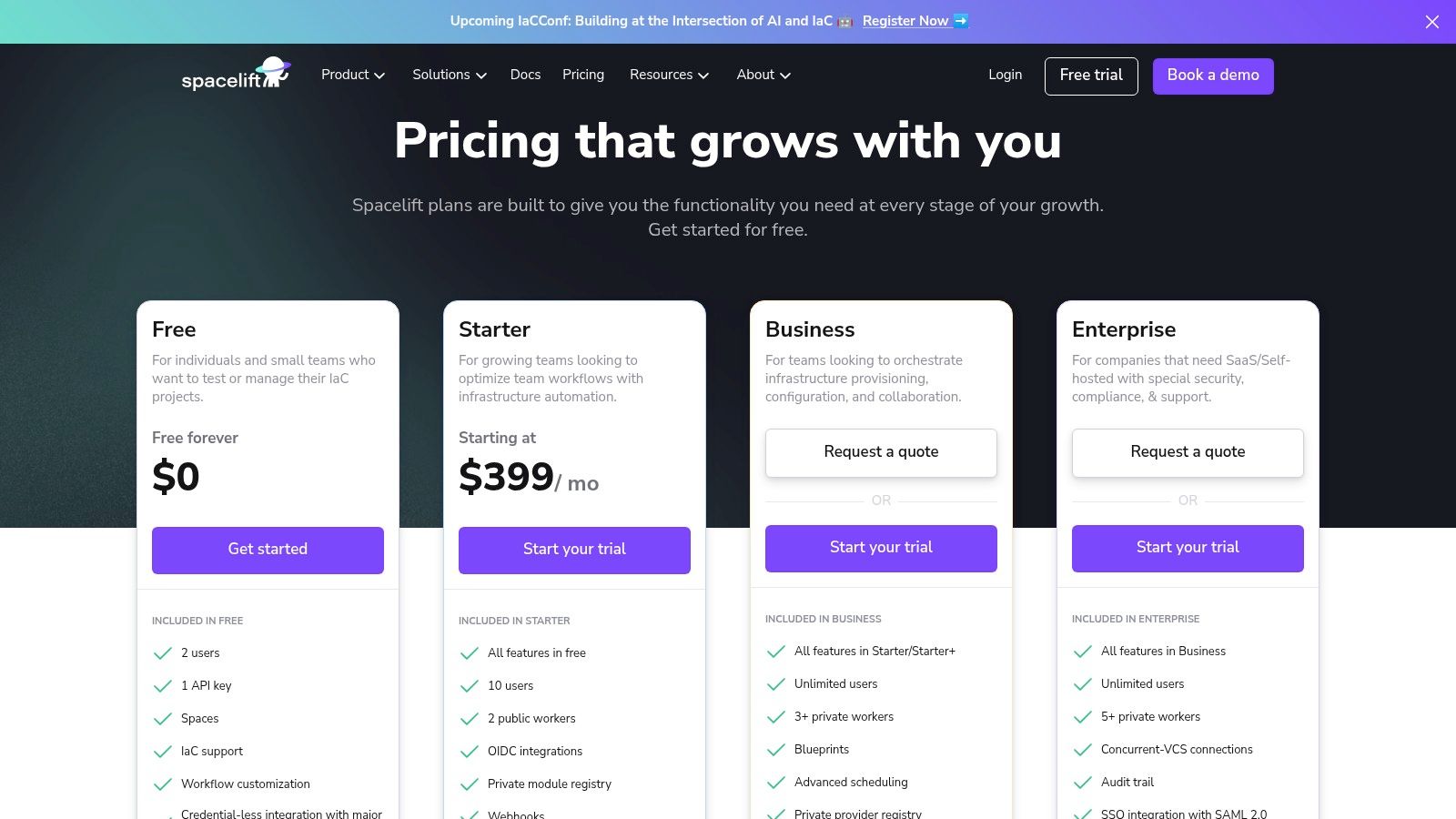
The platform shines in regulated or security-conscious environments where governance is paramount. Its native policy-as-code engine allows teams to enforce security, compliance, and cost-related rules before any infrastructure is provisioned. Features like drift detection and cost estimation (via Infracost integration) give operators full visibility and control over their cloud resources, bridging the gap between development agility and operational stability.
Key Features and Use Cases
- Unified IaC Orchestration: Manage multiple IaC tools (Terraform, Pulumi, etc.) from a single dashboard, providing a consistent workflow for provisioning and management. For more details on this topic, you can learn more about orchestration in cloud computing.
- Policy as Code Enforcement: Implement granular policies to control what resources can be created, what tags must be applied, and which teams can deploy to specific environments. This is critical for maintaining compliance and preventing configuration errors.
- Pricing: Spacelift offers a free tier suitable for individuals and small projects. Paid plans are based on the number of users and include features like SSO, private workers, and advanced security policies, with options for SaaS or self-hosted deployment.
| Feature | Highlight |
|---|---|
| Coverage | Native support for Terraform, OpenTofu, Pulumi, Kubernetes, and Ansible. |
| Collaboration | Git-based workflows, detailed audit trails, and PR comments showing planned infrastructure changes. |
| Governance | Powerful OPA-based policy engine, drift detection, and integrated cost estimation. |
| Deployment | Available as a flexible SaaS platform or a self-hosted agent for enhanced security and control. |
Website: https://spacelift.io/pricing
Top 12 Cloud Infrastructure Automation Tools Comparison
| Tool | Core features | UX / Governance | Value proposition | Target audience | Pricing & scale |
|---|---|---|---|---|---|
| CLOUD TOGGLE (Recommended) | Auto power-off idle VMs (AWS, Azure); precise daily/weekly schedules; RBAC; quick overrides | Intuitive non-engineer UI; team management; docs & demos | Predictable, scalable cost savings; share scheduling without exposing cloud accounts | SMBs, DevOps, FinOps, MSPs, operations/business teams | Starts $49/mo (15 servers), $99/$249 tiers, 30-day free trial, enterprise options |
| HashiCorp Terraform (HCP) | Declarative IaC; wide provider ecosystem; remote runs; policy as code; remote state | CLI-first with HCP SaaS for RBAC/SSO and collaboration | System-of-record for infra; broad multi-cloud provisioning | Infra teams, multi-cloud orgs, IaC practitioners | Free CLI tier; HCP paid tiers for governance & SLAs |
| OpenTofu (CNCF) | Terraform-compatible; client-side state encryption; -exclude ops | Community-driven CNCF governance; rapid community features | Fully open-source alternative; reduces vendor lock-in | Open-source advocates, orgs needing CNCF governance | Open-source (free); commercial SaaS by third parties |
| Pulumi | Multi-language IaC (TS/Python/Go/.NET/Java); managed state, secrets, CI/CD | Developer-friendly SDKs; managed governance in paid tiers | Code-first IaC for dev teams; integrated CI/CD & secrets | Developer-heavy teams, platform-engineering | Free individual tier; team/enterprise add per-resource or seat costs |
| AWS CloudFormation | Declarative templates; change sets; StackSets; provider registry | Deep AWS integration; drift detection; verbose templates | Native AWS support, predictable billing for AWS resources | AWS-centric teams and enterprise AWS shops | No added charge for AWS::* resources; pay for underlying services |
| AWS CDK | High-level constructs; multi-language; synthesizes to CloudFormation | Developer abstractions; reusable constructs ecosystem | Simplifies AWS infra authoring; faster developer workflows | Developers building AWS-native infra | Open-source framework; pay for AWS services used |
| AWS Marketplace (IaC) | Searchable IaC solutions; SaaS, AMIs, professional services; private offers | Centralized procurement; consolidated AWS billing & private offers | Simplifies purchasing and billing alignment for enterprises | Procurement, finance, enterprise buyers | Vendor-dependent pricing; supports AWS consolidated billing |
| Azure Marketplace | Deployable Terraform images/SaaS; private offers; partner services | Integrates with Azure billing & RBAC; Microsoft guidance | Streamlines procurement & deployment for Azure shops | Azure-centric organizations and procurement teams | Vendor-dependent; private offers through Azure billing |
| Google Cloud Marketplace | Terraform ingestion; Private Catalog; one-click deploys | Org-approved templates; reduces local tooling needs | Governance via approved blueprints; easier self-service delivery | GCP shops, central IT teams | Vendor-dependent; underlying GCP usage billed separately |
| Red Hat Ansible Automation Platform | Automation Controller, Hub, analytics; certified collections | Mature enterprise support; RBAC, scheduling, hybrid execution | Large-scale automation, compliance and certified content | Enterprises with complex orchestration and compliance needs | Node-based licensing; available via cloud marketplaces |
| Puppet Enterprise | Model-driven config; orchestrator; compliance & CI/CD integrations | Strong compliance tooling; enterprise operational guidance | Governance and compliance for regulated environments | Regulated enterprises, ops teams | Free trial (10 nodes); commercial node-based licensing |
| Spacelift | Orchestrates Terraform/OpenTofu/Pulumi; policy as code; drift detection; cost estimates | SaaS or self-hosted; SSO, audit trails, private/public workers | Managed IaC delivery & governance; reduces DIY state/runners | Teams running IaC at scale wanting governance & cost control | Transparent starter pricing, usable free plan; enterprise add-ons raise cost |
Choosing the Right Automation Tools for Your Cloud Environment
Navigating the expansive ecosystem of cloud infrastructure automation tools can seem daunting, but the journey from manual processes to a streamlined, automated environment is a crucial step in modern cloud management. As we've explored, the landscape is not about finding a single "best" tool, but about assembling the right combination of solutions that align with your team's skills, your company's scale, and your specific operational goals. The key is to move from a reactive posture, fixing issues as they arise, to a proactive one, where infrastructure is predictable, repeatable, and cost-effective by design.
The tools detailed in this article, from foundational Infrastructure as Code platforms like Terraform and OpenTofu to comprehensive management solutions like Spacelift and Ansible, each solve a distinct piece of the cloud puzzle. Your decision-making process should be a strategic exercise, not just a technical one. It requires a clear-eyed assessment of your current state and a defined vision for your future operational model.
Synthesizing Your Strategy: From Provisioning to Optimization
The first step in building your automation toolkit is to segment your needs. Think of your cloud operations as a lifecycle with distinct stages, each benefiting from a specific category of cloud infrastructure automation tools.
-
For Provisioning and Multi-Cloud Flexibility: If your primary challenge is creating and managing infrastructure across different cloud providers, declarative IaC tools are your foundation. Terraform and its open-source alternative OpenTofu are the industry standards for a reason, offering extensive provider support and a massive community. For teams who prefer writing infrastructure in familiar programming languages, Pulumi offers a powerful, developer-centric alternative.
-
For Deep Cloud-Native Integration: When your organization is heavily invested in a single cloud ecosystem like AWS, leveraging native tools can provide the most seamless experience. AWS CloudFormation and the AWS CDK are deeply integrated into the AWS ecosystem, offering day-one support for new services and tight integration with IAM and other core components.
-
For Configuration and State Management: Once infrastructure is provisioned, ensuring it remains in the desired state is paramount. This is where configuration management tools like Red Hat Ansible Automation Platform and Puppet Enterprise excel. They are designed to enforce consistency, manage software installations, and apply complex configurations across fleets of servers, whether on-premise or in the cloud.
The Critical Layer: Cost Control and Scheduling
Beyond provisioning and configuration lies a critical, often-overlooked area of automation: operational efficiency and cost optimization. It's not enough to build infrastructure efficiently; you must also run it efficiently. This is particularly true for non-production environments like development, staging, and QA, which frequently sit idle yet consume a significant portion of cloud budgets.
This is where a dedicated scheduling tool becomes an indispensable part of your stack. While native cloud schedulers offer basic functionality, a specialized solution provides granular control, policy-driven governance, and user-friendly accessibility that empowers teams beyond core DevOps. It addresses the business problem of wasted spend directly, turning cost management from a manual, after-the-fact analysis into an automated, proactive process. Choosing the right cloud infrastructure automation tools means addressing the full lifecycle, and cost control is a non-negotiable part of that cycle. By implementing a smart scheduling strategy, you can reclaim budget, reduce your carbon footprint, and ensure your cloud investment is delivering maximum value every minute of the day.
Ready to stop paying for idle cloud resources and see an immediate impact on your AWS or Azure bill? CLOUD TOGGLE is the simplest way to implement powerful, policy-driven scheduling for your non-production environments. Start your free trial at CLOUD TOGGLE and discover how much you can save with intelligent cloud infrastructure automation.