The core difference between a hybrid cloud and a multi-cloud setup boils down to one thing: the type of infrastructure you’re mixing together. Hybrid cloud is all about blending your private, on-premise gear with a public cloud, while multi-cloud means you’re using services from two or more public cloud providers.
The right choice really depends on what you're trying to solve. Are you balancing legacy systems with a need for modern scale, or are you trying to cherry-pick the absolute best services from every cloud provider out there?
Hybrid Cloud vs Multi Cloud Core Differences Explained
Getting this distinction right is the first step toward building an IT strategy that's both effective and cost-efficient. Each model opens up different possibilities, especially for small to midsize businesses (SMBs), DevOps teams, and FinOps specialists.
Think of a hybrid cloud architecture as a bridge. It creates one unified environment by connecting your private infrastructure, like your own data center, with at least one public cloud, such as AWS or Azure. This is the go-to approach for businesses that have to keep sensitive data on-premise for compliance reasons but still want the flexibility of the public cloud for everything else.
On the other hand, a multi-cloud strategy is about using services from several public cloud providers at the same time. For instance, you might use AWS for its raw computing power but lean on Google Cloud for its top-tier data analytics tools. This model doesn't require a private cloud component at all.
Here’s where it gets interesting: a hybrid cloud can also be a multi-cloud if you connect your private data center to more than one public cloud.
A hybrid cloud mixes private and public infrastructure. A multi-cloud leverages multiple public providers. This simple distinction shapes everything from security and governance to your monthly bill.
This foundational difference impacts everything down the line: your security protocols, operational governance, and cost management.
Key Differences At a Glance
Let's break down the fundamental attributes that define each strategy. This isn't about which one is "better," but which one fits your specific goals, existing tech stack, and compliance headaches.
| Attribute | Hybrid Cloud | Multi-Cloud |
|---|---|---|
| Core Components | A mix of private infrastructure (on-premise or hosted) and at least one public cloud. | Two or more public cloud providers (e.g., AWS, Azure, Google Cloud). |
| Primary Goal | Balance security and control with scalability and innovation. | Avoid vendor lock-in and use best-of-breed services from each provider. |
| Connectivity | Requires strong, secure integration between private and public environments. | Relies on managing distinct services across multiple public cloud platforms. |
| Best For | Regulated industries, legacy systems, and data sovereignty requirements. | Cloud-native applications, global reach, and service diversification. |
Looking at it this way, you can start to see how your business needs naturally point you toward one model or the other.
Adoption Trends and Business Drivers
Recent data shows a clear preference emerging. A staggering 86% of organizations now have a multi-cloud strategy in place, with 70% also reporting benefits from a hybrid cloud setup. This isn't just a trend; it's a strategic shift. Businesses are actively diversifying to grab the best services each provider offers. Think using AWS for compute-heavy lifting while tapping into Azure for its deep enterprise integrations.
Of course, to build a solid hybrid strategy, you first need to have your private infrastructure sorted. If you're still working through what that means, it helps to explore the differences between a true private cloud and a traditional on-premise setup. For a good breakdown, check out this guide on Understanding Private Cloud and On-Premise Differences.
Ultimately, getting these core concepts straight is the only way to have a meaningful conversation about the deeper factors, like cost optimization and operational complexity.
Comparing Architectural and Operational Demands
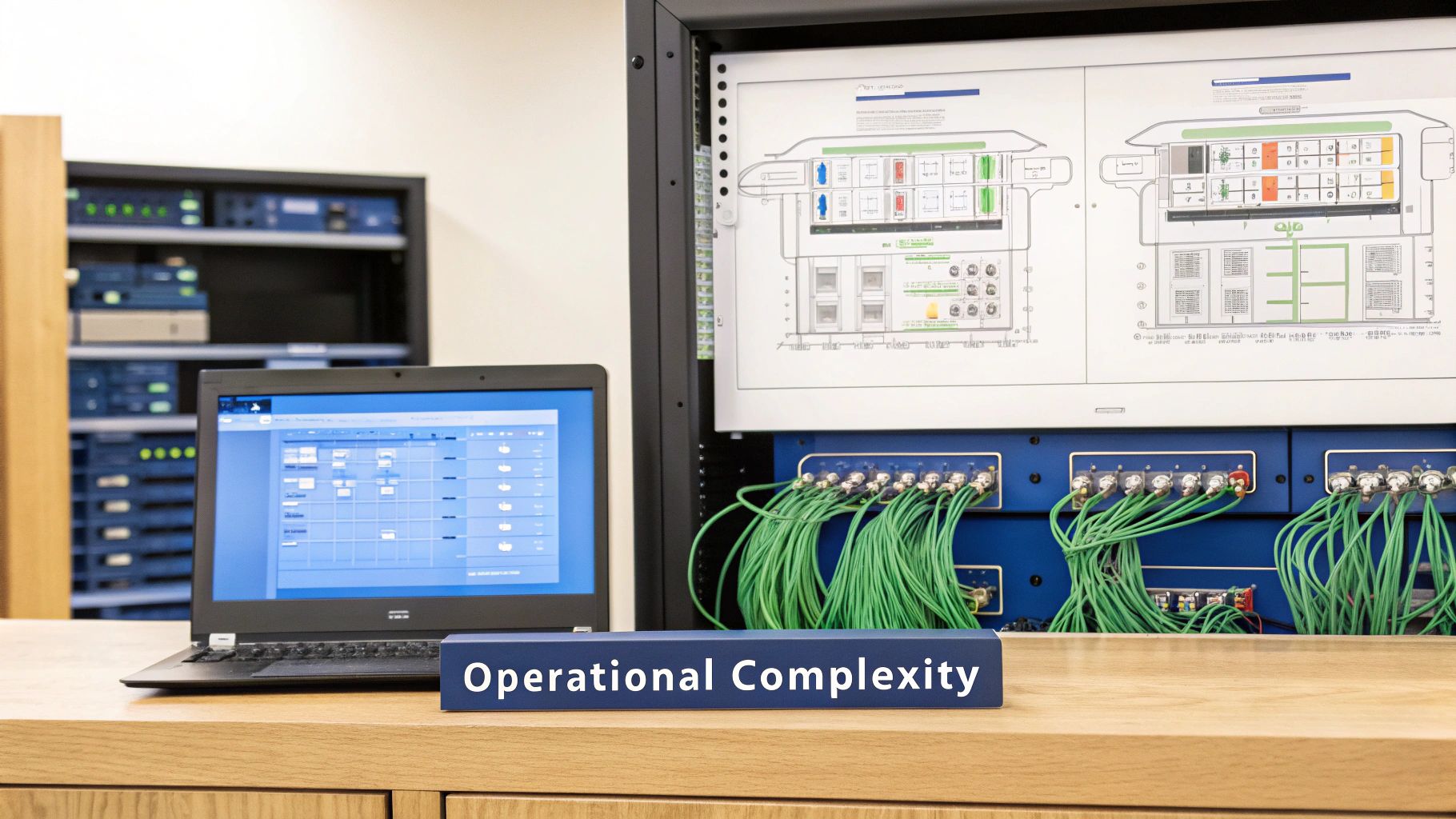
The choice between a hybrid and multi-cloud strategy goes far beyond your infrastructure blueprint; it dictates the day-to-day realities for your operations teams. Each model serves up its own unique architectural puzzles and management headaches. Getting a handle on these technical and operational demands is non-negotiable before you commit.
At its core, a hybrid cloud architecture is all about integration. The main technical challenge is forging a seamless, secure link between your private, on-prem hardware and a public cloud provider. This introduces a layer of complexity that you just don't find in a pure public cloud world.
The Hybrid Integration Hurdle
In a hybrid model, your DevOps team has to wrestle with key integration points that demand specialized skills and meticulous planning. Success boils down to making two fundamentally different environments act like a single, cohesive unit.
Here are the main architectural challenges you'll face:
- Network Latency: Data has to travel between your data center and the public cloud. This round trip can introduce latency that drags down application performance, especially for anything that needs rapid-fire data exchange.
- Data Synchronization: Keeping data consistent across on-premise and cloud databases is a constant operational battle. A slip-up in synchronization can corrupt data and cause major application errors.
- Consistent Security Policies: Trying to stretch your on-prem security posture to cover the public cloud is a heavy lift. You need to make sure your firewalls, access controls, and threat detection work uniformly across both environments.
Think of a retail company using a hybrid model for PCI DSS compliance. They have to keep sensitive cardholder data locked down on-premise. At the same time, they use the public cloud for their e-commerce storefront to handle massive swings in customer traffic. The operational challenge here is making sure that connection is fast, reliable, and absolutely bulletproof, with zero compliance gaps.
The Multi-Cloud Management Maze
A multi-cloud architecture dodges the on-prem integration problem but swaps it for a different beast: managing completely separate ecosystems. Instead of bridging two different types of infrastructure, your team is now juggling multiple, distinct public cloud platforms, each with its own set of rules.
This approach brings its own operational demands that can quickly overwhelm teams who don't have the right tools and expertise.
The core operational challenge of multi-cloud isn't integration; it's orchestration. Teams have to harmonize different APIs, security models, and management consoles to keep chaos and inefficiency at bay.
For example, a SaaS startup might use a multi-cloud setup for global resilience. They could host their app on AWS in North America and on Azure in Europe to guarantee uptime and performance for users everywhere. This means their DevOps team needs to be fluent in both AWS and Azure toolsets, from identity management to deployment pipelines.
Key operational complexities in multi-cloud include:
- Divergent APIs: Every cloud provider has its own unique APIs. Automating anything means writing and maintaining code that can talk to multiple, different API endpoints.
- Fragmented Identity and Access Management (IAM): Juggling user permissions across AWS IAM and Azure Active Directory creates a huge administrative burden. Without a central strategy, enforcing consistent access rules is tough and full of security holes.
- Lack of Interoperability: Services from different providers simply aren't built to play nice together. Moving data or orchestrating workflows between clouds almost always requires custom code or third-party tools.
Whether you go hybrid or multi-cloud, the rising complexity puts a massive strain on your DevOps and IT teams. A unified management approach becomes absolutely essential to cut down on manual work. Having a single dashboard to control resources, no matter where they live, is key. To learn more about this, explore what a modern cloud management platform can do to simplify your operations.
Navigating Security and Governance Challenges

When you’re weighing hybrid against multi-cloud, security and governance aren't just boxes to tick. They’re the foundation of your entire strategy. Get them wrong, and you're in for a world of trouble. Each model brings its own unique set of security puzzles and perks, so your choice really boils down to your company's risk appetite and compliance obligations.
A hybrid cloud strategy is often the go-to for businesses tangled in strict data sovereignty rules. If you’re in finance or healthcare, the ability to keep your most sensitive data locked down in your own private infrastructure is a massive win. This setup helps you stay on the right side of regulations like GDPR or HIPAA because the critical workloads never leave your direct control.
The real trick with a hybrid model, however, is stretching a single, cohesive security blanket over two completely different environments: your data center and the public cloud. It’s all about harmonizing network security, identity management, and threat detection so you don’t leave any gaps for attackers to sneak through.
The Hybrid Cloud Security Advantage: Control
With a hybrid setup, your security team can stick with the familiar, battle-tested security tools and policies they already use on-prem. That gives you a solid baseline of control. The challenge then becomes finding the right solutions to bridge the gap to the public cloud without introducing new risks.
A few key security points to nail down for hybrid cloud include:
- Secure Connectivity: A stable, encrypted, and low-latency connection between your on-premise environment and the public cloud isn't negotiable. This usually means dedicated connections that need constant monitoring.
- Consistent Policy Enforcement: The security rules you’ve defined for your private cloud have to be mirrored perfectly in the public cloud. Any drift between the two is a potential vulnerability waiting to happen.
- Unified Visibility: Your team needs a single pane of glass to watch for threats across both environments. Juggling separate monitoring tools for on-prem and the cloud is inefficient and just plain risky.
To get a better handle on locking down mixed environments, check out this practical guide to hybrid cloud security. It’s packed with great insights for building a solid defense.
The Multi-Cloud Fragmentation Risk
On the flip side, a multi-cloud strategy introduces a much more fragmented security landscape. Sure, it helps you avoid vendor lock-in, but it also means your team has to master the native security tools of every provider you use. Think AWS Security Hub, Azure Sentinel, and Google Security Command Center. Each one has its own security model, its own APIs, and its own way of doing things.
This fragmentation dramatically expands your attack surface. Every new cloud provider you add to the mix brings another set of configurations to manage, monitor, and secure. Without obsessive oversight, the odds of human error go up exponentially. For teams wrestling with this, figuring out how to effectively manage multi cloud environments is the first critical step toward a sane and secure operation.
The risk of a security breach from a simple misconfiguration doesn't just add up with each new cloud, it multiplies. One small oversight in an AWS IAM policy can create a ripple effect, exposing holes across your entire infrastructure.
No matter which model you choose, the shared responsibility model is always in play. The provider secures the cloud itself, but you’re always on the hook for securing what you put in the cloud. Whether you're running a hybrid or multi-cloud setup, centralized governance tools are essential. They help enforce consistent policies, manage identities, and give you the unified view you need to keep your infrastructure secure and compliant.
Analyzing Costs and FinOps Maturity
The financial side of choosing between hybrid and multi-cloud is where the rubber really meets the road. This decision directly shapes your total cost of ownership (TCO) and demands different levels of financial discipline, often called FinOps. While both models can lead to efficiency, they get there through completely different financial mechanics.
A hybrid cloud setup forces you to strike a careful balance between capital expenditures (CapEx) and operational expenditures (OpEx). You have the upfront CapEx hit for buying and maintaining your on-premise hardware, but you get the flexible OpEx model of the public cloud for workloads that are less sensitive or fluctuate wildly.
This approach is perfect for companies that want to get the most out of hardware they already own while slowly dipping their toes into the public cloud.
The Hybrid Cloud Cost Equation
In a hybrid world, one of the most effective cost-saving moves is cloud bursting. This lets an application that typically lives in your private data center "burst" into a public cloud when demand suddenly spikes.
This simple trick keeps you from buying mountains of on-prem hardware just to handle peak traffic that might only happen a few times a year. You pay for that extra compute power only when you absolutely need it, turning a potential CapEx nightmare into a predictable OpEx item on your budget.
Hybrid cloud’s real financial power is its ability to treat the public cloud as an on-demand extension of your own infrastructure. You squeeze every last drop of value out of your hardware and stop wasting money on servers that are just sitting idle.
But, calculating the TCO for a hybrid setup isn't straightforward. You have to account for more than just servers. Think networking gear, software licenses, cooling, and the specialized talent needed to make the private and public environments play nicely together.
Unpacking Multi-Cloud Economics
Multi-cloud, on the other hand, is almost entirely an OpEx game. Its financial appeal comes from smart diversification and avoiding getting locked into a single vendor. By using multiple providers, you can shop around for the best deals on specific services. For instance, you might find that one provider has dirt-cheap object storage while another offers better pricing on virtual machines.
This competitive environment can drive real savings. But the multi-cloud promise of cost efficiency has some major strings attached. Hidden costs can pop up and wipe out your savings if you aren’t managing them with a mature FinOps practice.
Some of the most common budget-killers include:
- Increased Operational Complexity: Juggling multiple platforms requires more advanced tools and skilled engineers who can navigate different ecosystems, which drives up your payroll.
- Specialized Talent Acquisition: Finding people who are experts in AWS, Azure, and Google Cloud is like finding a unicorn. It's both difficult and expensive.
- Cross-Cloud Data Transfer Fees: Egress fees, the cost of moving data out of a provider’s network, are notorious for killing budgets. An application on one cloud pulling data from a database on another can rack up huge, unexpected bills.
Cost control is a primary battleground in this debate. It's a key driver for both sides, with 39% of organizations picking hybrid and 33% choosing multi-cloud to improve efficiency. While multi-cloud lets you cherry-pick services to cut costs (39% cite this as a benefit), the complexity can get out of hand without the right tools, especially since four in five companies now use two or more major cloud providers. You can find more insights like these in these cloud computing statistics on CloudZero.com.
Ultimately, a strong financial governance plan is non-negotiable for either strategy. To get started building one, check out our guide on what is FinOps. Without it, cloud spending can spiral out of control fast.
Automated cost-control tactics are vital. Simple actions, like scheduling shutdowns for non-production servers on nights and weekends, can slash compute costs by up to 70%. This kind of automation is exactly what helps budget-conscious SMBs thrive, no matter which cloud model they choose.
How to Choose the Right Cloud Strategy for Your Business
Picking the right cloud strategy is a huge business decision, one that will define your budget, security, and operational rhythm for years to come. The choice between hybrid cloud vs. multi-cloud isn't about which is better in a vacuum. It's about which is the right fit for your specific situation. You absolutely need a solid decision-making framework to make sure your tech choices line up with your actual business goals.
The whole process starts with a really honest look at where your organization is today and where you want it to go. You need to get clear on things like data residency rules, your existing on-premise hardware, your team's skillset, and how much you can stomach the idea of vendor lock-in. Getting these answers right from the start will save you from expensive mistakes down the road.
This decision tree helps visualize how different business priorities, like dealing with legacy systems or keeping a tight grip on costs, can point you toward either a hybrid or a multi-cloud setup.
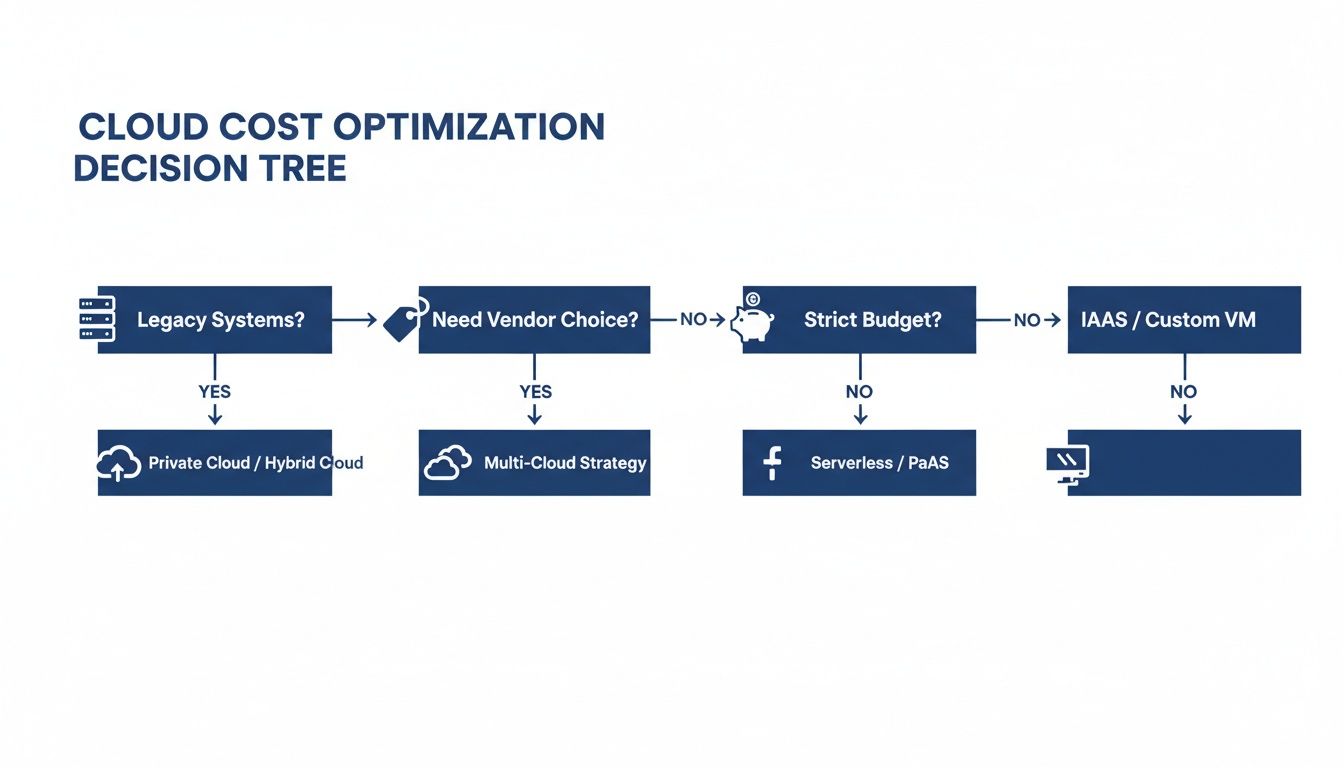
As you can see, if you're sitting on a lot of on-premise hardware, a hybrid model is often the most logical first step. On the other hand, if your priority is picking and choosing the best services from different vendors, you’re probably headed down a multi-cloud path.
Evaluate Your Regulatory and Compliance Needs
The very first question you should ask is about your data. Are you in a heavily regulated industry like healthcare, finance, or government? If you're handling sensitive information that falls under strict mandates like GDPR, HIPAA, or PCI DSS, a hybrid cloud strategy often gives you the clearest path to staying compliant.
By keeping your most sensitive workloads and data on-premise, you maintain direct control and make audits a whole lot simpler. This lets you use the public cloud for less sensitive applications, dev/test environments, and customer-facing services without putting your core compliance at risk.
For many businesses, compliance just isn't negotiable. A hybrid model is a practical way to keep direct control over regulated data while still getting the benefits of public cloud innovation and scale.
Assess Your Existing Infrastructure and Investments
Do you have a big investment in on-premise data centers that are still pulling their weight? If the answer is yes, a hybrid strategy lets you squeeze every last drop of value out of that hardware instead of just ditching it. It gives you a gradual, manageable way to move to the cloud, letting you shift workloads when it makes sense for you.
On the flip side, if you're a cloud-native startup with almost no legacy systems to worry about, a multi-cloud approach can be a massive competitive advantage right out of the gate. Without the baggage of physical servers, you're free to build a resilient, globally distributed infrastructure using the best-in-class services from multiple providers.
Consider Your Team's Skillset and Tolerance for Complexity
Your internal team's technical know-how is a massive piece of the puzzle. A hybrid cloud requires some serious skills in networking, data integration, and managing both on-premise and cloud worlds simultaneously. Your team has to be good at securely and efficiently bridging two very different environments.
Multi-cloud, however, demands expertise across several public cloud platforms. Your DevOps and security teams need to be fluent in the APIs, security models, and management tools for every provider you use. This can mean a steeper learning curve and a bigger need for specialized talent or a lot of training.
The market trends speak volumes. An incredible 92% of large enterprises are now running multi-cloud setups, while hybrid models are helping 70% of businesses with things like AI and edge computing. This shift is fueling a multi-cloud management market expected to rocket from $12.4 billion in 2024 to $40 billion by 2029. You can explore more data on multi-cloud strategies to see how other businesses are adapting.
Here’s a quick checklist to help you map your priorities to the right cloud model.
Decision Checklist for Your Cloud Strategy
Use this checklist to evaluate which cloud model best aligns with your business priorities and technical requirements.
| Consideration | Choose Hybrid Cloud If… | Choose Multi-Cloud If… |
|---|---|---|
| Data & Compliance | You handle sensitive data under strict regulations (HIPAA, GDPR) and need direct control. | Your data can reside in various public clouds, and compliance can be managed with provider-native tools. |
| Existing Infrastructure | You have significant investments in on-premise hardware that you want to keep using. | You are cloud-native or have minimal legacy systems, allowing for a fresh start. |
| Vendor Lock-In | You're comfortable deepening your relationship with one primary cloud provider. | You want to avoid vendor lock-in and use the best service for each specific job. |
| Team Skills | Your team has strong skills in on-premise infrastructure, networking, and a specific public cloud. | Your team is skilled (or can be trained) across multiple cloud platforms (AWS, Azure, GCP). |
| Cost Management | You want to optimize costs by balancing CapEx (on-prem) and OpEx (cloud). | You are focused on optimizing OpEx by finding the best price/performance for each workload. |
| Resilience & DR | You need a disaster recovery site in the cloud for your on-premise applications. | You require high availability by distributing applications across different cloud providers. |
| Performance | You need ultra-low latency for specific workloads that must run close to your users or hardware. | You need to deploy applications geographically close to users worldwide using different providers' regions. |
Ultimately, this isn't a one-and-done decision. Your needs will change, so the best strategy is one that's flexible enough to evolve with your business. By carefully weighing these factors, you can make a choice that sets you up for success now and in the future.
Frequently Asked Questions
When you're wading through cloud terminology, a few questions pop up again and again. Let's clear up some of the most common points of confusion around hybrid and multi-cloud to help you make smarter decisions.
Can a Cloud Strategy Be Both Hybrid and Multi-Cloud?
Absolutely, and this is a common mix-up. The terms aren't mutually exclusive. In fact, they often describe the same sophisticated setup. Think of it this way: a hybrid cloud is all about architecture. It’s a mix of your private infrastructure (like an on-prem data center) and at least one public cloud.
A multi-cloud strategy, on the other hand, is about vendor choice. It means you're using services from more than one public cloud provider, like AWS and Azure.
You can easily do both. For instance, a company running its core databases on its own private servers while using AWS for compute and Google Cloud for analytics is running a hybrid multi-cloud environment. This approach is getting more popular because it offers the best of both worlds: the control of private infrastructure with the specialized tools of multiple public clouds.
What Is the Biggest Hidden Cost in Multi-Cloud Environments?
While everyone obsesses over the price of virtual machines and storage, the real budget-killer in a multi-cloud setup is almost always data egress fees. These are the charges cloud providers hit you with every time you move data out of their network.
And these costs add up faster than you’d think.
Imagine your application logic is running on AWS, but it needs to pull information from a specialized database on Azure. Every single time your app queries that database, you’re getting dinged with egress fees. Without careful planning, these charges can completely wipe out any savings you thought you were getting. Solid multi-cloud financial management means mapping out your data flows to keep this expensive cross-cloud chatter to a minimum.
The sticker price of a virtual machine is only a small part of the story. The real cost of multi-cloud emerges when data starts moving between providers, turning seemingly small transfers into a significant operational expense.
Is Vendor Lock-In Still a Major Concern Today?
Vendor lock-in is definitely still a concern, but it looks a lot different now. Back in the early days of the cloud, the fear was getting stuck with one provider for basic compute or storage. Today, the lock-in is much more subtle and stickier.
Modern lock-in isn't about the basic infrastructure; it's about the high-value managed services. We're talking about powerful tools like Amazon Aurora, Google BigQuery, or Azure Synapse Analytics. These services are fantastic, but they're built to work seamlessly within their own ecosystem.
Pulling your business logic and data out of one of these platform-specific services is a massive undertaking, far harder than just moving a VM. A multi-cloud strategy is one of the best defenses against this, as it encourages using open-source or cloud-agnostic tools. You gain portability, even if it sometimes means giving up the peak performance of a fully native service.
Which Is Better for Disaster Recovery?
Both hybrid and multi-cloud setups offer great options for disaster recovery (DR), they just solve different problems. A hybrid cloud is perfect for backing up your on-premises applications. If your main data center fails, you can flip the switch and fail over to a replica environment in AWS or Azure. This gives you business continuity without the headache and cost of maintaining a second physical site.
A multi-cloud strategy, however, protects you from the failure of an entire cloud provider. By spreading your application across different public clouds, you avoid a single point of failure. If a major outage takes down one provider’s entire region, you can just redirect traffic to your app running on another cloud. The right choice really depends on what you’re trying to protect against: your own site going down, or your cloud vendor going down.
How Do I Choose If I Have No Legacy Systems?
If you're a cloud-native business starting from scratch, a multi-cloud strategy often makes the most sense right out of the gate. Without any legacy hardware to worry about, you're free to pick and choose the best services from every provider to build the perfect stack. This lets you create a resilient, cost-effective application designed for top performance.
That said, a hybrid model isn't entirely off the table. A startup in a heavily regulated field might still opt for a hybrid approach by using a private cloud for sensitive data from day one. In the end, even for new companies, the decision comes down to your core business needs, like compliance, performance, and long-term goals, not just whether you have old servers sitting around.
Are idle cloud resources driving up your monthly bill? With CLOUD TOGGLE, you can automatically shut down non-production servers on a schedule, cutting waste and delivering predictable savings. Stop paying for compute you aren't using and see how much you can save. Start your free 30-day trial at https://cloudtoggle.com.