Deciding on your software as a service pricing model is one of the most critical moves you'll make. It’s so much more than just a number on a page, it's how you tell the world what your product is worth and how you build a business that lasts.
Finding Your Perfect SaaS Pricing Strategy

Get your pricing right, and you've built a powerful engine for growth. Get it wrong, and you're looking at high churn, stalled growth, and a painful disconnect between what you've built and who you're selling to.
This guide is designed to cut through the noise. It’s for DevOps teams, FinOps leaders, and SMB owners who are moving away from old-school software sales toward a recurring revenue model. We’ll walk through how to match your price to the value you deliver, using real-world examples to make it all click.
The Shift to Recurring Revenue
The Software as a Service (SaaS) market is exploding. After hitting a value of USD 408.21 billion in 2025, it's projected to climb to USD 465.03 billion in 2026. This isn't just a trend; it's a fundamental shift in how businesses buy and use software.
Companies are trading massive upfront payments for predictable monthly or annual costs. This change has put powerful tools within reach for small and midsize businesses, who are exactly the audience for tools that can help them get the most out of every dollar spent.
But this move to recurring revenue isn't just about billing. It’s about a new kind of customer relationship. Buyers expect flexibility, scalability, and a clear line between what they pay and the value they get. If you want to see more on this, you might be interested in our deep dive into https://www.cloudtoggle.com/blog-en/cloud-services-solutions/.
Your pricing model is a core part of your product. It should feel fair, transparent, and logical, reminding your customers of the value you bring every time they see an invoice.
Aligning Price with Value
The real trick to any software as a service pricing model is pinning down the value your product delivers. This is especially true for technical tools aimed at DevOps or FinOps pros, where value is something you can actually measure.
It often comes down to a few key things:
- Cost Savings: Directly cutting expenses, like automatically shutting down idle cloud servers.
- Time Saved: Automating tedious jobs to free up your engineers for more important work.
- Risk Reduction: Boosting security, ensuring compliance, or making systems more stable.
- Operational Efficiency: Helping teams do more with less stress and effort.
As you build out your strategy, you’ll have to decide on the big question of putting a price tag on your product from day one. By the time you're done with this guide, you’ll have a clear roadmap for picking and launching a model that works for you.
Decoding the Core SaaS Pricing Models
Picking the right pricing model for your SaaS product is one of the most critical decisions you'll make. Before you can choose, you need to know your options. Let's break down the most common models without the confusing business school jargon.
Think of it like picking a mobile phone plan. Do you want a simple, flat monthly bill? A plan where you only pay for the data you use? Or a family plan that scales with more users? SaaS pricing works the same way, with different structures built for different customer needs.
Flat-Rate Pricing: The All-You-Can-Eat Buffet
This is as simple as it gets. Flat-rate pricing offers one product, one set of features, and one price. It’s the "all-you-can-eat buffet" of the SaaS world. Pay a single monthly or annual fee, and you get everything.
Simplicity is the name of the game here. No tiers, no usage caps, and no confusing add-ons. This makes your product incredibly easy to sell because the value is crystal clear: pay this price, get all this stuff.
- Pros: Easy to sell, simple for customers to understand, and generates predictable revenue.
- Cons: Hard to serve different types of customers (from small businesses to enterprises). You also leave money on the table, as your heaviest users pay the same as your lightest ones.
This model is a great fit for simple tools that do one thing really well. For example, a basic scheduling tool charging a flat $15 per month for unlimited appointments is a no-brainer for a solo entrepreneur.
Per-User Pricing: The Movie Ticket Model
Per-user pricing (also called per-seat pricing) is one of the most popular models out there. Just like buying movie tickets, every person who needs access pays for their own "seat." Your revenue scales directly as your customers add more people to their accounts.
The logic is easy for customers to follow. If a team grows from five people to ten, their bill doubles. This direct link between price and team size makes it a go-to for collaboration tools, CRMs, and project management software.
Per-user pricing works best when the product becomes more valuable as more people use it. More users usually mean more collaboration, making the tool more embedded in a company’s day-to-day workflow.
But it has a downside. The cost per seat can become a real barrier, discouraging wider adoption inside a company. It also tempts teams to share passwords, with multiple people using one login to keep costs down, which eats into your revenue.
Tiered Pricing: The Cable TV Package
Think of tiered pricing like a cable TV package. Customers pick from a few different plans (e.g., Basic, Pro, Enterprise), with each tier offering more features, more capacity, or better support. This is probably the most common SaaS pricing model because it lets you target multiple customer types with a single product.
The tiers are usually built around specific customer profiles:
- A low-cost tier for individuals or small teams who are just getting started.
- A mid-range tier for growing businesses that need more horsepower and features.
- An enterprise tier for big companies that need advanced security, dedicated support, and custom options.
This creates a natural upgrade path. As a customer’s business grows, they can jump to a higher tier, and your revenue grows right along with them. The trick is to define your tiers based on real value, so each step up feels like a worthwhile investment.
Usage-Based Pricing: The Electric Utility Bill
With usage-based pricing, customers pay only for what they actually use. It’s just like your monthly electric bill; the more power you use, the more you pay. This model perfectly aligns the price a customer pays with the value they get.
This approach is gaining a lot of traction, especially for infrastructure, API-first products, and DevOps tools. Cloud providers like AWS charge for things like compute hours and data storage. A tool like CLOUD TOGGLE could price based on the number of cloud resources managed or the hours of automated savings.
The public cloud market, which is the engine behind SaaS, was valued at USD 264 billion in 2024, driven mostly by large enterprises. This shows a huge market of companies that are already comfortable with paying for what they consume. You can discover more insights about the SaaS market from Technavio.
Usage-based pricing is a fantastic way to get customers in the door, since they can start with very low costs and scale up. The main challenge? Revenue can be unpredictable, swinging up and down with customer activity.
Freemium and Hybrid Models: The Free Sample Strategy
Finally, the freemium model is less a pricing strategy and more a powerful marketing engine. You offer a free-forever version of your product with limited features to attract a massive user base. It’s the ultimate "try before you buy," letting people see the product's value firsthand with zero risk. The goal is to convert a small fraction of those free users into paying customers who need the advanced features.
Many companies also land on hybrid models, mixing and matching elements from different strategies. For instance, a project management tool might charge per user (per-user model) but also have different storage limits for each plan (tiered model). This flexibility lets you build a pricing model that perfectly fits how your product delivers value.
How to Choose Your SaaS Pricing Model
Alright, let's move from theory to practice. Picking the right pricing model is a huge decision, and just copying what your competitor is doing is a classic mistake. Their pricing is built for their product and their customers, not yours. You need a strategy that turns your price tag into a growth engine.
It all starts by asking a few honest questions about your business. The answers will point you toward the model that makes the most sense for you and your customers, giving you a real strategic edge.
Key Questions to Guide Your Decision
Before you land on a price, you have to get clear on the value you're actually delivering. A solid pricing strategy is built on knowing your product and your market inside and out.
Start with these questions:
- Who are you selling to? Is it a small business watching every penny, or a big enterprise that needs all the bells, whistles, and security features? Your customer profile changes everything.
- What's your core value unit? What's the one thing customers will happily pay for? For a CRM, it might be contacts. For a DevOps tool like CLOUD TOGGLE, it's probably the number of servers you manage or the hours of idle cloud spend you eliminate.
- How complex is your product? If you have a ton of features for different types of users, a tiered model is a natural fit. If your product does one thing incredibly well, something simpler like flat-rate or usage-based pricing might be the way to go.
- What are your growth goals? Trying to get a massive number of users fast? A freemium plan could be your ticket. Focusing on maximizing revenue from a smaller, niche market? A premium, value-based price is probably a better bet.
This decision tree gives you a quick visual to help you think through these options based on your value metric and feature set.
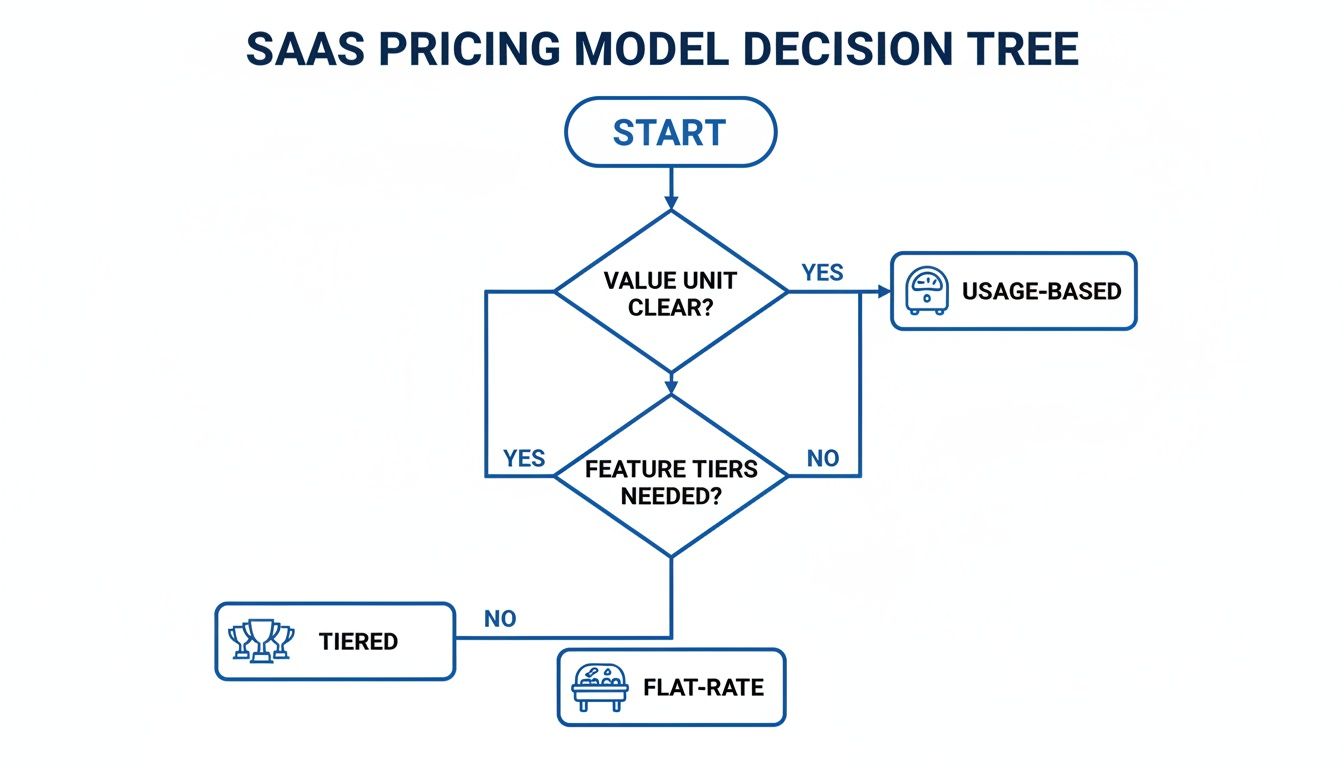
As you can see, if you have a clear, measurable unit of value, usage-based pricing is often a great path. If your features are more complex and varied, tiers usually make more sense.
Pricing for Different Business Types
The right model really depends on what you're selling and who's buying. A simple tool for a small business has totally different pricing needs than a complex platform built for engineers.
For instance, a project management tool for SMBs could do great with a simple tiered model based on users and projects. The value is obvious, and the tiers give them a clear path to upgrade as they grow. It's predictable and easy for a non-technical buyer to understand.
A critical mistake is pricing a technical product like a simple consumer app. For DevOps and cloud tools, value is not measured in "seats" but in performance, efficiency, and cost savings.
But pricing a technical DevOps tool is a different ballgame. A per-seat model often makes no sense. One engineer could be using your tool to manage a massive, expensive infrastructure. You'd be leaving a ton of money on the table. For tools like this, you need to tie your price to value metrics like API calls, data processed, or resources managed. A hybrid model that combines a base platform fee with usage-based billing is often the sweet spot. If you're managing complex cloud setups, you can learn more about how to structure them in our guide on multi-tenancy in the cloud.
Connecting Pricing to Profitability
At the end of the day, your pricing model has to make you money. To make sure your business is built to last, you have to get a handle on your SaaS unit economics. These numbers are what tell you if a pricing model is actually working or just bringing in vanity revenue. Answering these questions gives you the data you need to pick a model that doesn’t just attract customers, but builds a healthy, sustainable business.
Exploring Advanced and Hybrid Pricing Strategies
The most successful SaaS companies know that a basic pricing model is just the starting point. They don’t just stick with a simple per-user or tiered plan. Instead, they get creative, blending different strategies to build a software as a service pricing model that perfectly matches the value their customers get.
These hybrid strategies combine elements from two or more models. Think of it like creating a custom-fit suit instead of buying one off the rack. You get the best of both worlds: a predictable revenue stream mixed with the flexibility that today’s customers demand.
For instance, a company could charge a base subscription that covers its core features for a handful of users, then add a usage-based component on top. This creates a stable monthly income while letting customers scale up or down without being forced into a new, expensive tier.
Per-Active-User and Value-Based Tiering
Nobody wants to pay for software that just collects dust. This "shelf-ware" problem is a huge point of friction for buyers, but per-active-user pricing solves it head-on. You only bill for the users who actually log in and use the tool in a given month.
This approach builds a ton of trust. It just feels fair. When customers know they’re only paying for what they use, they’re much more willing to roll out the tool across their entire organization.
Another smart tactic is value-based tiering. This isn't just about cramming more features into pricier plans. It’s about designing tiers around what your customer is trying to accomplish.
- Startup Tier: Gives a small team the core tools they need to get going.
- Growth Tier: Adds automation and collaboration features for companies that are scaling up.
- Enterprise Tier: Delivers advanced security, compliance reporting, and dedicated support for large, complex organizations.
When you align tiers with real business outcomes, the upgrade path feels less like an upsell and more like a logical next step in your customer's journey.
The Rise of Dynamic and AI-Driven Pricing
The next frontier is using data to tweak pricing in real time. Dynamic pricing adjusts costs based on demand, time of day, or customer behavior. It's been common in travel and e-commerce for years, but it's finally making its way into SaaS, especially for tools with variable operating costs.
This data-driven approach is getting a massive boost from artificial intelligence. The growth of generative AI is accelerating the entire market. In fact, the global AI-created SaaS market is on track to hit USD 770.32 billion by 2031, with a staggering CAGR of 40.2%. This shows just how much value AI is adding, making it crucial for pricing to reflect that. You can read more about these SaaS market trends and what they mean for platforms like CLOUD TOGGLE.
A hybrid model can directly connect your price to the tangible value you create. For a cost-optimization tool, this could mean a base subscription plus a small percentage of the cloud savings it generates for the customer.
This model ties the tool’s cost directly to its performance. The more the customer saves, the more the provider earns. It creates a true win-win partnership.
This outcome-based pricing is a game-changer for DevOps and FinOps tools, where a clear ROI is the main reason people buy. It proves the tool’s value from day one and helps build loyal, long-term customers.
Implementing and Testing Your Pricing Strategy

A brilliant software as a service pricing model on paper is worthless without flawless execution. Launching your pricing isn’t the finish line; it’s the starting gun. From here, it’s a continuous process of testing, learning, and fine-tuning. This guide will walk you through rolling out your new model, from the nuts and bolts of operations to the art of the pricing experiment.
The first step is making sure you’re operationally ready. You need the right tools to bring your strategy to life. This means picking billing and metering software that can handle the logic you’ve designed, whether it’s tracking API calls for usage-based billing or managing seats for a per-user model. Your infrastructure has to accurately measure and invoice based on whatever value metric you've chosen.
Designing for Conversion and Clarity
Your pricing page is your most important salesperson. It has to communicate value clearly and guide visitors to the best plan for them. A confusing pricing page is a massive source of abandoned carts and lost revenue.
Focus on making the differences between your tiers obvious. Use clear, benefit-oriented language instead of just listing out features. For a cloud cost tool like CLOUD TOGGLE, this means highlighting outcomes like "Automated savings for up to 50 servers" instead of just "Server scheduling."
To make sure your pricing page performs, consider these best practices:
- Highlight the Recommended Plan: Use a visual cue like a colored border or a "Most Popular" badge to nudge visitors toward the tier that fits most customers.
- Include an FAQ: Proactively answer common questions about billing cycles, cancellation policies, and feature limits. This reduces friction and builds trust.
- Use Social Proof: Add customer logos or short testimonials. It shows that other businesses are already getting value from your product.
The Art of the Pricing Experiment
Pricing is not a "set it and forget it" task. The most successful SaaS companies treat it like a science, constantly running experiments to find their optimal price points. This data-driven approach removes the guesswork and helps you maximize revenue without scaring away customers.
A classic method is A/B testing, where you show different prices to different segments of your website traffic. For example, you might test a $49/month plan against a $59/month plan to see how the change impacts conversion rates and, ultimately, revenue. A/B testing tools can help you measure the results precisely.
A critical part of pricing is understanding what customers are willing to pay. Don't just guess. Use structured surveys to gather real data on perceived value.
One powerful technique is the van Westendorp Price Sensitivity Meter. This survey method asks customers four key questions to identify an acceptable price range. It helps you find the sweet spot where your price isn't seen as too cheap (raising quality concerns) or too expensive (creating a barrier to entry).
Analyzing and Acting on Your Data
Running tests is only half the battle; the real insights come from analyzing the results. Look at cohort data to see how different pricing affects your key metrics over time. For instance, did a price increase lead to a higher Customer Lifetime Value (LTV), or did it cause a spike in churn that wiped out those gains?
When you do make changes, especially for existing customers, communication is everything. Be transparent about why the price is changing and what extra value they’ll get. Offering to "grandfather" loyal customers on their old plan is a great way to reward them and minimize pushback.
Finally, use discounts strategically. Instead of random promotions, focus on incentives that drive specific behaviors, like a 10-20% discount for signing an annual contract. This improves your cash flow and lowers monthly churn. As you adjust pricing, understanding your cost structure is essential. Check out our guide on fixed and variable costs to learn more about managing your budget effectively.
Common SaaS Pricing Questions Answered
Once you've wrapped your head around the different pricing models, the real-world questions start to pop up. Let's tackle a few of the most common strategic hurdles you'll face after you've absorbed the main concepts.
How Often Should I Revisit My Pricing?
Pricing isn't a "set it and forget it" task. Think of it as a core feature of your product that needs regular attention to stay effective. A good rule of thumb is to review your pricing strategy at least once per year.
That said, don't wait for the calendar if you see a major change. You should be ready to act sooner if you spot certain triggers, like:
- Rolling out a major new feature that adds a ton of value for customers.
- A competitor makes a big pricing move that shakes up the market.
- Your own business metrics start to look off, like a sudden jump in churn or a drop in expansion revenue.
Keeping your price aligned with your product's value and the market isn't a one-off project; it's an ongoing process.
Pricing is a process of continuous improvement, not a project with a deadline. The goal is to keep your model aligned with the value you deliver as your product and market evolve.
What Is the Best Pricing Model for a New Startup?
When you’re a new SaaS startup, your number one goal is market validation. You have to prove customers not only want your product but are actually willing to pay for it. With that in mind, simplicity is your best friend.
A straightforward model like flat rate or a very simple tiered structure is usually the best place to start. These are dead simple for early customers to understand and easy for a small team to manage. Your job is to remove as much friction as possible from that first sale.
Usage-based models can work too, but only if your value metric is crystal clear from day one. Avoid getting tangled up in complex hybrid models until you have a much better feel for how your customers behave. Get those first paying customers in the door and start gathering feedback. You can always make your pricing more sophisticated later on.
How Do I Communicate a Price Change?
Telling your customers you're raising prices is never fun, but it doesn't have to be a disaster. The absolute key is transparent and proactive communication. Never, ever surprise a customer with a higher bill.
Give everyone plenty of warning. At least 30 to 60 days is standard. Be upfront about why the price is changing. Focus on the value you've added since they signed up, whether it's new features, better performance, or more integrations.
One of the best ways to soften the blow and reward your earliest supporters is to grandfather existing customers. This lets them stay on their current plan at the old price, either forever or for a long time. It shows you value their loyalty and can build a tremendous amount of goodwill.
Ready to stop wasting money on idle cloud resources? CLOUD TOGGLE makes it easy to schedule servers and VMs to power down when you're not using them, delivering predictable savings with minimal effort. Start your free trial and see how much you can save.