At its heart, the difference between multicloud vs hybrid cloud is pretty simple. Multicloud means you're using services from more than one public cloud provider, like AWS and Azure, without necessarily connecting them. Think of it as picking the best tool for each job from different toolboxes.
On the other hand, a hybrid cloud strategy connects your private, on-premise infrastructure with at least one public cloud, creating a single, unified environment where workloads can move between them. It’s all about blending the control of a private setup with the flexibility of a public one.
Understanding the Core Architectures
Deciding on the right cloud strategy is one of those critical calls that echoes through your entire operation, impacting everything from your budget to your security posture. While people often toss these terms around interchangeably, they represent two very different ways of thinking about and managing IT infrastructure.
One approach is all about having choices and cherry-picking best-in-class services from various vendors. The other is focused on maintaining control and tightly integrating with the systems you already own.
Before we get into the weeds, it’s important to really get a handle on what makes each architecture tick. Knowing their distinct makeups and goals will make it much clearer how each one can solve specific business problems.
And make no mistake, these strategies are everywhere. Recent data shows that by 2025, a staggering 92-93% of companies have adopted a multicloud approach, juggling an average of 4.8 different cloud platforms.
At a Glance Multicloud vs Hybrid Cloud
Sometimes, the best way to see the difference is a straightforward, side-by-side view. This table cuts through the noise and lays out the fundamental distinctions between the two models.
| Characteristic | Multicloud | Hybrid Cloud |
|---|---|---|
| Core Components | Two or more public clouds (e.g., AWS, Azure, GCP) | At least one public cloud and a private cloud or on-premises infrastructure |
| Primary Goal | Avoid vendor lock-in and use the best service for each specific task. | Blend public cloud scalability with private cloud control and security. |
| Integration Level | Low to moderate; services often run independently. | High; requires strong connectivity and interoperability between environments. |
| Typical Use Cases | Disaster recovery, specialized AI/ML services, global presence. | Data sovereignty, regulatory compliance, extending legacy applications. |
Getting these core differences down is the first step. You can also explore our detailed guide on cloud services solutions to see how these architectures fit into the bigger picture. In the end, each model offers its own set of advantages, and the right choice really comes down to your organization's specific goals, resources, and constraints.
Comparing the Architectural Foundations
To really get to the bottom of the multicloud vs hybrid cloud debate, you have to look past the high-level definitions and get into their architectural bones. How these environments are actually built dictates everything that follows: performance, security, and even how much of a headache they are to manage. These aren't just different strategies; they're fundamentally different ways to engineer a solution.
Think of a multicloud architecture as a federation of services. It’s a conscious choice to pick and choose the best tools from different vendors. This approach treats each cloud platform as a specialized resource pool you tap into for its unique strengths.
On the other hand, a hybrid cloud architecture is all about deep integration. Its entire purpose is to build a seamless, functional bridge between the infrastructure you own (private cloud or on-prem) and the services you rent from a public cloud. The goal is to make it all work as one cohesive system.

The Multicloud Model: Choice and Specialization
In a multicloud setup, getting everything to talk to each other isn't always the point. The architecture is often decentralized, with different jobs running in parallel across separate cloud environments. This separation is usually intentional, designed to squeeze every last drop of performance out of each platform and avoid getting locked into one vendor.
For example, a company might run its main application on AWS for its robust and mature compute services. At the same time, it could be running data analytics and machine learning models on Google Cloud Platform to access its top-tier AI tools. To round it out, they might use Microsoft Azure for its tight integration with Office 365 and other enterprise software.
These environments might operate as distinct silos, sharing very little data between them. The architectural focus is on using the right cloud for the right job, not forcing them all to play nice together. This gives you incredible flexibility and access to the best innovation from every major player.
Multicloud is about strategic selection. The architecture prioritizes using best-of-breed services from different providers, even if it means managing separate, distinct environments. The goal is capability, not necessarily cohesion.
But this distributed approach creates real complexity when it comes to governance and security. Each platform has its own APIs, security rules, and management consoles. Your team needs a broad skill set to manage it all effectively, and enforcing consistent policies across every provider becomes the central architectural challenge.
The Hybrid Cloud Model: Integration and Control
A hybrid cloud architecture is defined by its interoperability. The whole structure is designed from the ground up to let data and apps move freely between your private infrastructure and a public cloud. This requires a strong, secure connection linking your on-prem data center to your public cloud provider.
This connection is the architectural centerpiece, usually built with:
- Virtual Private Networks (VPNs) for secure, encrypted tunnels over the public internet.
- Dedicated Interconnects for private, high-bandwidth, low-latency connections that bypass the public internet completely.
This tight integration unlocks strategies that are simply impossible in a multicloud model. For instance, a business can use "cloud bursting," where workloads automatically spill over from the private cloud to the public cloud to handle sudden traffic spikes. You get the performance you need without having to over-provision your own expensive hardware.
It also creates a natural path for migration. You can keep legacy applications running securely on-premises while developing new, cloud-native apps in the public cloud, all while letting them share data and resources seamlessly.
The main architectural hurdle here is managing the network complexity and making sure the link between your two worlds is both reliable and secure. It demands serious networking expertise and careful planning to make two very different environments feel like one. When done right, a hybrid cloud feels like a true extension of your own data center, not some distant island.
Evaluating Strategic Benefits and Trade-Offs
Picking between multicloud and hybrid cloud isn't just a technical detail; it’s a major strategic decision. Each model comes with its own set of perks and headaches. The right call has less to do with which technology is "better" and more to do with what your business truly needs, whether that’s meeting strict regulations or pushing the envelope on innovation.
The whole multicloud vs. hybrid cloud debate really boils down to one thing: flexibility versus control. A multicloud strategy lets you cherry-pick the best services from any provider you want. A hybrid approach, on the other hand, gives you a solid way to bolt the public cloud's power onto your existing infrastructure. Nailing down which of these trade-offs works for you is the key to a decision you won't regret later.
The Multicloud Advantage: Gaining Flexibility and Performance
The number one reason companies go multicloud is to dodge vendor lock-in. When you spread your workloads across providers like AWS, Azure, and GCP, you keep your leverage. Your entire operation isn't hanging on a single company's pricing whims, product roadmap, or a catastrophic outage. That freedom is a huge strategic plus.
It also means you can fine-tune performance by putting the right job in the right place. For example, you could run a heavy-duty media transcoding job on a cloud known for its beefy GPU instances, while your e-commerce backend hums along on another provider's data center that's geographically closer to your customers.
This approach offers some serious wins:
- Best-of-Breed Services: Grab advanced AI and machine learning tools from one provider and rock-solid database solutions from another. You're not stuck with one vendor's entire menu.
- Enhanced Resilience: By spreading your apps across different clouds, you build a much tougher architecture that can survive a regional outage or even a provider-wide failure.
- Cost Optimization: You can play the field, taking advantage of competitive pricing, spot instances, and regional cost variations to drive down your total cloud spend. A tool like CLOUD TOGGLE becomes even more valuable here, helping you manage and automate savings across multiple platforms.
But all this flexibility isn't free. The biggest trade-off is a massive spike in operational complexity. Juggling different services, security rules, and billing cycles across several platforms demands a sharp team and some pretty sophisticated management tools.
The Hybrid Cloud Advantage: Mastering Compliance and Control
For a lot of businesses, especially in tightly regulated fields like finance or healthcare, a hybrid cloud isn't just a choice, it's a requirement. The main appeal of hybrid is keeping direct control over your most sensitive data by hosting it on-premises, while still tapping into the public cloud's massive scale and cool services.
This model is perfect for hitting strict data sovereignty and compliance marks like GDPR or HIPAA. You can keep confidential customer records or patient data safe within your own data center, where you call all the shots on security. Meanwhile, you can use the public cloud for less sensitive work like development, testing, or big data analytics.
Hybrid cloud is about balancing innovation with governance. It lets companies modernize their IT without sacrificing critical security and compliance duties, acting as a bridge between old-school systems and what's possible in the cloud.
Hybrid strategies are now standard practice for companies trying to balance agility and control. Reports show that around 73% of organizations worldwide were running hybrid cloud setups by 2025, with that number expected to hit 90% by 2027. You can dig into more cloud computing statistics and trends to see how these models are shaping up.
The main trade-off? Innovation can move a bit slower compared to a pure public cloud environment. You're still on the hook for managing and maintaining your on-prem hardware, which means serious upfront cash and ongoing operational costs. Getting legacy systems to play nice with modern cloud services can also be a complex, time-consuming puzzle. In the end, it all comes down to whether the benefits of control and compliance are worth the operational drag and a potentially slower pace of change.
Analyzing Costs, Security, and Governance
Beyond the architectural diagrams, the real story of multicloud versus hybrid cloud is written in the day-to-day grind of managing costs, security, and governance. These are the operational realities that make or break a cloud strategy. How you track spending, defend your assets, and enforce policies looks fundamentally different depending on which path you take.
The core distinction boils down to centralized control versus distributed management. One approach gives you a single pane of glass for many operations, while the other forces you to stitch together a cohesive view from disparate environments.

Unpacking the Cost Structures
With multicloud, cost management becomes a serious challenge. Each provider has its own unique pricing, discount structures, and billing cycles, creating a complex financial puzzle. Unexpected data egress fees, the cost of moving data out of a cloud, can blow up budgets if you're not watching carefully. It's a recipe for financial blind spots where waste can thrive.
Despite cloud being mainstream, many businesses still hemorrhage money. Reports show that around 27% of cloud spending is wasted on overprovisioned or forgotten resources. Both multicloud and hybrid strategies have to contend with this, but they approach the problem from different angles. You can read more about these trends in cloud usage statistics.
Hybrid cloud costs, on the other hand, are often more predictable, at least on the private side. You have a fixed, upfront capital expense for your on-prem hardware, which can be significant. But after that, the operational costs are much easier to forecast. The public cloud piece adds variable spending, but since it's typically from a single provider, financial tracking is far simpler.
Navigating Security and Compliance
From a security perspective, the differences are stark. A multicloud strategy dramatically expands your digital footprint, creating a much larger attack surface. Every cloud provider brings its own security tools, identity management systems, and compliance certifications to the table. Trying to maintain a consistent security posture and unified visibility across all of them is a heavy lift.
A key challenge in multicloud security isn't the strength of any single provider; they're all incredibly robust. The real danger lies in ensuring your own policies and configurations are applied consistently everywhere. One misconfiguration on one platform can expose your entire organization.
Hybrid cloud offers more centralized control. You can keep your most sensitive data and critical applications safely behind your own firewall, governed by your established security protocols. This makes it far easier to meet strict compliance mandates like HIPAA or PCI DSS, since auditors can verify controls in an environment you own. The public cloud connection is a critical security boundary that needs tight management, but the overall landscape is less fragmented.
Enforcing Governance Across Environments
Governance is all about setting the rules for how your cloud resources are used, managed, and secured. In a multicloud world, enforcing consistent policies is a constant battle. Each platform has different APIs and resource tagging conventions, making it tough to apply uniform access controls, budget limits, or configuration standards.
This complexity is precisely why specialized management platforms have become so popular. If you're wrestling with multiple cloud environments, our guide on effective multicloud management offers practical advice for staying in control. Without a unified governance strategy, you’re just asking for security gaps, cost overruns, and compliance failures.
With a hybrid cloud model, governance is much more straightforward. The on-prem portion of your infrastructure already operates under your existing IT governance framework. Extending those policies to a single public cloud provider is a manageable task, certainly simpler than trying to align three or more. This streamlined approach creates clearer accountability and makes compliance reporting easier, giving you a much firmer grip on your IT ecosystem.
Practical Use Cases for Each Cloud Model
Theory is one thing, but seeing how these cloud models solve real-world problems is where the multicloud vs hybrid cloud discussion really clicks. These aren't just abstract architectural choices; they’re strategic responses to specific business needs, whether it's performance, compliance, or pure innovation.
The decision rarely boils down to technology for its own sake. It’s almost always a direct answer to market demands, regulatory headaches, or a company's long-term vision. One model might be perfect for global reach and bleeding-edge features, while another is built for rock-solid security and getting more value out of existing investments.
Multicloud Scenarios Where Flexibility Wins
A multicloud strategy really shines when a business wants to avoid getting locked into a single provider. The goal is simple: use the best tool for every job, no matter who makes it. This approach is a favorite among tech-forward companies, global retailers, and anyone focused on digital product innovation.
Example 1: A Global E-commerce Platform
Imagine a massive online retailer with customers scattered across North America, Europe, and Asia. To crush latency and deliver that snappy, responsive shopping experience everyone expects, their servers need to be physically close to their users. Multicloud is the obvious answer here.
- They might lean on Amazon Web Services (AWS) in the United States and Europe for its huge footprint and mature e-commerce services.
- At the same time, they could deploy on Google Cloud Platform (GCP) in Southeast Asia to capitalize on its fantastic network performance in that region.
- For the heavy lifting behind the scenes, like the analytics and machine learning that power product recommendations, they might even tap a third provider known for its specialized AI tools.
In this setup, each cloud provider acts as its own distinct, geographically-tuned island. The main driver isn't deep integration between them; it’s all about performance and global reach.
A multicloud approach lets a business build a global presence by cherry-picking cloud regions and services that offer the best performance and price for each specific market.
Example 2: A Fintech Startup Focused on Innovation
Picture a fintech startup building a new investment platform from scratch. Their top priorities are speed to market and getting their hands on the latest tech. They might pick one public cloud for their core transaction systems, something reliable and battle-tested.
But when it's time to build a new fraud detection feature, they might look to a different cloud provider that offers more advanced (and maybe cheaper) machine learning services. This lets them innovate way faster by using best-of-breed tools, free from the limitations of a single ecosystem.
Hybrid Cloud Scenarios Where Control Is Critical
A hybrid cloud model is often the go-to choice when an organization has to juggle the perks of the public cloud with non-negotiable demands for data security, regulatory compliance, or just maximizing the ROI on infrastructure they already own.
Example 1: A Healthcare Organization
A hospital system is sitting on a mountain of highly sensitive protected health information (PHI). Regulations like HIPAA have strict, unforgiving rules about how this data is stored, accessed, and secured. For many, keeping patient records on-premises is the only surefire way to guarantee compliance and maintain total control.
- On-Premises Private Cloud: The hospital keeps all electronic health records (EHRs), patient histories, and billing info on servers tucked away in its own secure data center.
- Public Cloud: They then connect this data center to a public cloud provider to power large-scale medical research. Researchers can tap into the public cloud’s massive, on-demand computing power to analyze anonymized data sets, hunting for disease patterns without ever putting sensitive PHI at risk.
This hybrid approach gives the hospital the best of both worlds: the uncompromising security and compliance of a private environment for its crown jewels, plus the elastic, scalable power of the public cloud for driving innovation.
Example 2: A Manufacturing Company with Legacy Systems
Think of a long-standing manufacturing firm that runs its entire operation on a custom, on-premises Enterprise Resource Planning (ERP) system that’s been chugging along for decades. This system is mission-critical and way too complex to just lift-and-shift to the cloud.
By going hybrid, they can connect their legacy ERP to a public cloud. This move allows them to build modern, cloud-native apps for things like supply chain analytics or customer portals that can securely pull data from the on-prem system. It's a smart strategy that extends the life and value of their existing hardware while letting them modernize one piece at a time.
A Decision Framework for Your Business
Picking between a multicloud and a hybrid cloud strategy isn't just a technical detail; it’s a major business decision that will shape your operations for years to come. To get it right, you need a clear framework that connects your business goals directly to the right cloud architecture.
The best way to start is by asking a few pointed questions.
Assess Your Core Requirements
First things first: what are your regulatory and compliance obligations? If you handle sensitive data governed by strict laws like HIPAA or GDPR, the tight control of a hybrid model is often the clearest path to compliance. It lets you keep that critical information secure on your own hardware.
Next, take a hard look at your existing infrastructure. Do you have a significant investment in on-premise data centers that are still pulling their weight? A hybrid strategy lets you get the most out of those assets by blending them with public cloud services instead of just writing them off.
If data sovereignty is non-negotiable but you need scalable analytics, a hybrid model is your best starting point. This approach balances the need for control with the desire for modern, flexible computing power.
Evaluate Your Team and Future Goals
Your team's technical skills are another huge piece of the puzzle. Does your in-house talent have deep expertise across multiple platforms like AWS, Azure, and GCP? A multicloud strategy absolutely requires this diverse skill set to juggle different APIs, security models, and billing systems.
On the other hand, a hybrid cloud demands strong networking chops and rock-solid on-premise infrastructure management skills.
Finally, think about your long-term goals for scale and innovation. If your main objective is cherry-picking best-in-class services from different vendors to innovate faster and dodge vendor lock-in, then multicloud offers flexibility that's hard to beat. This is especially true for digital-native companies building cloud-first from the ground up.
The diagram below gives you a visual on how different types of businesses naturally lean toward one model over the other based on what they need most.
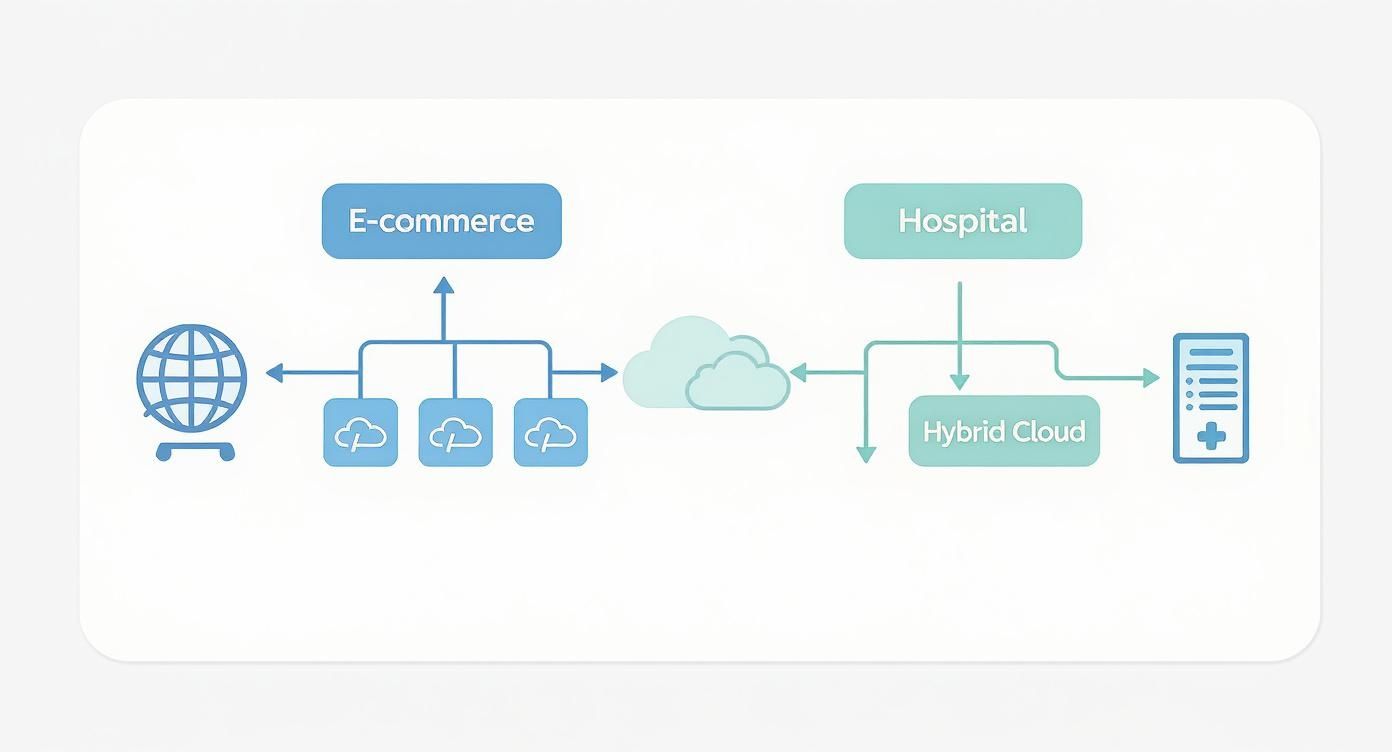
As the graphic shows, an e-commerce company that needs global reach and agility is a perfect fit for multicloud. Meanwhile, a hospital, where compliance and data control are paramount, will almost always be better off with a hybrid cloud.
No matter which path you take, you absolutely must have a solid governance and cost management strategy from day one. To get a head start, you can learn more about how to manage your multicloud environment to set yourself up for success. By carefully working through these questions, you’ll land on the cloud strategy that actually fits your business.
Common Questions Answered
Even after breaking down the differences, a few common questions always pop up when people weigh multicloud vs. hybrid cloud. Let's clear those up with some quick, straightforward answers.
Can an Organization Use Both Strategies?
Yes, absolutely. In fact, many large enterprises end up blending the two. For instance, a company might run a classic hybrid cloud, connecting its private data center to Azure, but also use AWS for a completely separate set of applications.
This combined model is often called a “hybrid multicloud” strategy. It’s the practical reality for mature organizations that need the highest degree of flexibility and want to use the best tool for each job.
Which Strategy Is More Secure?
Neither model is inherently more secure than the other; it all comes down to how well you implement and manage it. A hybrid cloud often feels more secure because it lets you keep your most sensitive data on-premises, which can be a huge plus for meeting strict regulatory requirements.
On the other hand, a multicloud approach can boost your resilience. By spreading your workloads across different providers, you reduce the risk of a single outage taking down your entire operation. The real challenge with multicloud is enforcing consistent security policies and maintaining visibility across every platform.
Security isn't about the architecture; it's about diligent execution. A well-managed multicloud environment can easily be more secure than a poorly implemented hybrid one, and vice versa.
What Are the Biggest Implementation Challenges?
For multicloud, the biggest hurdles are almost always operational complexity, cost management, and a skills gap. Juggling multiple platforms, each with its own APIs, services, and pricing models, demands a highly skilled team.
Keeping security and governance consistent across different clouds is a tough nut to crack. And without the right tools, tracking your spending can quickly become a nightmare, with unexpected data transfer fees between clouds creating surprise bills.
Ready to get your cloud costs under control, no matter the environment? With CLOUD TOGGLE, you can automatically shut down idle servers across AWS and Azure to stop wasting money. Start your 30-day free trial today and see just how simple it is to schedule your resources and maximize savings.