Let's get one thing straight from the start. The core difference is simple: hybrid cloud connects your private infrastructure to a public cloud, making them work as one unified system. Multi-cloud, on the other hand, means you’re using services from several different public cloud providers, and these services don’t necessarily talk to each other.
It all comes down to whether you need a seamless bridge to your on-premise gear or the freedom to pick and choose the best tools from various public cloud vendors.
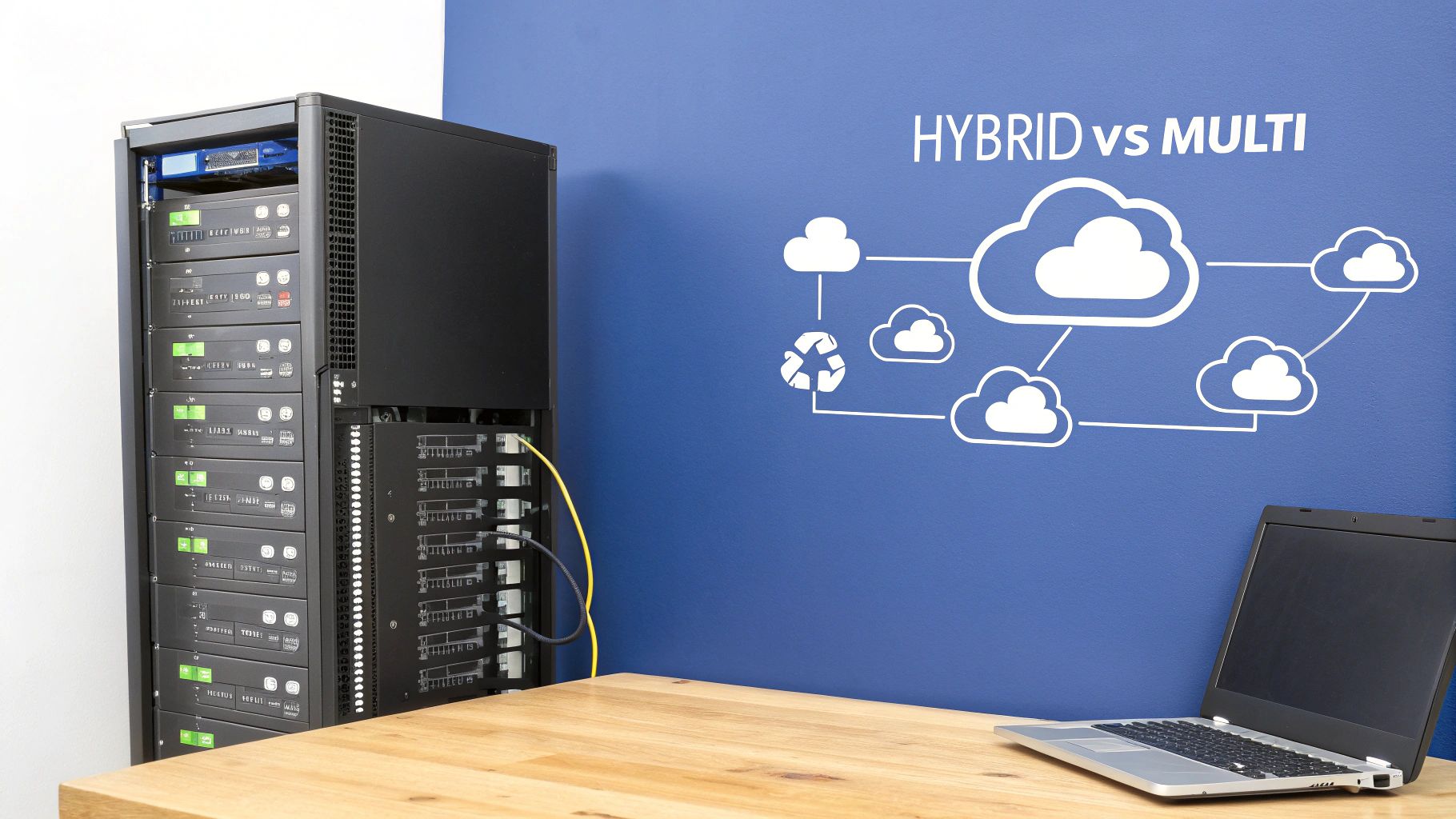
Decoding Hybrid And Multi Cloud Environments
Picking the right cloud strategy is a huge decision. It doesn’t just affect your IT budget; it shapes your operations, security posture, and how fast you can innovate. Before getting lost in the details, it's critical to have a solid grasp of what these models actually are.
Too many companies drift into a strategy by accident, only to find themselves tangled in unexpected complexity and runaway costs.
To sidestep that trap, let's break down what each approach really means. Getting these definitions right is the first step toward a smart decision that lines up with your business goals, whether that’s tightening data control, chasing service innovation, or just optimizing costs. You can explore different types of cloud services and solutions to see how they slot into these bigger pictures.
What Is a Hybrid Cloud?
Think of a hybrid cloud as a single, orchestrated system. It’s all about integration. You’re building a secure connection between your private cloud (or your own on-premise data center) and a public cloud like AWS or Azure.
This setup is perfect for businesses that have sensitive data they must keep in-house for compliance or security reasons but still want the public cloud’s massive scalability for other, less critical applications. It offers a balance between control and flexibility.
What Is a Multi-Cloud?
A multi-cloud strategy is all about diversification and freedom. Instead of committing to one public cloud provider, you use distinct services from two or more, think using Amazon Web Services (AWS) for its machine learning prowess and Google Cloud for its powerful data analytics.
The main driver here is to avoid being locked into one vendor’s ecosystem. It lets you cherry-pick the absolute best service for every specific job, giving you a competitive edge.
Hybrid Cloud vs Multi Cloud Core Distinctions
To make the comparison crystal clear, let's lay out the fundamental differences. This table cuts through the noise and shows you the core DNA of each model at a glance.
| Characteristic | Hybrid Cloud | Multi-Cloud |
|---|---|---|
| Infrastructure Types | Combines private infrastructure (on-prem or private cloud) with at least one public cloud. | Involves using services from two or more distinct public cloud providers. |
| Primary Goal | Create a single, integrated environment that balances control with public cloud scalability. | Avoid vendor lock-in and leverage the best-of-breed services from different providers. |
| Core Architecture | Relies on strong, secure connectivity and orchestration between private and public environments. | Consists of separate, independent cloud environments that don’t have to integrate directly. |
| Best For | Organizations with strict data sovereignty rules, legacy systems, or predictable workloads. | Cloud-native businesses seeking maximum flexibility, resilience, and specialized cloud services. |
As you can see, the choice isn't just about technology, it’s about your business strategy. Hybrid is about extending what you already have, while multi-cloud is about building with the best tools available, wherever they are.
Core Architectures and Real World Use Cases
It's one thing to talk about hybrid and multi-cloud in theory, but where things get interesting is seeing how they’re actually built and used in the real world. Each model's architecture is a blueprint for solving specific business problems, which makes choosing between them a deeply strategic decision.

This choice isn't just about picking technology. It’s about matching your infrastructure to your business goals, whether that means keeping certain data on-premise for compliance or chasing a competitive edge with specialized cloud services.
The Hybrid Cloud Blueprint and Its Applications
At its heart, a hybrid cloud architecture is all about integration. It works by creating a single, cohesive operating environment that securely connects your on-premise gear, like a private cloud or a traditional data center, with a public cloud provider like AWS or Azure. This isn’t just a basic network link; it's a sophisticated bridge that lets data and applications move back and forth between the two worlds.
This setup is tailor-made for handling critical business needs.
- Cloud Bursting for Peak Demand: Imagine a retail company running its e-commerce site on its private infrastructure. When a holiday sale hits and traffic goes through the roof, workloads can automatically "burst" into the public cloud for extra power. The site stays up, and the company only pays for the extra resources when they’re needed.
- Disaster Recovery and Resilience: A financial services firm can mirror its vital on-premise applications and data in a public cloud. This creates a highly effective disaster recovery site without the massive expense of building and maintaining a second physical data center.
- Data Sovereignty and Compliance: For a healthcare organization, sensitive patient data can stay on private, on-premise servers to meet strict regulations like HIPAA. At the same time, they can use the public cloud to analyze anonymized data or build new patient apps.
A hybrid cloud model offers a practical way forward for digital transformation. It lets you extend the life of your existing investments while cherry-picking public cloud features for speed and scale.
Multi-Cloud Architecture and Strategic Advantages
Where hybrid cloud is about integration, multi-cloud is all about diversification. The strategy here is to use services from two or more public cloud providers, but they operate as separate, independent environments. The goal isn’t to build one unified system but to tap into the unique strengths of each cloud.
This approach frees you up to assemble a best-of-breed tech stack. When you start planning for this, it's worth understanding the real-world hurdles involved in projects like large-scale cloud migrations, as they offer a good look at the complexities you might face.
Here are a few common reasons companies go multi-cloud:
- Avoiding Vendor Lock-In: A tech startup might host its main application on AWS but run its database on Google Cloud. This prevents them from becoming too dependent on one vendor, giving them more leverage in negotiations and more freedom down the road.
- Leveraging Best-of-Breed Services: A media company could use one provider for its best-in-class video transcoding and another for its advanced AI and machine learning tools to power content recommendations. They get to use the absolute best tool for every job.
- Enhancing Global Performance and Resilience: A global logistics company can deploy its applications in different cloud regions from multiple providers. This keeps latency low for users around the world and builds resilience; if one provider has a regional outage, traffic can be shifted to another.
The market growth here tells the story. The hybrid cloud market is set to jump from USD 194.14 billion in 2026 to USD 347.82 billion by 2031. This surge is fueled by the reality that 87% of enterprises are already using multiple clouds. It shows that hybrid isn't just a stepping stone; it's a destination for businesses looking for an integrated environment, something 70% of IT leaders now see as essential for transformation.
Comparing Management and Operational Complexity
When you're weighing hybrid cloud vs. multi-cloud, the day-to-day operational reality is a massive factor. Both models come with their own unique headaches that can easily overwhelm IT and DevOps teams if you’re not prepared. It’s crucial to understand these complexities to pick a strategy that actually fits your team’s skills and resources.
The core challenge isn’t just about the technology itself; it's about wrangling entirely different ecosystems. With a hybrid cloud, your focus is almost entirely on seamless integration. For multi-cloud, it’s all about managing fragmentation. This single distinction dictates everything from the talent you need to the tools you buy.
The Hybrid Cloud Management Puzzle
In a hybrid model, the biggest operational lift is maintaining that perfect, seamless integration between your private infrastructure and your public cloud environment. This isn't a "set it and forget it" task, it's a constant effort to make two different worlds operate as one cohesive unit. Get it wrong, and you’ll be chasing down performance bottlenecks and security holes.
Here’s where teams usually stumble:
- Consistent Network Connectivity: You need a rock-solid, secure, and low-latency connection between your on-premise datacenter and the public cloud. If that link hiccups, critical applications can grind to a halt.
- Unified Security Policies: Your security team has the tough job of enforcing the exact same policies and controls across both environments. Otherwise, you’re creating a weak spot right where your two worlds meet.
- Integrated Management Tools: Trying to manage on-prem and public cloud with separate toolsets is a recipe for operational chaos and information silos. You absolutely need a unified management plane to get a single source of truth for monitoring, alerts, and administration.
The real operational goal in a hybrid cloud is to make the boundary between private and public resources completely invisible to users and applications. Success hangs on deep integration and unified control.
As you think through these operational demands, remember that robust virtual machine backup solutions are non-negotiable for protecting data and ensuring continuity across both sides of your environment.
Navigating Multi-Cloud Operational Hurdles
Multi-cloud complexity comes from a totally different place: managing a collection of disparate, isolated ecosystems. Every public cloud provider, whether it's AWS, Azure, or Google Cloud, has its own unique set of services, APIs, and management consoles. This fragmentation creates a ton of operational friction for teams just trying to keep things consistent.
This naturally leads to several distinct challenges that can really slow you down.
The most common operational pain points include:
- Significant Skill Gaps: Your team needs to be fluent in multiple cloud platforms. An AWS guru might be completely lost in Azure’s control plane, which means you’re either investing heavily in cross-training or hiring specialized talent for each cloud.
- Complicated Automation: Writing automation scripts for one cloud is already a job. Building and maintaining scripts that work across different APIs and service endpoints is exponentially harder and eats up a ton of resources.
- Fragmented Visibility: Without a central tool, your team is stuck bouncing between different cloud consoles to check on performance, control costs, and track security alerts. This siloed view makes it incredibly easy to miss critical issues and leads to massive inefficiencies.
At the end of the day, both models add complexity, just in different flavors. A hybrid cloud demands serious integration skills to build a bridge between two different types of infrastructure. In contrast, a multi-cloud strategy requires your team to become multilingual, speaking the native language of several distinct cloud platforms. The right choice really comes down to whether your organization is better at building bridges or managing diversity.
Analyzing Cost Optimization and Financial Governance
The financial side of your cloud strategy is much more than just the monthly bill. Your choice between a hybrid and multi-cloud setup directly shapes how you handle budgets, control spending, and hunt for savings. Each model comes with its own financial playbook, complete with unique opportunities and gotchas.
A hybrid cloud setup runs on a blended financial model, mixing the capital expense (capex) of your on-premise hardware with the operational expense (opex) of the public cloud. You can keep your predictable, always-on workloads humming on hardware you already own. This lets you tap into the public cloud's pay-as-you-go flexibility for spiky, variable demands, creating a cost structure that's often easier to forecast.
On the other hand, a multi-cloud strategy is almost pure opex but brings a whole new level of financial juggling. While it lets you cherry-pick the best prices for specific services across different providers, it also opens the door to hidden costs and waste that can sneak up on you.

Unpacking the Multi-Cloud Financial Puzzle
On the surface, using multiple clouds looks like a slam dunk for saving money. You can make providers compete for your business on everything from compute to storage. But this freedom comes with a serious governance headache that can wipe out those savings in a hurry.
The big financial challenges you'll run into with a multi-cloud approach include:
- Fragmented Billing and Oversight: Every cloud provider sends you a separate bill in its own format. Without a single pane of glass, piecing together your total spend is a nightmare, making it nearly impossible to spot waste or opportunities to save.
- Surprise Data Egress Fees: Moving data from one cloud to another is almost never free. These data transfer costs, or egress fees, add up fast and can lead to some nasty surprises on your monthly invoices.
- Unchecked Resource Sprawl: When there's no central control, teams can easily spin up resources across different clouds without anyone noticing. This leads to duplicate services and "zombie" instances that rack up costs long after they've been forgotten.
This is where FinOps becomes absolutely essential. If the term is new to you, it's all about bringing financial accountability to the cloud. You can learn more about how FinOps brings financial accountability to cloud spending in our comprehensive guide at https://www.cloudtoggle.com/blog-en/what-is-finops/.
The Hidden Cost of Idle Resources
One of the biggest money pits in any cloud environment, especially a tangled multi-cloud setup, is idle resources. These are the servers and virtual machines left running 24/7, even if they're only needed during business hours. It's a massive, and completely avoidable, financial drain.
Industry data shows that companies often waste up to 30% of their cloud spend on servers that are just sitting there, doing nothing. And when you consider that 92% of organizations use an average of 2.2 public clouds, the lack of unified oversight makes this waste even harder to find and shut down. It's a critical battleground where a smart strategy can deliver huge savings.
In the hybrid cloud vs multi-cloud debate, financial governance often tips the scales. The ability to control and automate resource scheduling isn't a luxury; it's a core component of a cost-effective cloud strategy.
To get a clearer picture, let's break down how these cost challenges stack up.
Cost and Governance Comparison: Hybrid vs. Multi-Cloud
| Financial Aspect | Hybrid Cloud Implications | Multi-Cloud Implications |
|---|---|---|
| Budgeting Model | Blended Capex and Opex. Easier to forecast for steady-state workloads on-prem. | Almost entirely Opex. Can be highly variable and difficult to predict without strong oversight. |
| Cost Visibility | Simpler to track public cloud spend, but requires integrating on-prem TCO for a full picture. | Highly fragmented. Requires third-party tools to consolidate billing data for a unified view. |
| Optimization Levers | Focused on optimizing public cloud usage for variable workloads and maximizing on-prem hardware ROI. | Price arbitrage across providers, but risk of high data egress fees and management overhead. |
| Governance Difficulty | Moderate. Requires policies that span on-prem and a single public cloud environment. | High. Requires consistent policies, tagging, and controls across multiple, distinct platforms. |
| Risk of Waste | Primarily from over-provisioning in the public cloud or underutilizing on-prem assets. | High risk of idle resources, orphaned storage, and redundant services due to lack of central control. |
This comparison highlights that while multi-cloud offers flexibility, it demands a much more mature financial governance practice to prevent costs from spiraling.
Automated tools designed to schedule server uptime are essential for building that strong governance. By automatically shutting down resources when they aren't in use, you can eliminate idle waste and take back control of your cloud budget. This proactive approach turns cost optimization from a manual headache into a reliable, automated process, ensuring you only pay for what you actually use.
Evaluating Security and Compliance Considerations
When you're weighing a hybrid cloud against a multi-cloud setup, security and compliance aren't just items on a checklist. They're the foundation of your entire strategy. Each model brings its own unique set of risks and regulatory hurdles, and understanding these differences is what will protect your data and help you dodge expensive compliance penalties.
At first glance, a hybrid cloud approach looks like the simpler option for security. The biggest advantage is pretty clear: you can keep your most sensitive data and mission-critical apps tucked away safely on-premises, shielded by the corporate firewalls and security protocols you already know and trust. This gives you direct, physical control over your most valuable assets.
But the real complexity in a hybrid world pops up right at the point of integration. That secure link between your private infrastructure and the public cloud can quickly become a major weak spot if you don't manage it with extreme care. The core challenge is creating and maintaining a single, consistent security posture that stretches across both environments.
Hybrid Cloud Security Challenges
In a hybrid model, you’re essentially stretching your security perimeter to cover two completely different types of environments. To avoid creating gaps that attackers love to exploit, you absolutely need a unified way to handle threat detection, identity management, and policy enforcement.
Here’s what you need to keep a close eye on:
- Consistent Policy Enforcement: The security rules you apply to your on-premise data have to be just as tough in the public cloud half of your setup. Any mismatch creates a weak link in the chain.
- Data in Transit Security: The connection between your private and public clouds must be heavily encrypted and constantly monitored. This is non-negotiable for protecting data as it moves back and forth.
- Unified Monitoring: Your security team can't be flipping between different dashboards. They need a single pane of glass for visibility across both environments, otherwise, it's far too easy to miss correlated threats.
The real security challenge in a hybrid cloud isn't the individual environments themselves, but the bridge that connects them. Locking down this integration point is the most important thing you can do to maintain a strong defense.
Multi-Cloud Security and Governance Gaps
A multi-cloud strategy gives you a ton of flexibility, but it also dramatically expands your organization's attack surface. Every new cloud provider you bring on board adds another distinct environment, complete with its own security tools, APIs, and configuration quirks. This fragmentation is where most multi-cloud security problems begin.
Trying to manage a patchwork of different security controls across multiple platforms is a recipe for complexity. That complexity often leads straight to human error; misconfigurations are one of the leading causes of cloud data breaches for a reason. Imagine a team that's brilliant with AWS security groups but overlooks an equivalent setting in Azure, leaving a massive vulnerability wide open. It happens all the time. On top of that, implementing consistent, strict access controls is crucial. You can dive deeper into this topic in our guide on role-based access control best practices to make sure permissions are locked down across all your platforms.
The main security and compliance headaches in a multi-cloud setup include:
- Expanded Attack Surface: More platforms simply mean more potential entry points for attackers to poke and prod.
- Fragmented Security Tooling: Each provider pushes its own native security services, making it nearly impossible to get a unified security view without investing in third-party tools.
- Compliance Complexity: Proving you're compliant with regulations like GDPR or HIPAA gets a lot harder when your data is scattered across different providers, each with its own compliance certifications and audit processes.
- Governance Blind Spots: Without a centralized way to oversee everything, it's incredibly difficult to enforce uniform security policies and track compliance, which creates dangerous gaps in governance.
Ultimately, the security decision between hybrid and multi-cloud boils down to which kind of complexity you're better equipped to handle. A hybrid cloud demands deep expertise in securing the integration between private and public systems. A multi-cloud setup, on the other hand, requires a sophisticated strategy for unifying security management and governance across several independent cloud providers.
Choosing the Right Cloud Strategy for Your Business
Figuring out the winner in the hybrid vs. multi-cloud debate comes down to a hard look at your own company's reality. There's no single right answer; it all depends on your current infrastructure, your team's skills, your budget, and any compliance rules you're bound by. The best choice is the one that fits your long-term goals and day-to-day operations.
For example, a business with a heavy investment in on-premise servers and strict data residency laws will almost certainly lean toward a hybrid model. This lets them keep their existing hardware running while dipping their toes into the public cloud for less sensitive workloads. It’s a pragmatic, controlled way to modernize.
On the flip side, a born-in-the-cloud, digital-native company that prizes agility will probably go multi-cloud from the get-go. This strategy helps them dodge vendor lock-in and hand-pick the best services from AWS, Azure, and Google Cloud to build a powerful, best-of-breed tech stack.
Key Evaluation Criteria for Your Decision
To make the right call, you need to get your leadership, FinOps, and DevOps teams in a room to weigh a few core factors. A frank assessment here will point you down the most logical path.
- Existing Infrastructure: Do you have a data center full of servers that are still pulling their weight? A hybrid model makes the most of that investment. If you're starting from scratch, multi-cloud might be a cleaner approach.
- Technical Expertise: A multi-cloud strategy demands that your team is fluent in several different platforms. Hybrid cloud, meanwhile, requires deep skills in networking and building secure bridges between your data center and a public cloud.
- Budget and Cost Model: Are you set up for a mix of capital expenses (capex) and operating expenses (opex)? Or does a pure opex, pay-as-you-go model fit your finances better?
- Security and Compliance Needs: If you're in a heavily regulated field like healthcare or finance, data sovereignty rules are non-negotiable. This often makes a hybrid solution the default choice, as sensitive data can stay safely on-premise.
This decision tree gives you a clear visual for how a single requirement, data location, can shape your entire cloud strategy.
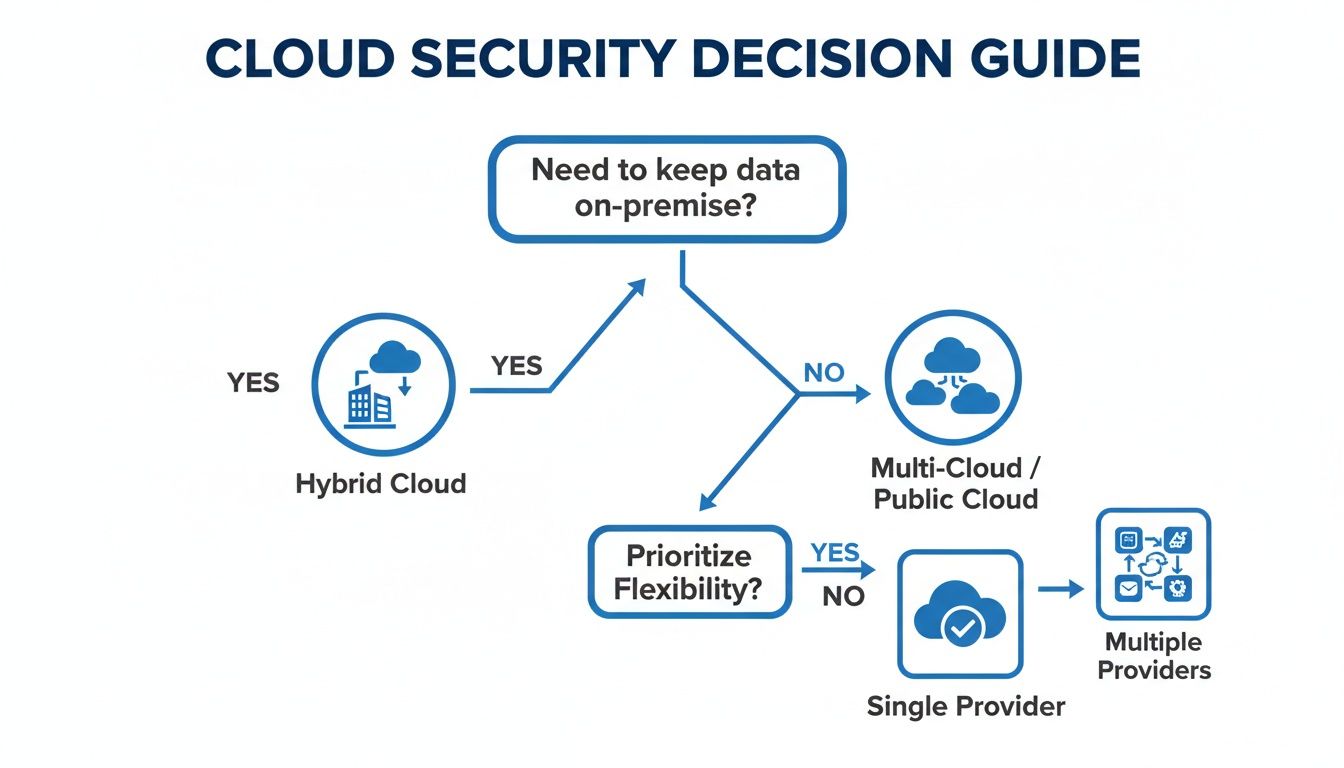
As the flowchart shows, the minute you need to keep certain data on-premise, the path immediately forks toward a hybrid cloud model.
Navigating Multi-Cloud Complexity and Costs
While multi-cloud sounds great in theory, it opens up a Pandora's box of operational and financial headaches. In fact, while 92% of organizations now have a multi-cloud strategy, many are struggling with the fallout. The average enterprise is juggling an incredible 1,295 cloud services, leading to sprawl where companies run 50% of their workloads across an average of 2.2 different providers.
This fragmentation makes it nearly impossible to get a clear view of what’s running where, leading to a massive problem with idle resources. These "zombie servers" can end up wasting 30-50% of a company's total cloud bill. You can learn more about how these cloud computing statistics impact financial governance in practice.
The biggest challenge with multi-cloud isn’t the technology, it’s the cost control. Without a central way to see and automate everything, the flexibility you were promised gets eaten alive by runaway spending on resources you aren't even using.
This is exactly where specialized cost optimization platforms become a necessity. They give you the unified dashboard and automation needed to stamp out that waste for good. Tools like CLOUD TOGGLE offer a simple way to set power schedules for your servers, ensuring you only pay for compute when you actually need it.
Frequently Asked Questions
Digging into cloud strategy always brings up a few common questions. Let's tackle some of the most frequent ones that pop up when teams compare hybrid and multi-cloud.
Can a Company Use Both Strategies Simultaneously?
Yes, absolutely. It's not only possible but increasingly common. This approach is often called a hybrid multi-cloud strategy, and it blends on-premise infrastructure with services from multiple public cloud providers for maximum flexibility.
Think of it this way: a company might keep its sensitive customer database on its own private servers (the hybrid part) but use AWS for its main application hosting and Google Cloud for specialized machine learning tasks (the multi-cloud part). This gives them tight control over core data while still tapping into the best tools each public cloud has to offer.
What Are the Biggest Hidden Costs in a Multi-Cloud Environment?
While a multi-cloud approach can save money by letting you shop for the best prices, some hidden costs can sneak up on you if you're not careful. These are the usual suspects we see tripping up budgets.
- Data Egress Fees: The cost to move data out of a cloud provider's network can be surprisingly high. If your application constantly shuttles data between different clouds, these fees can add up fast.
- Idle Resources: This one is huge. Development servers, testing environments, and VMs left running 24/7, even when they're only needed during business hours, are a massive source of wasted money. Without a central way to manage them, it's easy to lose track.
- Operational Overhead: Don't underestimate the human cost. Training your team to be proficient on multiple platforms and the time they spend managing separate, fragmented environments is a real and significant expense.
Which Model Is Better for Startups Versus Enterprises?
The right choice really depends on where your company is in its lifecycle and what kind of infrastructure you already have.
Startups usually don't have legacy systems to worry about, so they often gravitate toward a multi-cloud approach. It gives them agility right out of the gate, helps them avoid getting locked into a single vendor, and provides access to world-class services with no major upfront investment.
On the other hand, established enterprises that have already invested heavily in on-premise data centers often find a hybrid cloud strategy makes more sense. It lets them get more value from the hardware they already own while gradually moving workloads to the cloud at a pace that works for them.
Ready to eliminate the hidden cost of idle servers in your cloud environment? CLOUD TOGGLE provides a simple, automated solution to schedule your AWS and Azure resources, ensuring you only pay for what you use. Start your free trial and see how much you can save at https://cloudtoggle.com.