Cloud cost optimisation tools span a wide range of capabilities – from full FinOps platforms to lightweight task schedulers. As organisations look to manage rising cloud bills, choosing the right tool is critical: too heavy and you over-pay for features you don’t need; too light and you miss out on savings opportunities.
In this comparison, we look at how CLOUD TOGGLE compares to three alternatives commonly referenced in the cloud cost space:
-
IBM Turbonomic (including its scheduling and automation functionality)
-
Flexera (enterprise FinOps suite with scheduling capabilities)
-
Skeddly (cloud automation and scheduling tool)
We focus on what each tool actually does, and where CLOUD TOGGLE’s scheduling-focused simplicity can be an advantage.
What CLOUD TOGGLE Does Best
CLOUD TOGGLE is built around one core objective: simple, effective cloud scheduling to reduce idle spend. It offers:
-
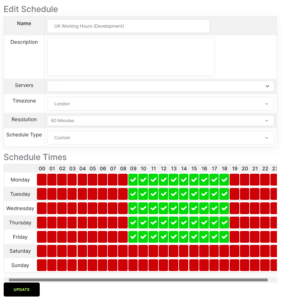
Automated scheduling that lets teams define “on/off” windows for virtual machines and servers so they only run when needed.
-
Multi-cloud support (AWS and Azure) from a single dashboard.
-
Role-based access control (RBAC) – so project leads can adjust schedules without full cloud access.
-
Manual overrides and flexible rules, putting control in users’ hands without complex scripts.
Why this matters: CLOUD TOGGLE’s focus on scheduling and idle resource shutdown means it does one thing well – reducing non-production compute costs – without bundling in analytics, forecasting, or broad FinOps features you might not need.
Turbonomic Scheduler: Part of a Bigger Optimization Suite
IBM Turbonomic is an established cloud optimisation platform that spans automated resource management, rightsizing, performance optimisation, and cost reduction across compute, storage, containers and more.
Key capabilities
-
Demand-driven optimisation: Continuously adjusts resources to match actual application needs.
-
Automated rightsizing and autoscaling – not just scheduling.
-
Broader optimisation beyond idle scheduling, including database, storage and discount coverage.
Scheduling in Turbonomic
While Turbonomic can schedule resources and automate stop/start patterns, this sits within a broader suite that includes performance-aware optimisation and automated scaling, not purely scheduling for cost savings.
What that means: If your goal is strict scheduling to reduce idle resource costs, Turbonomic is powerful but comes with a much larger set of capabilities and price points you may not need, especially for small teams focused on scheduled shutdowns.
Flexera: Enterprise FinOps with Scheduling Capabilities
Flexera is a mature cloud cost management and FinOps platform that provides a compelling set of tools for organisations that want deep visibility, governance, and automation across their cloud estate.
Core features
-
Multi-cloud cost visibility and allocation across AWS, Azure, Google Cloud and hybrid environments.
-
Rightsizing, termination of idle resources, and budget forecasting.
-
Policy-driven automation, including scheduling, though scheduling is part of a much broader toolset.
-
Governance, anomalies and FinOps collaboration across teams.
Scheduling with Flexera
Flexera includes scheduling as one possible action among many optimisation strategies, but it is not a standalone scheduling-first interface.
What that means: For enterprise organisations with mature FinOps programs and hybrid IT estates, Flexera can unify reporting and automate actions. But if you’re primarily interested in straightforward scheduling to cut idle compute costs, you might be paying for a wider platform you don’t need.
Skeddly: Cloud Scheduling & Automation Specialist
Skeddly is a veteran cloud automation service that emphasises scheduling tasks to manage costs and routine operations. It lets users:
-
Schedule start/stop events for instances and resources across AWS, Azure, and Google Cloud.
-
Automate backups, snapshots and other maintenance tasks.
-
Provide a broad set of “action types” beyond just scheduling.
How it compares to CLOUD TOGGLE
-
Similar in focus: Both tools help you schedule on/off patterns to reduce unnecessary cloud costs.
-
Skeddly is broader in automation: It includes backups and snapshot scheduling, not just idle shutdown.
-
CLOUD TOGGLE zeroes in on scheduling simplicity: Its UI and RBAC model are purpose-built for non-engineers managing schedules, with a clear cost reduction goal.
This means if you just need to schedule instances and want a specialist tool, Skeddly is strong, but you may pay for broader automation actions you won’t use if scheduling is your only priority.
Choosing What’s Right for You
-
Want simple scheduling that saves immediately?
CLOUD TOGGLE keeps things lean, does exactly what scheduling-oriented teams need, and avoids the broader complexity (and cost) of larger FinOps platforms. -
Need enterprise analytics and governance?
Flexera or Turbonomic provide deep cost insights, automation and policy enforcement across multi-cloud estates – but you’ll be buying much more than scheduling. -
Like automation beyond scheduling?
Skeddly’s broader action sets give flexibility, though this also means more features to learn and potentially pay for.
Final Thoughts
Cloud cost optimisation is most effective when tools match your team’s needs. AWS and Azure users focused on development or QA environments can cut waste fast with scheduling-first tools. But larger organisations with hybrid architectures and FinOps processes often need platforms that unify cost, governance and optimisation into a single engine.
CLOUD TOGGLE’s advantage is its focus – deliberate, lean, and centred on one of the highest-impact cost levers: shutting down idle infrastructure without paying for surplus features.