Technology Business Management is all about running your IT department like a business. It's a framework that draws a straight line from every dollar you spend on tech, servers, software, people, to the actual business value it delivers. Think of it as a financial roadmap for your entire tech stack, showing you exactly how those investments help your company hit its goals.
What Is Technology Business Management?
Ever tried driving cross-country without a map or GPS? For many businesses, that’s exactly what managing IT spending feels like. They get a huge, ever-growing cloud bill but can’t pinpoint which products, teams, or projects are driving the costs. This creates a massive disconnect between tech and finance, leading to runaway cloud bills and missed opportunities.
Technology Business Management (TBM) fixes this. It provides a standard way to get total cost transparency, helping leaders understand the true total cost of ownership for their IT services. Instead of seeing IT as just another unpredictable cost center, TBM repositions it as a strategic partner that actively creates value.
The Core Problem TBM Solves
The biggest challenge TBM tackles is the communication gap between tech experts and business leaders. An engineer talks about CPU utilization and instance types, while the CFO is focused on profit margins and OpEx. They’re speaking different languages, which makes smart, informed decision-making nearly impossible.
TBM acts as a universal translator, converting technical metrics into business outcomes. It helps answer the questions that really matter, like, "How much does it cost us to support one new customer?" or "What's the real ROI on our cloud migration?"
Getting this clarity is more critical now than ever. The global cloud computing market was valued at USD 752.44 billion and is projected to blow past USD 912.77 billion, potentially hitting an incredible USD 2,390 billion by 2030. Without a solid management framework, CTOs are flying blind into a market where budget overruns are almost guaranteed. You can explore more data on this multi-trillion dollar trajectory to see just how big the challenge is.
The table below breaks down the core goals of the TBM framework.
The Core Pillars of Technology Business Management
| Pillar | Objective | Key Question It Answers |
|---|---|---|
| Cost Transparency | Provide clear visibility into the total cost of IT services. | "What are we spending our money on, and why?" |
| Business Alignment | Connect technology investments directly to business outcomes. | "How is this tech investment helping us achieve our goals?" |
| Value Optimization | Make data-driven decisions to maximize the ROI of tech spending. | "Are we getting the most value from our technology?" |
Ultimately, these pillars work together to shift the conversation from cost-cutting to value creation.
Moving from Cost Center to Value Creator
At its heart, TBM is about a fundamental mindset shift. The conversation moves away from "How can we cut the IT budget?" and toward "How can we invest in technology to get the best possible business results?" It shares a lot of DNA with other financial management practices, and you can see how it applies in the cloud by reading our guide on what FinOps is.
With a TBM approach, your organization can:
- Justify Technology Spending: Clearly show how IT investments are fueling specific business services and driving revenue.
- Improve Decision Making: Use hard data to decide where to invest more, where to pull back, and what to optimize.
- Foster Collaboration: Get IT, finance, and business units on the same page by giving them a shared financial language.
This structured approach isn't just for huge enterprises anymore. It’s become an essential strategy for any company, especially SMBs, that wants to grow smartly and efficiently.
Understanding the Core TBM Framework
To really get what Technology Business Management is all about, you need to look under the hood at its core framework. The best way I’ve found to explain it is to think of a professional kitchen. Every ingredient, every chef's action, and every finished plate is tracked to understand its cost and how it adds up to the final dining experience. TBM does the exact same thing, but for your IT spending.
This approach takes the incredibly complex world of IT and organizes it into a clear, logical structure that everyone, from engineers to the CFO, can actually understand. It draws a straight line from a single item on a cloud bill all the way to the specific business service it supports. At its heart, the TBM framework is built to create real business technology alignment, making sure every dollar spent on tech is pushing the company’s goals forward.
The diagram below shows how TBM acts as that critical translator between raw IT spending and the business value everyone cares about.
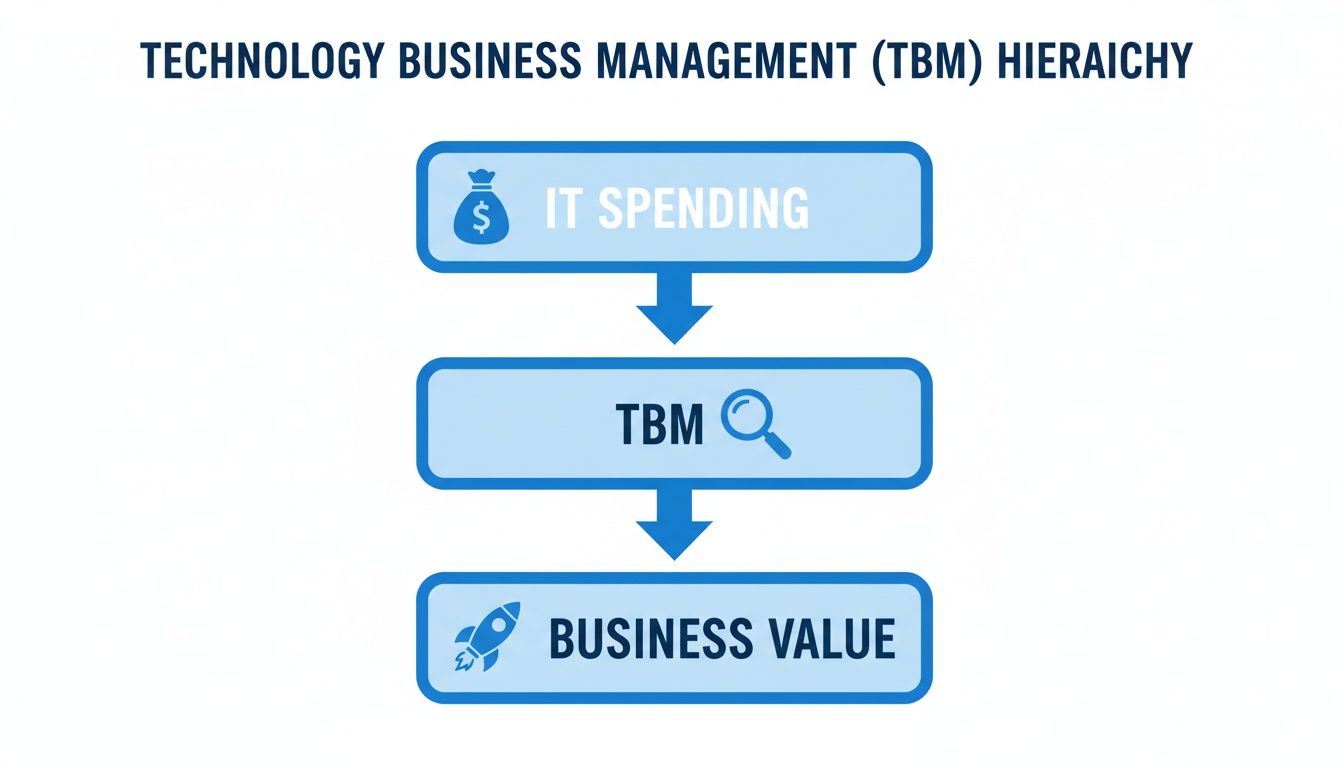
As you can see, TBM isn't just about counting costs. It's the engine that turns those financial inputs into strategic outputs, transforming expenses into a competitive edge.
Breaking Down the Components
The TBM framework really boils down to a few key pieces that work together. Getting a handle on these is your first step toward building a transparent financial model for your company's technology.
-
Cost Pools: Think of these as your raw ingredients. Cost Pools are simply the general ledger accounts where money is spent, things like hardware, software licenses, cloud services, and salaries. Your monthly AWS bill, for instance, is a classic example of a cost pool.
-
IT Towers: These are the prep stations in your kitchen. IT Towers are used to categorize costs from the pools into common technology buckets like compute, storage, networking, or application support. This step helps you group similar expenses together so you can analyze them more effectively.
-
Technology Services: This is the finished dish, ready to be served. A Technology Service is the actual product that IT delivers to the business, which is made up of different elements from various IT Towers. For example, your "Customer Relationship Management Platform" is a service that consumes compute, storage, and software from multiple towers.
TBM's superpower is its ability to show the fully burdened cost of a Technology Service. It proves that the CRM platform isn't just a software license, it's the sum of the servers, network traffic, and support staff hours needed to keep it running.
Connecting Costs to Business Value
The last, and most crucial, step is linking these technology services directly to the business units that use them. This is where the framework truly shines, giving you a crystal-clear picture of which departments are using which IT resources and exactly what it costs.
This connection is made using carefully designed allocation models. These are basically the rules that dictate how costs from IT Towers are assigned to specific Technology Services, and then how those service costs are passed on to different business units. There are many ways to do this, depending on the cost and how precise you need to be. We actually cover a bunch of these in our guide on cost allocation methods.
For example, the total cost of that CRM platform could be allocated to the Sales and Marketing teams based on their number of active users. Suddenly, the leaders in those departments can see exactly how much of the company's IT budget they're responsible for.
This process arms everyone with the data needed for much smarter conversations. A marketing VP can see the real financial impact of requesting a new analytics feature, and the IT team can justify a platform upgrade in terms the business understands. It takes Technology Business Management from a high-level concept and turns it into a practical, everyday tool for making data-driven decisions.
The Tangible Benefits of Adopting TBM
Putting a framework like Technology Business Management in place isn’t just an academic exercise. It’s about moving from theory to tangible results that show up on the bottom line. You stop just organizing expenses and start turning your technology department into a real engine for business growth. The benefits are clear, measurable, and often show up faster than you’d think.
By adopting TBM, you get the clarity you need to make smarter, data-driven decisions. It forces a direct alignment between IT initiatives and what the business is actually trying to achieve, making sure every dollar spent on tech is pushing the company forward. This alignment naturally boosts resource efficiency, cuts out waste, and frees up cash for innovation. TBM also helps organizations pinpoint and implement effective strategies to improve operational efficiency with AI, ensuring technology investments deliver real business value.
Gaining True Cost Transparency
The first and most powerful benefit of TBM is simply seeing where the money is really going. So many businesses operate with a "black box" of IT spending, especially in the cloud, where costs can spiral out of control with almost no warning. TBM shines a light into that darkness, mapping every single cost to a specific service and the business unit that used it.
This level of detail is non-negotiable in a complex tech landscape. A staggering 82% of cloud decision-makers say managing spend is their biggest challenge. It gets worse: 33% of companies are spending over $12 million a year on public cloud, and over 20% of them admit they have little to no idea how those costs break down. TBM is the direct answer to this widespread chaos.
Here’s a real-world example. A marketing tech company thought its cloud budget was in good shape. But a TBM analysis uncovered a shocking truth: 30% of their monthly bill came from development and testing servers left running 24/7. Weekends, holidays, overnight, it didn't matter. These idle resources were a silent budget killer that had gone completely unnoticed.
Making Smarter Data-Driven Decisions
Once you have that transparency, you can finally make decisions based on hard data instead of gut feelings. TBM gives you the financial context to evaluate the true cost and value of your tech services, empowering leaders to invest wisely. It turns abstract IT metrics into concrete business conversations.
Technology Business Management transforms the conversation from "How much does IT cost?" to "What business value are we getting for our technology investment?" This shift is fundamental to running IT like a business.
Let’s go back to that marketing tech company. Armed with clear data showing the waste, the CTO could make a specific, data-backed case for change. It wasn't a vague "we need to cut costs" directive. Instead, the team implemented a simple scheduling policy to power down non-essential environments outside of work hours.
Aligning IT Initiatives with Business Goals
TBM ensures that technology investments aren't made in a vacuum. By tying costs to specific business services and outcomes, it guarantees that IT projects directly support strategic priorities. This alignment is critical for preventing wasteful spending on projects that don't actually move the needle for the business.
The marketing tech company’s story is a perfect illustration. After they eliminated the waste from idle servers, they reallocated the savings, nearly $15,000 per month, into a high-priority project. That money directly funded and accelerated the development of a critical product update their customers had been demanding for months.
Maximizing Resource Efficiency and Innovation
Ultimately, TBM helps you get the most out of all your resources, both financial and human. When you automate cost controls and get rid of manual expense tracking, your teams can stop firefighting budget issues and start focusing on innovation. This creates a direct line between operational efficiency and a real competitive advantage.
Here's how it broke down for them:
- Identified Waste: The company found that 30% of its cloud spend was on servers that were completely idle most of the time.
- Action Taken: They used an automated scheduling tool to shut down non-production instances when they weren't needed.
- Resulting Savings: This simple change freed up thousands of dollars every single month in the IT budget.
- Business Impact: They reinvested those savings into a key product update, which boosted customer satisfaction and drove new revenue.
This straightforward, TBM-guided action turned a hidden cost into a tangible business win.
How to Implement TBM for Cloud Cost Optimization
Applying Technology Business Management principles to your cloud bill might sound like a huge undertaking. But you don't need a massive, company-wide overhaul to start seeing real results. The key is to start with a phased, practical approach that targets the biggest source of waste: idle cloud infrastructure.
This process turns TBM from a high-level concept into a daily, cost-saving habit. It’s a journey that starts with seeing where the money is going, moves to making teams responsible, and locks in the savings with smart automation.
Phase 1: Gain Complete Visibility
You can't manage what you can't see. The very first step is getting total transparency into your cloud costs. This means digging deeper than the single number on your monthly bill and figuring out exactly which resources are driving the spend, and why.
The foundation for this is a rock-solid resource tagging strategy. Think of tags like digital price tags you attach to every single thing you use in the cloud, from servers to storage. Without a consistent tagging policy, effective TBM is nearly impossible.
At a bare minimum, your tagging strategy should cover these key areas:
- Project or Application: Link every resource to the specific project it supports.
- Team or Owner: Assign responsibility to the team or person who owns it.
- Environment: Differentiate between production, development, staging, and testing.
- Cost Center: Map the resource back to the right financial department or budget.
Once these tags are in place, you can use your cloud provider's cost tools to generate incredibly detailed reports. All of a sudden, you can see exactly how much that new feature costs to develop or which team has the biggest infrastructure footprint. This data becomes the bedrock for every decision you make next.
Phase 2: Establish Clear Accountability
With clear visibility, the next phase is all about accountability. This is as much a cultural shift as it is a technical one. The goal is to move the responsibility for cloud spending from a central IT or finance team to the engineers and product teams actually spinning up the resources.
This idea, often called cost ownership, gives teams the power to make smarter financial choices right inside their daily workflows. When an engineering team sees the direct dollar impact of the infrastructure they provision, they are naturally driven to be more efficient.
Accountability turns cost management into a shared responsibility. It transforms abstract budget numbers into concrete, team-level metrics that engineers and product managers can directly influence and optimize.
This shift doesn't happen overnight. It requires open communication and giving teams the right data. A great starting point is sharing those tagged cost reports from Phase 1 with team leads. Set up regular meetings to talk about their spending, celebrate wins, and find areas to improve. This collaboration builds a culture where everyone is mindful of the costs.
For a deeper look into this subject, you can learn more about the broader principles of what cloud cost optimization is and why it's critical for modern businesses.
Phase 3: Implement Automated Governance
The final phase is putting governance in place to turn your insights into automated, consistent savings. Visibility and accountability are great, but without clear rules and automation, waste will always creep back in. Governance, in a TBM context, means setting smart policies that kill inefficiency without slowing your teams down.
One of the most effective and easiest policies to implement is managing non-production resources. Environments for development, testing, and staging often eat up a huge chunk of a company’s cloud budget, yet they're typically only needed during business hours. Leaving them running 24/7 is just throwing money away.
A simple governance policy to schedule these resources to shut down automatically on evenings and weekends can often cut cloud costs by 30% or more. Best of all, it has zero impact on productivity.
Trying to manage these schedules manually is a recipe for failure. It's tedious and prone to human error. This is where tools become absolutely essential. A platform like CLOUD TOGGLE lets you automate these on/off schedules without any fuss.
- Set and Forget Policies: Create simple, recurring schedules for different projects or teams.
- Empower Teams Safely: Let teams manage their own schedules or override them for late-night work, all without giving them risky, full access to the cloud account.
- Drive Consistent Savings: Automation ensures the rules are followed every single time, turning your TBM strategy into predictable, daily cost savings.
By automating this key governance policy, you make cost optimization the default, not a chore. This final step solidifies your TBM implementation, delivering measurable ROI and building a culture of continuous financial improvement.
Calculating Your ROI from TBM in the Real World
The real power of Technology Business Management hits home when you see the direct impact it has on the balance sheet. Big ideas like “cost transparency” and “business alignment” sound great, but they only truly land when they turn into measurable financial returns. So, let's make this tangible with a common, real-world scenario.
Imagine a mid-sized software company struggling with AWS bills that were not just growing, but completely unpredictable. The finance team saw the costs spiraling, but the IT team couldn’t pinpoint which projects or teams were driving the spend. This lack of visibility was creating friction and making any kind of realistic budgeting feel like a shot in the dark.
The Shocking Discovery
Guided by TBM principles, the company's first move was to get some clarity. They rolled out a simple, consistent resource tagging policy across all their non-production environments, that means development, testing, and staging servers. What this basic exercise uncovered was shocking.
After analyzing just one month of data, they found that a staggering 40% of their non-production instances were running 24/7. These servers were essential for development sprints during the week, but they were sitting completely idle on nights and weekends, quietly racking up charges. The team had fallen into the classic "always-on" trap, a massive source of hidden cloud waste.
This discovery wasn't magic; it was the direct result of applying a core TBM principle: connecting infrastructure costs to their actual business purpose. The data was undeniable, these resources were providing zero value for a huge chunk of the week.
Taking Action with a TBM-Aligned Policy
Once the problem was so clearly defined, the solution was straightforward. The company put a simple governance policy in place: all non-production servers would be automatically shut down outside of standard business hours (7 PM to 7 AM on weekdays) and all day on weekends.
To make sure this policy was actually followed without burdening their engineers, they used a scheduling tool to automate the process. This was the key. Automation removed the risk of human error and freed up the engineering team to focus on building products instead of babysitting server uptime.
This is Technology Business Management in action. It's not about wrestling with complex financial models; it’s about using data to find the waste and putting a practical, automated solution in place to eliminate it for good.
That single, targeted action transformed an abstract TBM concept into a profitable strategy that started delivering measurable results almost overnight.
Breaking Down the Financial Impact
The return on investment (ROI) was both immediate and significant. By simply powering off idle resources, the company slashed its billable compute hours.
Let's look at the numbers.
The table below gives a simplified breakdown of the costs before and after implementing the automated scheduling policy. It shows just how quickly a TBM-aligned tool can deliver savings by tackling idle compute.
ROI Calculation for Idle Compute Management
| Metric | Before Implementation | After Implementation | Monthly Savings |
|---|---|---|---|
| Total Non-Production Instances | 100 | 100 | N/A |
| Average Monthly Uptime (Hours) | 720 (24/7) | 240 (Business Hours Only) | N/A |
| Average Cost Per Instance/Month | $80.00 | $26.67 | $53.33 |
| Total Monthly Non-Prod Cost | $8,000 | $2,667 | $5,333 |
| Annualized Non-Prod Cost | $96,000 | $32,004 | $63,996 |
As the data shows, this simple, TBM-guided policy cut their non-production compute costs by nearly 67%. Those $5,333 in monthly savings quickly added up to over $63,000 in annual savings.
This is proof that you don't need a massive, years-long initiative to get value from TBM. By focusing on a high-impact area like idle cloud resources, you can generate a powerful ROI and build the momentum you need to apply these principles across your entire technology landscape.
Of course. Here is the rewritten section, crafted to sound like an experienced human expert and match the provided examples.
Your TBM Questions, Answered
As teams start digging into Technology Business Management, a few questions always pop up. It’s a big shift, after all. You’re moving from seeing IT as just another line item on a spreadsheet to treating it like a core part of the business that creates real value. Let’s tackle the most common points of confusion to get you started on the right foot.
Think of this as a practical guide to demystify the process and show you how TBM can work in your own company, no matter how big or small you are today.
Is Technology Business Management Only for Large Enterprises?
This is probably the biggest myth out there. While TBM got its start in huge, complex companies, its principles are arguably even more critical for small and midsize businesses, especially if you're heavily reliant on the cloud. An unexpected budget overrun can be a minor headache for a massive corporation, but for an SMB, it can be a serious problem.
The whole point is to connect every dollar you spend on tech back to the value it delivers. That’s a universal need, not an enterprise luxury. A small startup benefits just as much as a Fortune 500 company from knowing which product features cost the most to run. You don't need a massive, bureaucratic rollout to see the benefits.
A simplified TBM approach, focused on high-impact areas like cloud cost visibility, provides a significant competitive advantage for businesses of any size. It levels the playing field by enabling smarter, data-driven financial decisions.
Modern tools have made TBM accessible to everyone. Platforms designed for SMBs make it simple to get a grip on major cost drivers like idle cloud servers without needing a dedicated FinOps team or a complex financial modeling suite. This lets smaller teams get powerful results, fast.
What Is the Difference Between TBM and FinOps?
It’s easy to get these two mixed up, but they’re different sides of the same coin. Think of TBM as the overall strategy for the entire business of IT. It’s the high-level framework that covers everything from your on-premise data centers and hardware purchases to software licenses and, of course, the cloud.
FinOps is much more specialized. It’s the hands-on, operational discipline that applies TBM principles specifically to the wild, variable world of the public cloud. FinOps is all about making real-time, data-driven decisions and getting finance, engineering, and product teams to work together to squeeze the most value out of every cloud dollar.
- TBM is the "Why": It sets the high-level strategy and governance for all technology spending.
- FinOps is the "How" for Cloud: It provides the tactical, day-to-day practices for making that strategy happen in a cloud environment.
For example, your TBM strategy might be to cut non-production environment costs by 30%. A classic FinOps tactic to achieve that goal would be using a tool to automatically shut down those servers at night.
How Can I Start Implementing TBM with Limited Resources?
You don’t need a massive budget or a new department to get started with TBM. The trick is to start small, aim for a quick win in an area with high impact, and build from there. For most companies right now, the most obvious place to start is public cloud spending.
Try a simple, three-step approach:
- Focus on Visibility: You can't manage what you can't see. Your first job is to use your cloud provider's native tools and a solid resource tagging policy to get a clear picture of where the money is actually going.
- Identify Low-Hanging Fruit: Once you have that visibility, look for the easy wins. For almost every single company, the biggest source of waste is non-production servers left running 24/7.
- Implement a Simple, Effective Tool: Use a dedicated scheduling tool to solve that specific problem. Automating the shutdown of idle resources delivers immediate, measurable savings with very little effort.
Nailing this first step does two things. It directly helps your bottom line, and more importantly, it creates the momentum you need to get buy-in from leadership to expand your TBM practice to other areas.
What Are the Most Common Challenges When Adopting TBM?
The biggest roadblocks aren't technical; they're almost always about people and data.
On the people side, the main challenge is changing the mindset. You have to get the entire company to stop seeing IT as a cost center and start treating it as a strategic partner that drives the business forward. This means getting real buy-in from business leaders, finance, and engineers by showing them exactly what’s in it for them.
The data side can be tricky, too. Pulling cost data from dozens of different systems and mapping it all back to specific business services is a ton of work. This is exactly why starting with a focused area like the public cloud is so effective. The cost data is already structured and much easier to get your hands on, so you can analyze it and take action right away.
When you use a simple tool to deliver a clear, undeniable financial win, you cut through the cultural resistance. Nothing proves the value of running technology like a business better than cold, hard cash saved.
Ready to take the first practical step in your Technology Business Management journey? CLOUD TOGGLE makes it easy to eliminate wasted cloud spend by automatically scheduling your idle AWS and Azure resources to power off. Start your free 30-day trial and see how much you can save.