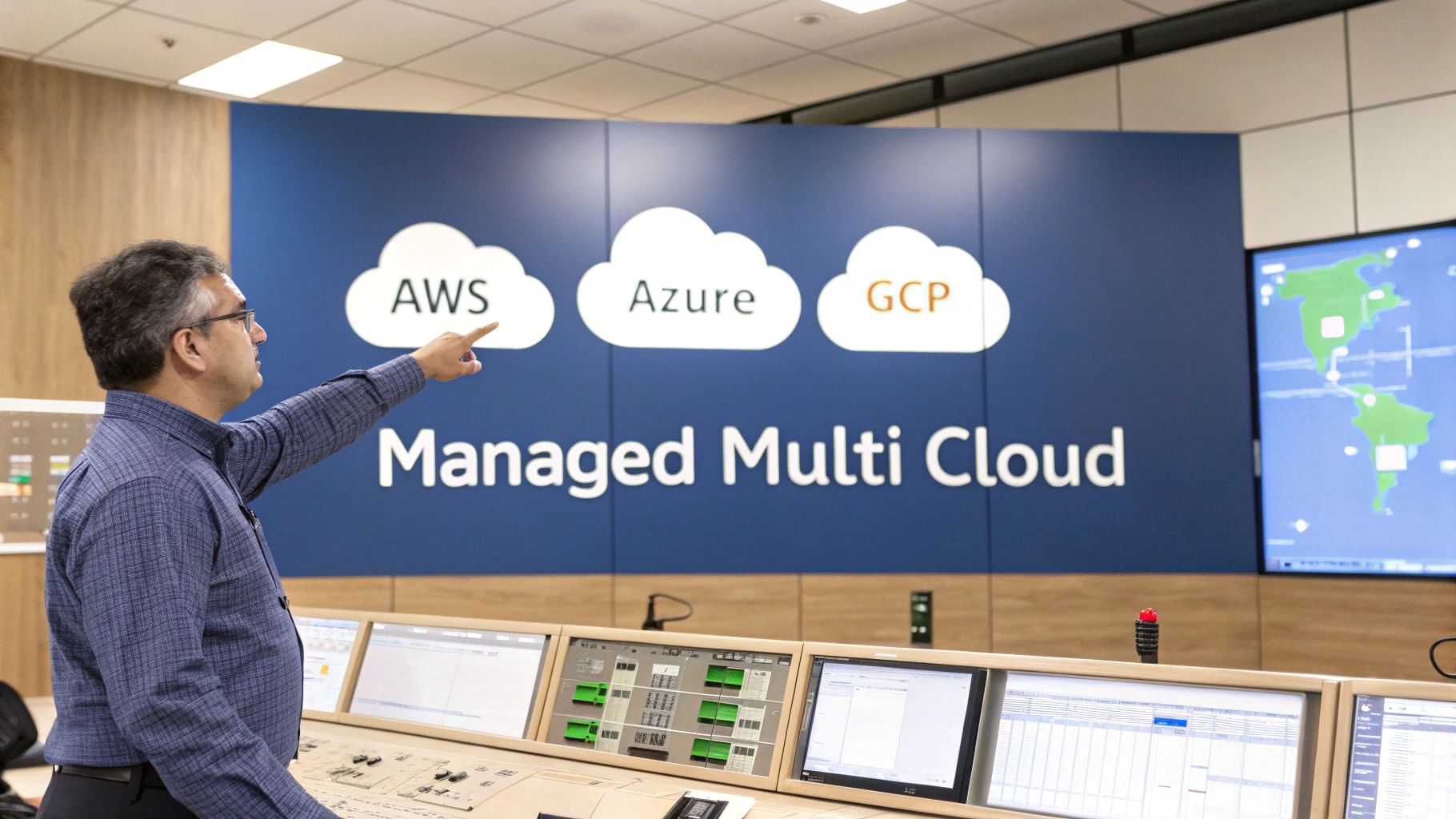
So, what exactly is managed multi cloud?
In simple terms, it’s a service where a third-party expert takes the reins, managing your applications and workloads across multiple public clouds like AWS, Azure, or Google Cloud. Think of it as a strategic partnership designed to cut through the complexity, rein in costs, and bolster security, all without you needing to build a massive in-house team of multi-cloud specialists.
Understanding the Core Concept
Here’s a good analogy: A managed multi cloud approach is like hiring a world-class orchestra conductor. Your organization has access to incredible musicians; these are the powerful services offered by cloud providers like AWS and Azure. But making them all play together in perfect harmony? That requires specialized expertise. A managed service provider acts as that conductor, ensuring every component works together seamlessly to create a masterpiece.
This model is a huge step beyond just using multiple clouds. While a standard multi-cloud strategy means you're picking services from different vendors, the "managed" part is the game-changer. It means an external partner is handling all the operational heavy lifting, from monitoring and security to cost management and governance across all your cloud environments.
To get a clearer picture of the different cloud models, check out our deep dive comparing hybrid vs multi cloud strategies.
To help break it down, here’s a quick overview of what a managed multi cloud approach entails.
Managed Multi Cloud At a Glance
| Concept | Description | Business Impact |
|---|---|---|
| Unified Management | A single partner oversees operations, security, and costs across all your public clouds. | Reduces operational friction and the need for multiple specialized in-house teams. |
| Expertise on Demand | You gain access to certified cloud experts without the high cost of direct hires. | Accelerates innovation and problem-solving with top-tier talent. |
| Cost Optimization | The provider actively manages spend, right-sizes resources, and identifies savings opportunities. | Lowers your total cost of ownership (TCO) and prevents budget overruns. |
| Enhanced Security | A consistent security and compliance posture is applied across all cloud environments. | Strengthens security, simplifies audits, and reduces the risk of data breaches. |
This table shows how a managed approach transforms a complex, multi-vendor setup into a streamlined, high-performing asset for your business.
Why This Shift Matters for Business
The explosion in managed multi cloud adoption isn't just a trend; it's a fundamental shift in IT strategy. Businesses are tired of being locked into a single vendor and are pivoting toward more flexible, resilient, and cost-effective infrastructure. The numbers back this up.
The global multi-cloud management market was valued at USD 8.03 billion in 2022 and is expected to skyrocket to USD 56.02 billion by 2030, growing at a blistering compound annual growth rate of nearly 28%.
This isn’t growth for growth’s sake. It’s fueled by very real business needs that a managed approach solves head-on. Companies are desperate to innovate faster, but they can't afford to get bogged down by the sheer complexity of managing all these disparate systems. You can dig deeper into the data behind this shift with the latest market research on multi-cloud management.
The Primary Business Drivers
So, what’s the real motivation pushing organizations to hand the keys to a managed provider? It usually comes down to a few critical goals that every modern business shares.
- Avoiding Vendor Lock-In: Putting all your eggs in one cloud basket is risky and expensive. A managed multi cloud strategy gives you the freedom to move workloads where they make the most sense, letting you take advantage of competitive pricing and new innovations.
- Boosting Resilience: Spreading your applications across different clouds is just smart business. It drastically minimizes the impact of a regional outage from any single provider, ensuring your services stay online and your business keeps running.
- Accessing Best-of-Breed Services: Let’s be honest, each cloud provider has its superpowers. You can tap into AWS for its unmatched machine learning capabilities, use Azure for its deep integration with the Microsoft ecosystem, and lean on Google Cloud for its world-class data analytics, all orchestrated under one unified management framework.
The Real Benefits of a Managed Multi Cloud Approach
Choosing a managed multi cloud strategy is about more than just technology; it’s a business decision that directly impacts your bottom line and agility. This isn't simply about using a little AWS here and a little Azure there. It's about bringing in an expert partner to orchestrate those environments, unlocking advantages that are incredibly difficult to achieve on your own.
Let's break down what that really means for your business.

The first and most obvious win is cost optimization. Cloud waste is a huge, silent budget killer. Teams often overprovision resources "just in case" or forget to shut down idle instances, leading to a bill full of charges for services that aren't delivering any value.
A managed service provider makes tackling this their top priority. They bring specialized tools to the table that hunt down and eliminate wasted spend across every single one of your cloud accounts.
It all starts with getting a single, consolidated view of your billing, which instantly highlights spending patterns you’d otherwise never see. From there, it's about smart resource allocation and rightsizing to ensure you only pay for what you actually use. This turns a chaotic, unpredictable cloud bill into a manageable expense. Getting the fundamentals of multi cloud management right is the key to unlocking these savings.
Fortifying Security and Compliance
Next up is a massive improvement in security and compliance. Trying to enforce consistent security policies across different cloud platforms like AWS and Azure is a nightmare for most teams. Each one has its own unique toolset, security configurations, and potential weak spots.
A managed provider acts as a single, unified security shield over your entire cloud footprint. They deploy and enforce consistent security protocols everywhere, building a standardized defense that's far stronger than a fragmented, cloud-by-cloud approach. This makes audits simpler and helps you meet strict, industry-specific compliance rules without the constant fear of a misconfiguration slipping through the cracks.
A centralized management platform provides a single pane of glass to deploy applications, monitor performance, manage costs, and ensure security compliance across your entire cloud infrastructure. This unified view is essential for controlling complexity.
By standardizing your security, you shrink your attack surface and plug holes that could otherwise go unnoticed. This is absolutely critical for any business in regulated fields like finance or healthcare, where protecting data isn't just a good idea; it's the law.
Gaining Operational Efficiency
Finally, a managed approach gives you a huge boost in operational efficiency. Let’s be honest: day-to-day cloud maintenance is a grind. Repetitive but necessary tasks like patching, monitoring, and running backups consume a ton of time, pulling your best engineers away from work that actually moves the business forward.
An expert partner automates these routine jobs and brings centralized control to your environment. This frees your internal team from the endless cycle of infrastructure maintenance. Instead of constantly fighting fires, they can finally focus on building new products, improving the customer experience, and driving real growth.
Ultimately, this shift transforms your IT department from a cost center into a genuine engine for innovation.
Navigating Multi Cloud Challenges and Risks
While going multi-cloud has some serious upsides, you have to walk in with your eyes open to the potential pitfalls. It’s a powerful strategy, but it adds new layers of complexity that can absolutely bury teams that aren't ready for it. If you don't have a unified way to manage everything, the very advantages you were chasing can get lost in operational chaos and mounting risk.
The first big wall you'll hit is operational complexity. Think of it like trying to manage several different houses at once, each with its own set of keys, security systems, and utility companies. That's what juggling multiple clouds feels like. Each platform, including AWS and Azure, has its own APIs, billing models, and management tools. This forces your team to become experts in several different ecosystems all at the same time.
This kind of fragmentation turns simple tasks into a chore and complex ones into a nightmare without some kind of unifying platform. It quickly leads to siloed teams, duplicated work, and a massive drag on productivity. A managed multi-cloud service tackles this head-on by giving you a single pane of glass to see and control everything.
Containing Security Vulnerabilities
When you expand your digital footprint, you naturally create a larger surface for attackers to target. Spreading your workloads across different clouds means you're also creating more potential doors for them to try and open. Keeping your security policies and controls consistent across diverse environments becomes a huge challenge.
This inconsistency can leave dangerous gaps in your defenses. A single security setting missed in one cloud could expose your entire organization. A managed approach helps fix this by applying a uniform security posture across all your cloud assets, making sure your data is protected by the same robust policies everywhere it lives.
Preventing Uncontrolled Costs
Without a central way to watch your spending, cloud costs can spiral out of control. Fast. Each cloud provider has a unique pricing structure, and trying to track spending across a half-dozen different dashboards is a recipe for error. This lack of visibility is what leads to "bill shock," those nasty, unexpected charges that blow up your budget.
Hybrid and multi-cloud strategies are the new norm. Estimates show that around 92% of organizations will be using them by 2025. While this flexibility is great, it makes it incredibly difficult to see and control your costs. You can dive deeper into these trends and their security implications in the latest market analysis.
The biggest financial risk in a multi-cloud setup isn't a single big expense; it's the death-by-a-thousand-cuts from not having a unified view of your spending. Hidden costs from idle resources, oversized servers, and inefficient data transfers add up fast across different providers.
Addressing the Skills Gap
Finally, you have to deal with the talent gap. Finding and keeping people with deep, certified expertise across multiple major cloud platforms is both incredibly hard and expensive. The demand for these skills is way higher than the supply, which has created a fiercely competitive hiring market.
Partnering with a managed service provider gives you immediate access to a team of certified experts without the high costs and long waits of trying to hire them yourself. It lets you tap into top-tier talent to shut down risks and optimize your environment from day one.
Choosing the Right Managed Multi Cloud Partner
Picking a partner for your managed multi cloud strategy is one of the most important calls you'll make. The right provider feels like an extension of your own team. The wrong one just adds friction, complexity, and cost. You have to look past the technical spec sheets and find a partner whose expertise, tools, and even culture click with your business goals.
Your evaluation should start with a serious look at their technical chops. Don't settle for a provider who just "knows" the cloud. You need a partner with deep, certified expertise in the specific platforms you rely on, like AWS and Azure. Ask them for real-world case studies and talk to their references to see if they've actually managed environments as complex as yours.
Vetting Core Competencies
Beyond raw technical skill, their security and compliance credentials are table stakes. A provider you can trust will be upfront about their certifications, like SOC 2 or ISO 27001, which prove they follow strict security standards. These aren't just logos for their website; they're proof that they have solid processes in place to protect your data.
Just as critical are their Service Level Agreements (SLAs). Read the fine print here. A good SLA offers clear, financially-backed guarantees for uptime, response times, and how quickly they'll resolve issues. If the SLAs are vague or weak, that's a huge red flag because it probably means their commitment to service quality is just as weak.
Evaluating the Management Platform
The technology a provider uses to manage your environment is every bit as important as the people behind it. A powerful, unified cloud management platform is the engine that drives an effective managed service. To get a better handle on this, check out our guide on choosing the right cloud management platform. The platform is what will simplify the complexity and make your operations more efficient.
Make sure their platform includes these essentials:
- A Single Dashboard: Gives you a bird's-eye view of all your resources, performance metrics, and costs across every single cloud you use. No more jumping between portals.
- Cost Optimization Tools: These should actively hunt down and help you eliminate wasted spending by right-sizing resources, scheduling non-production environments to turn off, and spotting cost anomalies.
- Automation Features: You want to automate the boring stuff, like patching, backups, and scaling, so your team can focus on work that actually moves the needle.
A great partner provides more than just a tool; they offer a transparent and collaborative experience. Their platform should empower your team with insights, not obscure the details behind a complex interface.
Finally, don't forget the "soft" factors that can make or break a partnership. How good is their support? Can you get a certified engineer on the line 24/7 when something breaks? Think about their cultural fit with your team and whether their pricing is transparent. A true partner invests in your success with clear, predictable costs with no hidden fees or nasty surprises.
Proven Implementation Patterns for Your Strategy
Let's move from theory to practice. A successful managed multi-cloud strategy isn't just about picking a few cloud services; it relies on proven implementation patterns. Think of these not as rigid rules, but as flexible blueprints you can tailor to your organization's unique goals.
Choosing the right pattern brings clarity and purpose to your architecture. It’s how you make sure you’re getting the full value from every dollar you invest in the cloud. By understanding their ideal use cases, you can build an IT infrastructure that is more resilient, cost-effective, and powerful.
Let's dig into three of the most effective patterns we see in the wild today.
The Best-of-Breed Pattern
The "Best-of-Breed" pattern is exactly what it sounds like: you strategically cherry-pick the top-tier services from different cloud providers for specific jobs. You're no longer stuck with the tools offered by a single vendor. Instead, you get to assemble a custom technology stack that uses the strongest offering from each cloud.
For instance, you might lean on AWS for its industry-leading machine learning and AI services while using Azure for its seamless integration with Microsoft 365 and Active Directory. This approach ensures every part of your application runs on the optimal platform, squeezing out maximum performance and efficiency.
When you're managing this kind of complex ecosystem, a good partner is critical.
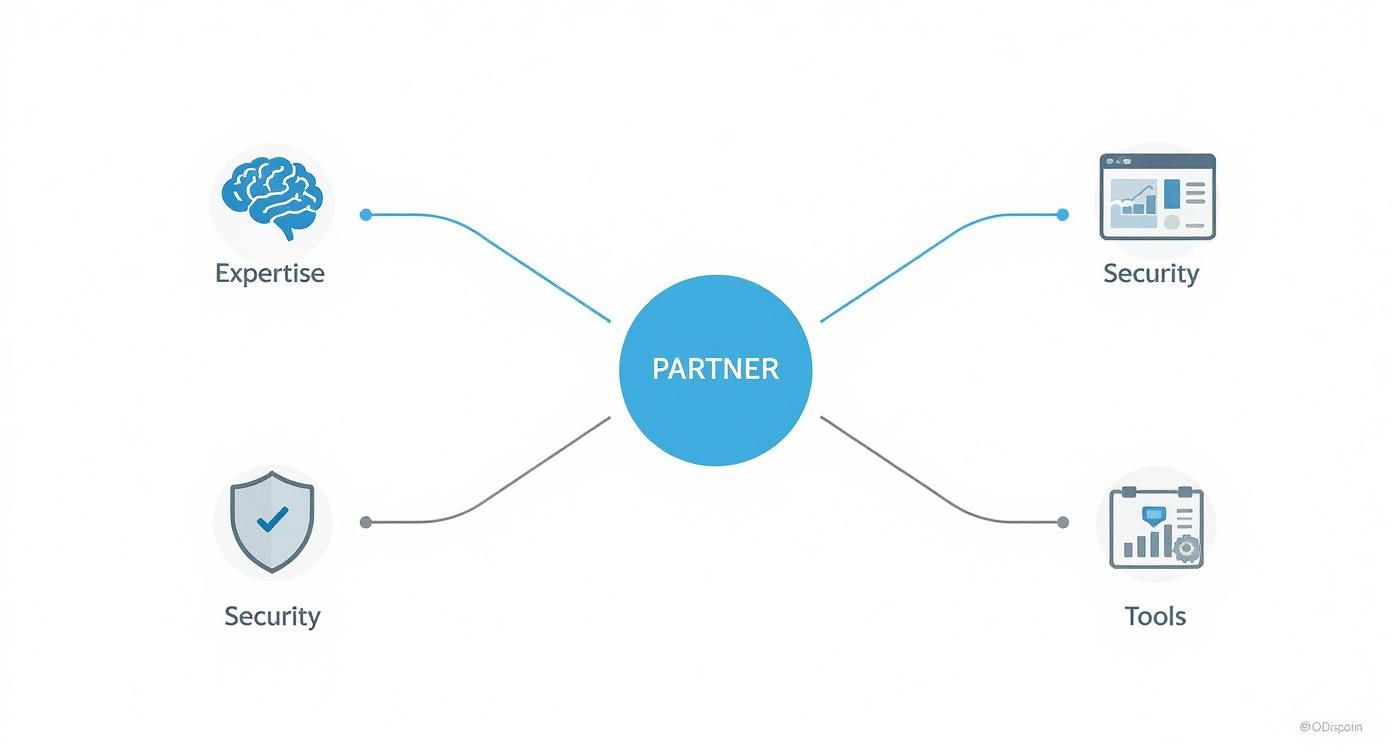
As you can see, a successful partnership hinges on deep expertise, a robust security posture, and powerful management tools to keep everything running smoothly.
The Resilience and Recovery Pattern
Another powerful approach is the "Resilience and Recovery" pattern. In this setup, a second cloud provider acts as a high-availability failover environment for your primary cloud. This active-active or active-passive configuration gives you a level of business continuity that's nearly impossible to achieve with just one provider.
If your primary cloud goes down in a specific region, your managed service can automatically reroute traffic to the backup environment with little to no downtime. This pattern is a must-have for mission-critical applications where every second of availability counts.
It’s no surprise that the Banking, Financial Services, and Insurance (BFSI) sector accounted for the largest end-user share at 26% in 2024, given its total dependency on this kind of operational resilience. You can dive deeper into these multi-cloud market trends to see how different industries are putting this to work.
The Workload Portability Pattern
Finally, the "Workload Portability" pattern is all about architectural freedom. This strategy uses containerization technologies like Kubernetes to decouple applications from the underlying cloud infrastructure. By packaging your applications into portable containers, you can move them seamlessly between AWS, Azure, and other clouds without a major rewrite.
This pattern effectively eliminates vendor lock-in at the application layer. It gives you the ultimate flexibility to shift workloads based on cost, performance, or new feature availability. A managed multi-cloud provider makes this simple by orchestrating your Kubernetes clusters across all your different environments.
Charting Your Path to a Smarter Cloud Future
Shifting to a managed multi-cloud strategy isn't just a technical refresh; it's a core business decision that builds agility and resilience. Done right, it transforms the cloud from a simple utility into a serious competitive advantage. When you partner with an expert, you trade complexity for clarity, finally gaining real control over costs, security, and performance across every cloud you use.
The benefits are tangible. You get optimized costs by cutting out waste and making sure you only pay for what you actually need. Security gets a major boost through consistent, expert-led policies that protect your entire digital footprint, not just isolated silos. The whole game is about turning risks into strengths through smart planning and picking the right partner.
So, What Are Your Next Steps?
The journey starts with one simple action: take a hard look at your current cloud setup. Where are the biggest headaches? Are surprise bills blowing up your budget? Is your team drowning in routine maintenance tasks? A managed approach is built to solve these exact problems.
A well-executed managed multi-cloud strategy doesn’t just simplify operations; it turns your infrastructure into a growth engine. The efficiency and insight you gain let you focus on innovation instead of administration.
With the right strategy and partner in your corner, the complexities of juggling providers like AWS and Azure become your organization's greatest asset. This is your path to a smarter, more efficient, and secure future in the cloud.
Got Questions About Managed Multi-Cloud?
Stepping into a new IT strategy like managed multi-cloud is bound to bring up a few questions. It’s a smart move to get clear on the details before you dive in. Here are some straightforward answers to the questions we hear most often.
What’s the Real Difference Between Multi-Cloud and Hybrid Cloud?
It's easy to get these two mixed up, but the distinction is actually quite simple.
Think of a multi-cloud strategy as using specialized tools from different toolboxes. You might run some workloads on AWS for its data analytics and others on Azure for its strong enterprise integrations. The goal is to pick the best-in-class service for each specific job and avoid being locked into a single provider's ecosystem.
A hybrid cloud, on the other hand, is about mixing your own private infrastructure with a public cloud. You might keep sensitive customer data on your own on-premise servers but use the public cloud to handle a sudden surge in website traffic. It’s all about blending the control of a private data center with the flexibility of the public cloud.
How Does a Managed Service Actually Cut Cloud Costs?
It's a fair question. A managed service provider acts like a financial detective for your cloud spend, constantly hunting down waste that busy internal teams often miss. They bring specialized tools and a ton of experience to the table.
They focus on practical, high-impact savings:
- Rightsizing Your Resources: They dig into your usage data to make sure your virtual machines and databases aren't oversized. Why pay for a V8 engine when a four-cylinder will do the job?
- Smarter Reserved Instance Management: They help you strategically buy reserved capacity for your predictable, long-term workloads, locking in some serious discounts that you might otherwise miss.
- Finding "Orphaned" Resources: It's shockingly easy to leave unused storage volumes, old snapshots, and other digital clutter lying around. These "zombie" assets don't do any work but quietly rack up charges month after month. A good MSP finds and deletes them.
Is Moving to a Managed Multi-Cloud Environment a Headache?
A well-planned migration shouldn't be a painful, drawn-out process. A good partner does the heavy lifting for you.
It all starts with a thorough assessment of what you have now, which they use to build a detailed, step-by-step roadmap. From there, they handle the technical side of things, like setting up secure network connections, moving data, and reconfiguring your apps to work seamlessly in their new home.
The key is partnership. A capable provider guides you through each phase, minimizing disruption and ensuring your team is prepared for the transition. They manage the complexity so you can focus on your business.
What Kind of Industries Benefit the Most from This?
While just about any organization can see benefits, some sectors get exceptional value because of their unique demands for security, resilience, and tight data control.
Industries like finance, healthcare, and retail are prime examples. Financial firms need near-perfect uptime for trading platforms. Healthcare organizations are bound by strict compliance rules for handling patient data. And retailers need the elasticity to handle massive, unpredictable traffic spikes during events like Black Friday without breaking a sweat.
Ready to stop wasting money on idle cloud resources? CLOUD TOGGLE makes it simple to automate server schedules across AWS and Azure, cutting costs without complex configurations. Start your free 30-day trial and see the savings for yourself. Learn more at cloudtoggle.com.