Ever heard of IT Financial Management, or FinOps? Think of it as the rulebook that brings financial common sense to the wild, pay-as-you-go world of cloud computing. It’s all about getting a handle on every dollar you spend on tech, especially with services like AWS or Azure, and making sure it’s actually working for you.
Simply put, this approach is about stopping the financial leaks from resources that are running but not being used.
What Is IT Financial Management and Why It Matters Now

Imagine your company’s cloud spend is like a utility bill for a massive house where every single light, appliance, and faucet is left running 24/7. The bill would be astronomical, and most of that spending would be pure waste. This is the exact problem countless businesses are facing with their cloud infrastructure.
IT Financial Management (ITFM) is the practice of figuring out which "lights" are on, who left them there, and most importantly, turning them off when they aren't needed. It’s less of a rigid process and more of a cultural shift that aligns what you spend on tech with what your business is trying to achieve. It turns a mysterious, ever-growing cloud bill into a predictable and optimized investment.
The Soaring Cost of Unchecked Cloud Spend
Without a clear game plan, cloud bills can spiral out of control, leaving finance and tech leaders scratching their heads. Where is all this money going? This lack of visibility is a huge pain point, especially for small and midsize businesses (SMBs) where every dollar is precious.
The main culprit is usually idle resources, things like development or testing servers that spin continuously, racking up charges on nights and weekends even when nobody is using them.
This challenge has created a booming industry. The global ITFM tools market has exploded, jumping from USD 4.75 billion to USD 5.38 billion in just a short period, with projections showing it could hit USD 12.71 billion by 2032. This isn't just hype; it's a direct response to organizations bleeding money, with many SMBs losing 20-30% of their cloud budgets to forgotten, idle resources.
Why a Proactive Approach Is Essential
Adopting a FinOps mindset isn't just a "nice-to-have" anymore; it's essential for sustainable growth. When you put a framework in place for cost visibility, allocation, and optimization, you give your teams the power to make smarter, cost-aware decisions.
This creates a culture of accountability where engineers and developers actually understand the financial impact of the code they ship and the infrastructure they provision.
Ultimately, effective ITFM delivers a few knockout punches:
- Reduced Waste: It directly targets and eliminates the money you’re burning on unused cloud resources.
- Improved Predictability: It transforms volatile, surprising cloud bills into manageable and forecastable expenses. When looking at predictability, it's worth considering how different strategies fit in, like protecting your budget with flat-rate IT management.
- Enhanced ROI: It ensures every dollar you invest in technology is actually driving real business value.
This proactive approach paves the way for smarter scaling, letting your business innovate and grow without the constant fear of runaway costs.
Understanding the Core Principles of FinOps

Getting IT financial management right isn't about buying a new tool or hiring a new team. It’s a cultural shift, built on a few core principles that completely change how your teams think about cloud spending. Instead of seeing the cloud bill as a mysterious invoice that just shows up every month, this approach embeds financial accountability directly into day-to-day work.
Think of it like a team sport. Traditionally, the finance department was just the scorekeeper, telling everyone the final score long after the game was over. FinOps puts the scorekeeper right on the field, letting the players, your engineers and developers, see the score in real time so they can adjust their strategy on the fly.
The whole point is to give teams the data and freedom they need to make smart, cost-aware decisions without killing innovation. It creates a simple feedback loop where spending, performance, and actual business value are all tied together.
Fostering Cross-Functional Collaboration
The first, and most important, principle is collaboration. It’s no secret that finance, engineering, and business teams often work in their own little worlds. Engineers build stuff, finance pays the bills, and business leaders hope for the best. In the cloud, that separation is a recipe for wasted money.
FinOps tears down those walls by creating a shared language and common goals. Finance folks get a better handle on the technical reasons behind cloud usage, while engineers finally see the real-world cost of their architectural decisions. Everyone starts speaking the same language.
Imagine an engineering team wants to use a more powerful and more expensive server to boost application speed. Through collaboration, finance can help weigh that cost against the potential revenue bump or better user experience. It leads to a decision that’s good for the entire company, not just one department. You can get a great primer on this philosophy by reading this guide on what is FinOps.
Promoting Ownership and Accountability
Next up is ownership. In old-school IT, costs were centralized and totally disconnected from the teams actually running up the bill. FinOps flips that model on its head by pushing responsibility for cloud spending out to the edges. Individual product and engineering teams own the costs of their specific resources.
This doesn't mean your engineers need to become accountants. It just means giving them clear, timely data about the cost of the services they're building and running. When a developer can see a new feature is costing $500 per day in a staging environment, they are empowered to find a smarter way to get the job done.
This principle is about shifting the mindset from "The company pays for it" to "My team is accountable for this cost." That sense of ownership naturally leads to more responsible resource management and creative cost-saving ideas.
To see how these ideas translate into real savings, check out this detailed technical guide to cloud computing cost reduction.
Building Centralized Governance
While ownership gets distributed, a great FinOps practice still needs centralized governance. Don't worry, this isn't about creating a "cost police" department that slows everyone down. Instead, a small, central FinOps team acts as an enabler and a center of excellence.
This core team is typically responsible for a few key things:
- Setting Standards: They define company-wide tagging policies, security rules, and best practices for cost optimization.
- Negotiating Commitments: They handle the big-picture agreements with cloud providers, like Savings Plans or Reserved Instances, to lock in discounts for everyone.
- Providing Tooling: They choose and manage the tools that give feature teams the visibility and control they need to manage their own costs.
By centralizing these key functions, the FinOps team ensures everyone is playing by the same rules and takes advantage of economies of scale. This frees up engineers to focus on creating value, all while operating inside a cost-efficient framework.
Core FinOps Principles and Actionable Steps
To put it all together, here’s a simple breakdown of the FinOps principles and how you can start applying them with your own team.
| FinOps Principle | Primary Goal | Example Action for Your Team |
|---|---|---|
| Collaboration | Unite finance, tech, and business teams around the common objective of maximizing business value from cloud spend. | Create a weekly meeting where an engineering lead and a finance analyst review the cost of a key application together. |
| Ownership | Empower engineering teams to take direct responsibility for the cost and efficiency of the cloud resources they use. | Implement showback reports that clearly attribute cloud costs to specific teams, projects, or features using resource tags. |
| Centralized Governance | Establish consistent, organization-wide best practices and policies for cloud financial management. | Designate one person to create a company-wide tagging strategy and ensure all new resources follow it. |
Putting these three principles into motion, collaboration, ownership, and centralized governance, is the foundation for truly effective IT financial management. It’s a journey, but one that pays dividends by aligning your technology spending directly with your business goals.
Key Metrics for Tracking Your Cloud Spend
Once you’ve got the core ideas of IT financial management down, it's time to put them into practice. This means moving beyond just staring at that single, terrifying number on your monthly cloud bill and starting to measure what actually matters. The only way to know where your money is going, and whether it’s doing any good, is to measure it effectively.
Think of it like a doctor diagnosing an illness. They wouldn’t just say, "You feel sick." They'd take your temperature, check your blood pressure, and run tests to pinpoint the problem. In the same way, you need the right metrics to diagnose the health of your cloud spending. These metrics break down a complex bill into actionable data, so you can finally make smart decisions.
The goal here is to answer the big questions. Which teams are spending the most? What’s the real cost of adding a single new customer? Is our dev environment secretly costing more than production? Getting these answers starts with a few key concepts.
Mastering Cost Allocation and Attribution
The first and most important metric is cost allocation. This is simply the process of assigning every single dollar of your cloud spend to a specific team, project, product feature, or department. If you skip this step, you’re flying blind.
A great way to think about it is splitting a restaurant bill with friends. You wouldn't just divide the total cost evenly if one person ordered a side salad and another had a three-course meal with pricey drinks. Cost allocation is like itemizing that bill so everyone pays for exactly what they got. In the cloud, this is done with a disciplined resource tagging strategy, where every single resource (like a server or database) is labeled with its owner.
Once you’ve nailed allocation, you can roll out two powerful processes:
- Showback: This is where you simply show teams how much the resources they're using cost. You’re not billing them, just making them aware. It’s like handing each friend their piece of the itemized bill with no payment required, but now they see what they spent.
- Chargeback: This takes it a step further by formally billing internal departments for their cloud usage. This approach treats IT like a real business service and creates serious financial accountability. For most SMBs, showback is the perfect place to start, building a cost-aware culture without causing a bunch of internal arguments.
Understanding Your Unit Economics
While cost allocation tells you who is spending the money, unit economics tells you why they're spending it and what business value it’s creating. This metric is all about connecting your cloud spend directly to what drives your business. It answers the questions that really matter:
- What is our cost per customer?
- How much infrastructure cost does each new user signup create?
- What’s the cloud cost behind a single transaction or API call?
Figuring out your unit economics changes the conversation from "How do we cut cloud costs?" to "How do we spend more efficiently as we grow?" For instance, if you know your cost per customer is $5 a month, you can accurately predict your cloud bill will jump by $5,000 when you onboard 1,000 new customers. This makes your financial planning incredibly precise and ties your tech spending directly to your growth.
By focusing on unit economics, you shift from simply managing expenses to making strategic investments. It provides a clear framework for deciding whether a particular cloud expense is a necessary cost of doing business or an inefficiency that needs to be fixed.
The Importance of Proactive Monitoring
Getting these metrics in place isn't a one-and-done task. Cloud environments are always changing, and so are their costs. Cloud cost management has become central to IT financial management precisely because runaway expenses are forcing companies to rethink how they manage their AWS and Azure environments.
Budgets are under the microscope, and studies show that up to 35% of cloud spend is wasted on idle compute resources globally. IT leaders have seen costs double year-over-year without proactive tools, a trend that hits SMBs especially hard. You can learn more about these ITFM trends and challenges.
This is why continuous monitoring is non-negotiable. Setting up simple dashboards and cost reports is your first step toward getting control. They don't have to be complicated; just tracking spending by team or by project tag over time is a huge win. The key is to make this data easy to access and to review it regularly. That’s how you turn IT financial management from a reactive, monthly panic into an ongoing, active practice.
Building Your IT Financial Management Roadmap
Jumping into a mature IT financial management practice doesn't happen overnight. For a small or midsize business, the whole idea can feel completely overwhelming. But here's the secret: don't try to do everything at once.
A structured, phased approach makes the journey manageable. It helps you score early wins and build momentum without needing a dedicated FinOps team from day one. A proven way to do this is with the "Crawl, Walk, Run" framework. This roadmap breaks down ITFM adoption into logical, achievable stages. Each phase builds on the last, letting your team develop skills and processes as you go while delivering real value every step of the way.
This simple flow shows how you can progress from basic cost allocation to real financial accountability.
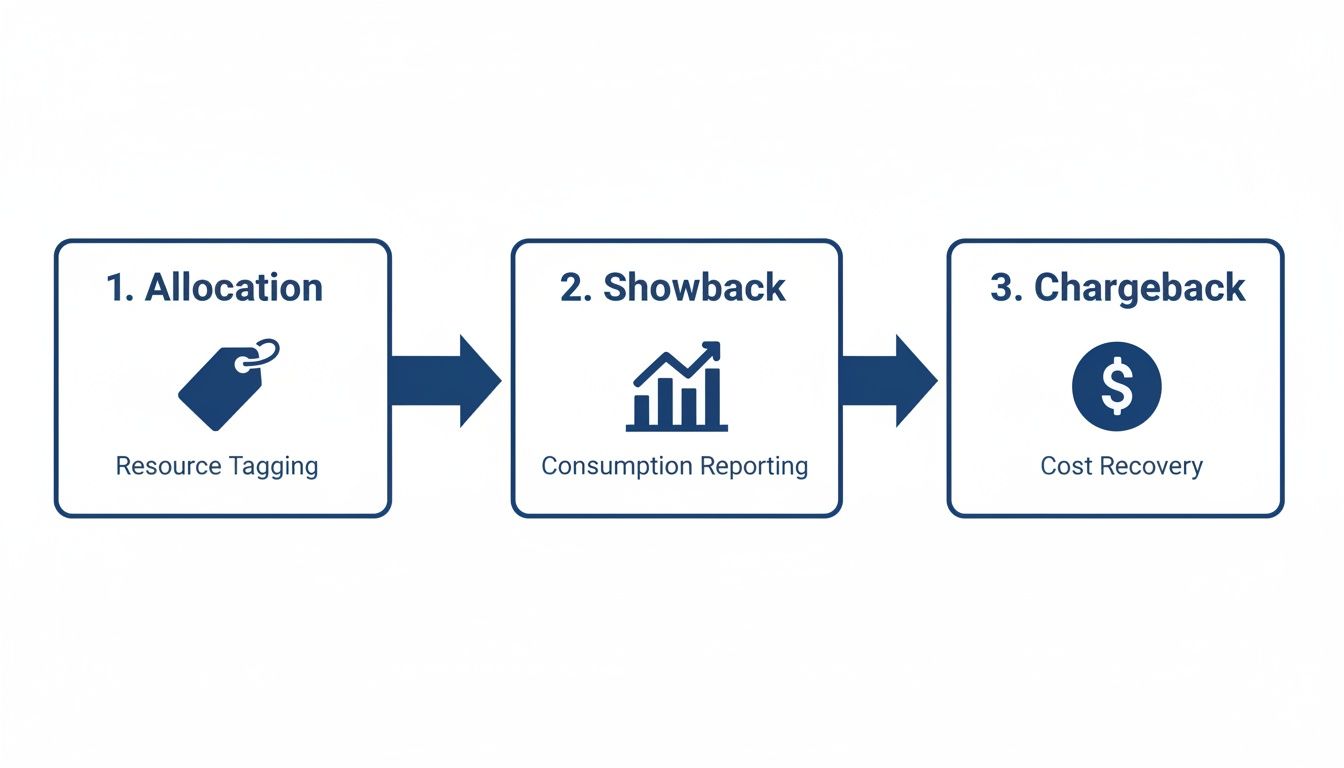
As the visual shows, effective financial management starts with simply knowing who is spending what (Allocation). From there, it evolves into creating visibility (Showback) and, finally, accountability (Chargeback).
Phase 1: The Crawl Stage
The first phase, Crawl, is all about getting basic visibility. You can't manage what you can't see, so this stage is laser-focused on figuring out where your cloud money is actually going. The goal is to turn that single, mysterious monthly bill into a detailed breakdown of costs.
The most important activity here is implementing a consistent resource tagging strategy. Every single new cloud resource, whether it’s a server, database, or storage bucket, has to be tagged with essential information.
Key milestones for the Crawl phase include:
- Defining a Tagging Policy: Set up a simple, mandatory tagging policy. Start with the basics like
owner,project, andenvironment(e.g., production, development). - Achieving Tagging Coverage: Your target is to have at least 80% of your cloud resources tagged according to the new policy. This is the foundation for everything that comes next.
- Basic Cost Allocation: Use your cloud provider’s built-in tools to generate reports that group costs by your tags. This gives you your first real glimpse into which teams or projects are driving your spending.
At this point, you're purely gathering information. Think of it as creating the map that will guide all your future optimization efforts.
Phase 2: The Walk Stage
Once you have clear visibility, it's time to move into the Walk phase. Here, the focus shifts from just seeing the data to acting on it. This stage is about putting foundational optimization practices in place and building a culture of cost awareness across your teams.
The main goal is to introduce the concept of showback. You'll start sharing cost reports with the engineering and development teams actually responsible for the spending. This isn't about pointing fingers; it's about providing transparency so they feel empowered to make more cost-conscious decisions. To manage these costs well, you need to connect your team's day-to-day work with the financial outcomes. You can learn more by exploring the fundamentals of creating accurate budgets and forecasts for your cloud infrastructure.
This is where the cultural shift really starts. When engineers see the direct cost of the resources they deploy, they naturally start looking for ways to be more efficient, often without any top-down pressure.
Key milestones for the Walk phase include:
- Implementing Showback: Regularly send cost reports to team leads, showing them their specific contribution to the overall cloud bill.
- Identifying Quick Wins: Use the data to spot the low-hanging fruit, think oversized virtual machines or unattached storage volumes, and fix them.
- Manual Optimization: Get in the habit of manually shutting down non-production environments (like development and staging servers) on nights and weekends.
Phase 3: The Run Stage
Finally, the Run phase is where ITFM becomes a mature, automated, and integrated part of how you operate. The goal is to make cost efficiency a systematic, continuous process, not just a series of one-off projects.
In this stage, you graduate from manual optimization to automated solutions. This is also where you integrate cost metrics directly into your engineering workflows, making cost a first-class citizen right alongside performance and security.
Key milestones for the Run phase include:
- Automating Optimization: Implement tools that automatically shut down idle resources based on a schedule, which eliminates both manual effort and human error.
- Integrating Cost into CI/CD: Add cost estimation checks into your deployment pipelines. This lets developers see the potential cost impact of a code change before it goes live.
- Establishing Unit Economics: Mature your metrics to track things like cost per customer or cost per transaction. This ties your cloud spend directly to real business value and growth.
This phased roadmap makes IT financial management accessible for any organization. It proves you can achieve significant savings and control without a massive upfront investment.
Essential Tools for Cloud Cost Control
Having a solid IT financial management roadmap is one thing, but putting it into practice requires the right tools. The world of cloud cost control tooling is vast, stretching from powerful native platforms offered by the cloud vendors themselves to specialized third-party solutions built for simplicity and automation. The right choice really comes down to your team's size, technical expertise, and what you're trying to achieve.
Most companies naturally start with the tools built right into their cloud provider's ecosystem. These are incredibly powerful and give you a microscopic view of your spending, if you know where to look. They're the logical first step for anyone trying to get a handle on their costs.
But as you dig in, a common problem surfaces. These native tools are often complicated, built by engineers for engineers. Their dashboards can be a sensory overload for finance professionals or project managers who just want to know, "Are we on budget?" This complexity can become a real bottleneck, slowing down any real progress on cost optimization.
Native Cloud Provider Tools
Every major cloud provider, AWS, Azure, and Google Cloud, offers its own suite of cost management tools to help you analyze, control, and optimize your spending. These platforms are the foundation of any FinOps strategy and are the perfect place to start your cost visibility journey.
The main native tools you'll encounter are:
- AWS Cost Explorer: This tool lets you visualize and manage your AWS costs and usage over time. You can build custom reports to analyze spending at a high level (like total monthly costs) or drill down into the cost of a single, specific resource.
- Azure Cost Management + Billing: This is Microsoft's command center for monitoring, allocating, and optimizing your Azure spend. It provides deep analytics and lets you create budgets with alerts to prevent nasty surprises on your bill.
- Google Cloud Cost Management: This suite of tools, including Cost Table and detailed reports, helps you understand spending patterns and pin costs to specific projects and teams inside your Google Cloud environment.
While these tools are essential for deep-dive analysis, their greatest strength is also their main weakness for many teams. They demand a serious investment in time and training to master, and their granular nature can make it tough to spot the most obvious sources of waste quickly.
The Value of Specialized Platforms
This is exactly where specialized third-party platforms shine. These tools are built from the ground up to cut through the complexity of cloud cost management, making it accessible to everyone, not just cloud architects. They often focus on solving one problem exceptionally well, offering a much faster path to real savings.
A perfect example is tackling idle compute resources. Non-production environments, like development, testing, and staging, are often the biggest culprits of silent waste. They run 24/7 but are typically only used during business hours. This is where automated scheduling tools fit perfectly into an IT financial management strategy.
Instead of asking engineers to manually shut down servers every evening, a specialized tool automates the process. This guarantees savings without adding any manual work, turning a daily chore into a reliable, automated cost-control mechanism.
These platforms are all about ease of use and secure, role-based access. This means you can empower a project manager to schedule server shutdowns without giving them the keys to your entire cloud kingdom, a critical security win. By focusing on automation, these tools deliver predictable and immediate savings, often slashing non-production server costs by over 65%.
For a deeper look, check out our guide on the best cloud cost management tools available today. Ultimately, finding the right mix of native and specialized tools is the key to building a successful and sustainable FinOps practice.
Practical Ways to Reduce Cloud Costs Today
Theory is great, but sometimes you just need to slash your cloud bill now. The good news is, there are a few high-impact moves you can make right away to stop the bleeding. These aren't just generic tips; they're tangible actions that target the biggest sources of waste without messing with your core operations.
Think of it like plugging the biggest leaks in a bucket. By focusing on rightsizing, cleaning up digital junk, and automating shutdowns, you can see significant savings almost immediately.
Automate Non-Production Server Schedules
This is the low-hanging fruit of cloud savings. Your development, staging, and testing environments almost never need to be running 24/7. In reality, they often sit idle for over 120 hours a week (nights, weekends, holidays), all while racking up charges.
Automating their shutdown is a guaranteed win. Simply schedule these resources to power down when your team clocks out and power back on before they start their day. It’s a simple change that can easily cut their costs by 60% or more.
Mini Case Study: A small software startup was watching their cloud bill creep up every month. They set up a basic schedule to shut down their staging environment on weeknights and weekends. The result? They cut their non-production compute costs by 40% in the first month alone, saving thousands of dollars a year without impacting a single developer's workflow.
Rightsize Your Virtual Machines
Rightsizing is just a fancy term for making sure you're not paying for more server than you actually need. It's incredibly common for teams to overprovision resources "just in case," leaving you with a fleet of oversized, underused, and expensive virtual machines. You might be paying for an 8-core server when a 4-core machine would do the job just fine.
Getting started is straightforward:
- Look at the Data: Dive into your cloud provider's monitoring tools. Check the CPU and memory usage for your instances over the last few weeks.
- Find the Loafers: Keep an eye out for any VMs that consistently hover below 20% CPU utilization. These are your prime candidates for downsizing.
- Test, Then Change: Before you make it permanent, test the smaller instance size under a normal workload. This quick check ensures you won't see any negative performance impact.
Eliminate Unused and Orphaned Resources
Over time, every cloud environment accumulates a bit of "digital clutter." These are the forgotten resources that aren't attached to anything but are still quietly costing you money. The usual suspects are unattached storage volumes (like EBS volumes in AWS) and ancient machine snapshots.
A regular audit is your best defense. For example, when you terminate a virtual machine, its storage disk often isn't deleted automatically. A single forgotten high-performance disk can cost you hundreds of dollars a year for absolutely nothing.
Making a quarterly cleanup a team habit is a simple but powerful FinOps practice. It ensures you're only paying for what you actually use and stops those slow, silent financial leaks from draining your budget.
Your Questions Answered
Diving into IT financial management can feel like a big step, especially when you're just starting out. Here are a few of the most common questions we hear from SMBs, DevOps teams, and finance folks trying to get a handle on their cloud bill.
Is This Stuff Too Complicated for a Small Team?
Not at all. The best part about IT financial management is that it scales to fit your needs. You don't need a massive team or a complex strategy to make a real difference.
For a small company, it can be as simple as a few high-impact habits. Start by actually reading your cloud bill every month. Tag your most expensive resources so you know where the money is going. Then, find a tool that can automatically shut down your dev servers at night and on weekends. The goal is to grab the low-hanging fruit first and build from there as you grow.
How Do We Get Our Engineers to Care About Costs?
Let's be honest: engineers want to build amazing things, not get bogged down in billing dashboards. The trick is to bring the cost conversation to them, in their world, without making it feel like you're pointing fingers.
Show them the numbers, but don't blame them for them. Frame it as an engineering problem they can help solve: "How can we get the same performance for less money?" Give them easy-to-use tools, like scheduling, so they can be part of the solution. This builds a culture of cost awareness without creating a bunch of administrative work nobody wants to do.
What's the Single Biggest Thing We Can Do to Cut Our Bill Right Now?
For the vast majority of businesses, the quickest win is tackling idle cloud waste. Think about all your development, testing, and staging environments. They’re probably running 24/7, but people are only using them 8-10 hours a day, Monday through Friday.
By setting up automated schedules to shut these servers down on nights, weekends, and holidays, you can slash the cost of those resources by over 65%. It's a simple, set-it-and-forget-it action that delivers immediate savings that repeat month after month, making it the perfect first move.
Ready to stop wasting money on idle cloud resources? CLOUD TOGGLE makes it easy to automate server schedules, reduce your cloud bill, and put FinOps principles into practice. Start your free 30-day trial and see how much you can save at https://cloudtoggle.com.