In the world of software development, Agile and DevOps are two distinct but complementary philosophies that work together to boost speed, efficiency, and quality.
Think of it like this: Agile is the team that designs and builds a race car with speed and adaptability in mind. DevOps is the pit crew that makes sure the car runs flawlessly and gets back on the track in seconds. This partnership is what separates the leaders from the laggards.
The Power Couple of Modern IT
Welcome to the engine room of modern software delivery. For any business to stay competitive today, releasing high-quality software quickly isn't just an advantage; it's a requirement.
The old, siloed ways of working, where development, testing, and operations teams were walled off from each other, just can't keep up. This is exactly where the powerful combination of Agile and DevOps comes in.
These two approaches grew from the need to break free from slow, rigid processes. To really get why Agile and DevOps became the 'power couple' of IT, it helps to look at the evolution of software testing from Waterfall to DevOps. That history shows a clear shift toward more connected and responsive ways of working.
The Rise of Agile and DevOps
The story of modern software delivery really starts in the early 2000s, when the Agile methodology burst onto the scene. It was a direct response to the frustration of rigid models that dragged projects out for months, and it was formalized in 2001. The results speak for themselves. A 2015 report found that high-performing organizations adopting these practices deployed code 30 times more frequently with 200 times shorter lead times than their slower counterparts.
This incredible performance is why so many businesses are focused on combining these two approaches. They share some critical goals:
- Faster Time to Market: Getting features and updates to customers sooner.
- Improved Collaboration: Tearing down the walls between development, operations, and business teams.
- Enhanced Quality and Reliability: Building more stable and dependable products through a constant feedback loop.
Building a Foundation for Success
The synergy between these two philosophies creates a cycle of continuous improvement. Agile is all about building the right product through iterative development and customer feedback. DevOps then makes sure that the product can be built, tested, and released reliably and quickly.
You can get a deeper understanding of how this works by exploring the role of automation in DevOps.
This partnership isn't just about speed. It’s about creating a culture of shared ownership and continuous learning that drives both technical excellence and financial efficiency.
By integrating these practices, organizations can react to market changes with incredible agility while still maintaining a high standard of quality. This sets the stage for how these practices directly impact your cloud budget and overall business success, which we'll explore next.
Understanding Agile and DevOps Principles
To get Agile and DevOps working together, you have to look past the buzzwords and get to the core ideas. These aren't just checklists of tasks; they're mindsets that change how teams build and deliver software. Thinking you can just adopt a few practices from each is a common mistake. The real power comes when you integrate their shared values.
A good way to think about it is with a skyscraper analogy. Agile is the architectural blueprint. It’s all about iterative design, staying flexible, and constantly talking with the future tenants to make sure the building actually meets their needs. DevOps, on the other hand, is the super-efficient, automated construction crew that builds, deploys, and maintains that skyscraper.
This is where speed and delivery come together. Agile focuses on building the right product, while DevOps makes sure it gets delivered and runs perfectly.
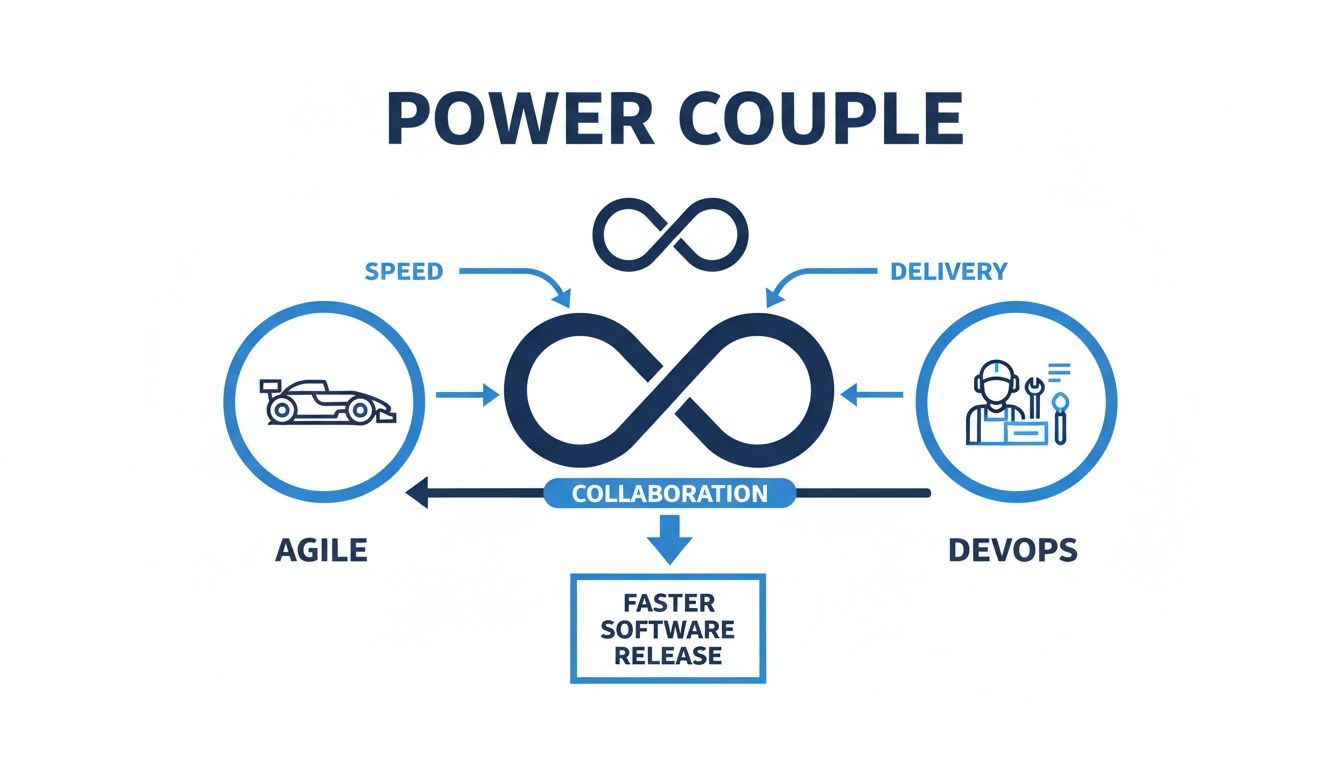
Agile drives the "what" and "why" of what you're building. DevOps provides the "how" and "how fast," creating a complete, high-velocity system from idea to production.
The Four Core Values of Agile
The Agile Manifesto isn't complicated. It’s built on four core values that put people and results ahead of rigid processes. These are the foundation of any real Agile practice.
- Individuals and Interactions Over Processes and Tools: Agile knows that direct communication is king. A quick chat between a developer and a product owner almost always beats a long email thread or a stuffy ticketing system.
- Working Software Over Comprehensive Documentation: The only true measure of progress is software that actually works and delivers value. Documentation is important, but it should never get in the way of creating a functional product.
- Customer Collaboration Over Contract Negotiation: Agile teams treat their customers like partners. This constant feedback loop ensures the final product solves a real problem, instead of just checking boxes on a contract.
- Responding to Change Over Following a Plan: Markets change. New opportunities pop up. Agile is designed to embrace this, letting teams pivot quickly instead of being shackled to an outdated plan.
These values foster a flexible, human-centered way of working. It’s a shift away from the old, document-heavy methods and toward an environment where teams can deliver what users actually need.
The C.A.L.M.S. Framework for DevOps
If Agile provides the development philosophy, DevOps gives you a framework for extending those ideas across the entire delivery lifecycle. The C.A.L.M.S. model is a fantastic way to grasp the pillars of a strong DevOps culture.
C.A.L.M.S. acts as the connective tissue between development and operations. It is not just about tools; it is a holistic model for creating a high-performing, collaborative IT organization.
Here’s a breakdown of what each letter stands for:
- Culture: This is everything. It’s about tearing down the walls between Dev and Ops, creating shared ownership, and building a blame-free environment where the entire team is on the hook for the product's success.
- Automation: A cornerstone of DevOps is automating everything you can. This includes automated software testing for faster, high-quality releases, infrastructure provisioning (Infrastructure as Code), integration, and deployment. The goal is to get rid of manual, error-prone work.
- Lean: Drawing from lean manufacturing, this principle is all about cutting waste. In software, that means reducing half-finished work, killing unnecessary processes, and shipping value in small, frequent batches.
- Measurement: You can't improve what you don't measure. DevOps thrives on data from the entire pipeline, from the first line of code to production performance, to find bottlenecks and see where you can get better.
- Sharing: This pillar is all about making knowledge and tools accessible. When teams openly share their best practices, their code, and even their failures, the whole organization gets smarter and stronger.
How Agile and DevOps Fuel Cloud Success
This is where Agile and DevOps stop being just buzzwords and start delivering real value, especially in the cloud. The cloud isn't just a different place to host your apps; its on-demand, automated nature is the perfect environment for both Agile and DevOps to shine. When you bring them together, you create a powerful engine for getting things done quickly.
Let's use an analogy. Think of it like a top-tier restaurant. Agile is the head chef who's always out in the dining room, talking to customers and getting instant feedback. They're constantly tweaking the menu with small-batch specials (sprints) to see what people love.
DevOps, on the other hand, is the state-of-the-art automated kitchen. It ensures every dish, whether it’s a classic or a brand-new special, is made with perfect consistency and delivered to the table the moment it’s ready.

This partnership turns ideas into working features at an incredible speed, all powered by the capabilities built right into the cloud.
Connecting Agile Sprints to the CI/CD Pipeline
The real magic happens when Agile’s quick development cycles plug directly into the DevOps continuous integration and continuous delivery (CI/CD) pipeline. Each Agile sprint delivers a small, working piece of software. That piece doesn't just get put on a shelf; it's fed straight into the automated pipeline.
Here’s a practical look at how that connection works:
- Plan: An Agile team plans a sprint, grabbing a small handful of user stories based on customer needs and business goals.
- Code: Developers write the code to bring those stories to life.
- Integrate: As soon as a piece of code is finished, it’s checked into a shared code repository. This action automatically kicks off the CI/CD pipeline.
- Build & Test: The pipeline builds the application and runs a whole suite of automated tests to find bugs or integration problems right away.
- Deploy: If all the tests pass, the new code is automatically deployed to a staging environment for review, or sometimes, straight into production.
This creates a smooth, automated path from a line of code to a live feature. The cloud is what makes this a reality by providing the on-demand infrastructure needed for testing and deployment: servers that can be spun up and torn down automatically as needed. You can dig deeper into how this works by exploring cloud application automation and its effect on development speed.
A Self-Improving System Fueled by Feedback
When you merge Agile and DevOps, you don’t just get speed; you get a powerful, self-improving system. Agile’s core idea of "customer collaboration" doesn't stop once the software is launched. It extends right into the operational phase through DevOps.
For instance, continuous monitoring is a fundamental part of DevOps. Teams use tools to watch how features are actually performing in the wild, see how users are interacting with them, and spot any errors.
This real-world data isn't just for the ops team. It's funneled directly back to the Agile product owner and developers, becoming critical information for planning the very next sprint.
This closes the feedback loop completely. Instead of guessing what customers want, teams can see what they actually do. If a new feature isn't being used or is causing headaches, the team can quickly pivot in the next sprint to fix it or build something more valuable.
Cloud Platforms as the Perfect Enabler
Cloud platforms like Amazon Web Services (AWS) and Microsoft Azure are built from the ground up to support this kind of integrated workflow. They offer the essential building blocks that make a combined agile and devops strategy a success.
- Elasticity: Need to run thousands of automated tests all at once? The cloud can give you the compute power in seconds and shut it down the moment you're finished, so you only pay for what you use.
- Managed Services: Ready-to-use services for CI/CD, container orchestration (like Kubernetes), and serverless functions reduce the operational grunt work, freeing up your team to focus on building features.
- Infrastructure as Code (IaC): Cloud-native tools let teams define their entire infrastructure in code. This makes setup repeatable, testable, and completely automated.
By using these native cloud tools, companies can build a solid foundation for their Agile and DevOps practices. This ensures that the speed you gain from Agile development isn’t wasted on slow, manual deployments, turning the promise of fast, high-quality releases into a daily reality.
Your Blueprint for an Integrated Strategy
So, you're ready to build a high-performing IT engine? The secret isn't just buying new software. Merging Agile and DevOps is about fundamentally rewiring how your teams think, work, and collaborate. This is your practical roadmap to making it happen, starting with the people and then moving to the technology that powers it all.
Real success comes from creating a smooth, automated workflow from start to finish, not just chasing the latest shiny tools. This blueprint will walk you through the process, whether you’re a small startup or a larger organization ready for a change.
First, Build a Collaborative Culture
Before you write a single line of code or spin up a new tool, you have to get the culture right. A unified Agile and DevOps culture is the foundation for everything else. Without it, even the best technology stack will fall flat. The goal is to tear down the traditional walls between your development, operations, and business teams.
This shift starts by giving everyone the same goals. For decades, developers were judged on feature speed while operations was judged on uptime, pitting them against each other by design. Instead, your entire team needs to be responsible for the product from initial idea to production performance.
The single most important part of this strategy is creating a blame-free environment. When something breaks, the first question shouldn't be "Who did this?" It needs to be, "What can we learn from this to make our system stronger?" This psychological safety is what allows people to experiment, innovate, and be honest.
Here are a few ways to start building this culture:
- Promote Shared Ownership: Make sure everyone, from the product manager to the ops engineer, feels accountable for the product's success.
- Create Cross-Functional Teams: Build small, independent teams that have all the skills needed to design, build, test, and run their own features. Silos can't survive in this environment.
- Celebrate Learning from Failure: Treat outages and bugs as valuable lessons. Run blameless post-mortems to find the systemic cause, not to point fingers at an individual.
Second, Assemble Your Technology Stack
Once you have a collaborative culture taking root, you can bring in the technology to automate and speed up your workflow. Your toolchain should support the entire lifecycle, from a developer's first code commit all the way to production monitoring.
The technical heart of Agile and DevOps is the Continuous Integration/Continuous Delivery (CI/CD) pipeline. This is an automated assembly line that builds, tests, and deploys your code, drastically cutting down on manual work and human error. Tools like Jenkins, GitLab CI, or GitHub Actions are the engines that run these pipelines.
Another critical piece is Infrastructure as Code (IaC). With tools like Terraform or AWS CloudFormation, your teams define infrastructure like servers, networks, and databases in code files. This makes creating new environments fast, repeatable, and consistent, finally killing the "it works on my machine" problem for good.
Finally, you need solid monitoring and observability. Solutions like Prometheus, Grafana, or Datadog give you a real-time pulse on your application and infrastructure. This data gets fed straight back to the development team, closing the feedback loop and helping them make improvements quickly.
A Step-by-Step Implementation Guide
Adopting a unified strategy is a journey, not a flip of a switch. Here’s a practical, step-by-step plan that works for teams of any size.
- Start Small with a Pilot Project: Don't try to boil the ocean. Pick one low-risk project or service as your testbed and form a dedicated, cross-functional team with folks from both dev and ops.
- Establish a Basic CI Pipeline: Your first goal is to automate the build and test process. Every time a developer commits code, it should be automatically built and run through a set of unit and integration tests.
- Introduce Infrastructure as Code (IaC): Have the pilot team define their application's infrastructure using an IaC tool. This is a massive step toward creating identical, reproducible environments.
- Automate Your First Deployment: Configure your pipeline to automatically deploy the application to a staging or testing environment after all tests pass. This is your first taste of Continuous Delivery.
- Implement Basic Monitoring: Add monitoring to your staging environment. Start tracking simple but important metrics like response time, error rates, and CPU usage.
- Measure and Iterate: Use the data from your pilot to prove the benefits: faster delivery, fewer errors, quicker recovery times. Use these wins to get buy-in to roll out these practices to more teams.
By following this blueprint, you'll systematically build the cultural and technical foundations for a powerful Agile and DevOps practice, creating an IT engine that is truly responsive and efficient.
Connecting DevOps to Your Bottom Line with FinOps
A well-oiled agile and DevOps machine delivers incredible efficiencies. Faster deployments and fewer bugs are great wins for the tech team, but they can feel a bit abstract to business leaders. How does all that technical improvement actually save the company money?
This is exactly where FinOps comes in. FinOps, or Cloud Financial Operations, bridges the gap between your technical operations and the company's bottom line. Much like DevOps, it’s a cultural practice that gets engineering, finance, and business teams talking and making smart, data-driven spending decisions together. The automation and visibility at the heart of DevOps are the perfect tools to make FinOps a reality.

By applying DevOps practices to how you manage cloud costs, you can turn technical metrics into financial wins that everyone can understand.
A Powerful Example: Automating Idle Resources
One of the biggest, most avoidable cloud costs is paying for non-production environments that just sit there, running idle. Think about your development, staging, and QA servers. They often run 24/7, but they’re only really used during business hours. It’s like leaving the lights on in an empty office building all night and every weekend, just pure waste.
Let's do the math. A standard 8-hour workday, five days a week, adds up to 40 hours of active use. But a full week has 168 hours. This means your non-production servers are sitting idle for 128 hours every single week, and you're paying for all of them.
By simply powering down these non-production resources during evenings, weekends, and holidays, organizations can often reduce their cloud bills by 60% or more on those specific resources. This is not a complex architectural change; it is low-hanging fruit with a massive financial impact.
This is a perfect job for DevOps automation. Instead of asking engineers to remember to shut down servers every evening, a tedious task that's easy to forget, you can automate the entire process.
Making Cost Savings Accessible to Everyone
While native cloud tools from AWS and Azure have ways to schedule server shutdowns, they’re often complicated. They usually require scripting knowledge and deep access rights to the cloud account, creating a bottleneck where only a few senior engineers can manage costs. A much better approach is to use tools that give this power to more people.
This is where a solution like CLOUD TOGGLE makes a real difference. It offers a simple, straightforward interface that lets both technical and non-technical people get involved in saving money.
- Easy Scheduling: FinOps teams or project managers can set up automated on/off schedules in a few clicks, no code needed.
- Role-Based Access: You can grant scheduling permissions without giving users full administrative access to your sensitive cloud environment, which is a big win for security.
- Simple Overrides: If a developer needs to work late or on a weekend, they can easily override the schedule for a specific server without having to hunt down an admin.
This approach turns cost optimization into a team sport. It fits perfectly with the agile and DevOps principle of shared ownership, extending that responsibility to the budget. When everyone can see how their actions affect the cloud bill, they naturally become more mindful of resource use.
For a deeper dive into these principles, check out our guide on what is FinOps and how it can help your business. By connecting your DevOps automation engine to a user-friendly FinOps tool, you make cloud cost savings concrete, measurable, and accessible to the whole organization, proving the direct financial value of your modern IT practices.
Common Pitfalls to Avoid on Your DevOps Journey
Making the shift to Agile and DevOps is a huge step forward, but the road is paved with common roadblocks that can stop progress dead in its tracks. Knowing what these mistakes are ahead of time is the best way to make sure your efforts actually deliver the speed and quality you're after.
The most common mistake we see is companies focusing on tools instead of culture. Many teams think that buying a shiny new CI/CD platform or automation suite means they are "doing DevOps." This approach almost always fails because it completely ignores the people involved.
For example, a company might invest in a top-of-the-line automation tool but see zero improvement in how often they can deploy. Dig a little deeper, and you'll find the dev and ops teams are still stuck in their silos, talking through tickets, and working toward different goals. The new tool just becomes another confusing layer on top of a broken process.
Forgetting Leadership and Security
Another major pitfall is not getting real buy-in from leadership. Without active support from the top, any DevOps transformation will lack the authority it needs to tear down those old organizational walls. Leaders have to do more than just sign the check; they have to be the biggest champions of the cultural shift.
A classic example is a team trying to adopt blameless post-mortems, but management still comes in after an outage asking, "Whose fault was this?" This kind of mixed message kills trust and psychological safety instantly, sending everyone right back to their defensive corners. Real buy-in means leaders actively model and defend the new, collaborative way of working.
A common, and frankly dangerous, oversight is leaving security until the very end of the pipeline. In a world of rapid releases, this is a recipe for disaster. You have to integrate security from the start, a practice known as DevSecOps, as it's completely non-negotiable for modern software delivery.
This mistake usually shows up in a few predictable ways:
- Security as a Gatekeeper: The security team is brought in for a final review right before release, creating massive bottlenecks and forcing last-minute rework.
- Manual Security Reviews: Security checks are done by hand, which is way too slow for an automated CI/CD pipeline. The two can't keep pace.
- Lack of Security Training: Developers are never taught how to write secure code, so the same old vulnerabilities keep showing up in the codebase.
The fix is to build automated security scanning tools directly into your CI/CD pipeline and give developers the training they need to fix security issues early. Instead of trying to "do DevOps" by buying another tool, start a small, cross-functional pilot project. This lets you show real value fast, build momentum, and create a blueprint that the rest of the organization can follow for a successful transformation.
Frequently Asked Questions About Agile and DevOps
As teams start to weave Agile and DevOps together, a few key questions always pop up. Let's tackle them head-on to clear up any confusion and get you on the right track.
Can We Do DevOps Without Being Agile?
Technically, you can. But it’s like having a Formula 1 engine sitting in your garage without the car. You've got all this incredible power and automation, but no direction or purpose. It's not going anywhere useful.
Agile provides the "why" and the "what." It breaks down big goals into small, manageable chunks that are perfect for the DevOps pipeline. Without Agile's constant feedback loops and iterative planning, your powerful automation might end up just building the wrong thing, faster.
Is Agile Just for Developers?
That’s a classic myth. While Agile certainly got its start in the world of software development, its principles are much bigger than just code. It’s all about collaboration, responding to change, and delivering value in small, frequent steps.
The real magic happens when the Agile mindset breaks out of the engineering department. When your marketing, sales, and support teams are also working in Agile sprints, the entire business can pivot in unison to meet customer needs and crush market opportunities.
This kind of "whole-company" alignment is what separates the teams that just talk about transformation from the ones that actually achieve it.
How Long Does It Take to See Results?
You'll likely see the first glimmers of progress surprisingly fast, often within a few weeks of launching a pilot project. These early wins are usually pretty clear:
- Faster build times: Automating even the first few stages of your CI/CD pipeline delivers immediate speed boosts.
- Fewer manual errors: Automation doesn't have a bad day. It's consistent and reliable, which cuts down on human slip-ups.
- A happier team: When you break down silos and give people shared goals, morale almost always gets a lift.
But let's be real: achieving a mature, company-wide practice is a journey. It takes a serious commitment to changing culture and always looking for ways to improve. The trick is to start small, measure everything, and celebrate those early wins to build momentum. The combination of agile and devops is a marathon, not a sprint.
Are idle cloud resources inflating your budget? CLOUD TOGGLE helps you reclaim those costs with simple, automated scheduling for your AWS and Azure servers. Start saving in minutes with our 30-day free trial. Learn more at https://cloudtoggle.com.