If you hear the acronym TBM, what it means really depends on who you're talking to. But in the world of IT and finance, TBM stands for Technology Business Management. It’s a discipline that helps companies get a firm grip on their technology costs and, more importantly, understand them.
This isn't just another way to track expenses. TBM is all about drawing a straight line from every dollar spent on technology to the actual business value it delivers.
What Does Technology Business Management Mean?
You can think of Technology Business Management as a financial GPS for your entire tech stack. It gives IT, finance, and business leaders a shared framework and a common language to finally get on the same page. Instead of seeing the IT department as an expensive, mysterious black box, TBM reframes it as a business partner that drives real value.
Here’s an analogy. A traditional IT budget is like a grocery receipt. It's just a long list of items: servers, software licenses, cloud services. It tells you what you bought, but gives you no clue why.
TBM, on the other hand, is like the meal plan that goes with that receipt. It shows exactly how those groceries are being used to create specific dishes (business services) that ultimately nourish the company (by driving revenue or supporting key operations).
Shifting the Conversation From Cost to Value
The real goal of TBM is to completely change the question leaders ask about technology. It moves the conversation away from, "How much are we spending on IT?" and toward a far more important question: "What business value are we getting for our technology investment?"
That shift is what enables smarter financial decisions. When organizations put TBM into practice, they can unlock a few powerful outcomes:
- Full Transparency: Get a clear, granular view of all technology spending across the entire company.
- Business Alignment: Directly connect technology costs to the specific business units, products, or services they support.
- Informed Decision Making: Give leaders the hard data they need to optimize spending, prioritize new investments, and justify budgets based on performance.
With this kind of clarity, a company can finally see exactly how its cloud bill contributes to a new product launch or a sales team's quarterly numbers. This is the core power of TBM in action: it allows you to run IT with the same financial discipline as any other part of the business.
The Core Principles Guiding the TBM Framework
Technology Business Management isn't just another buzzword; it's a practical framework built to tear down the walls between IT, finance, and business leaders. It works by establishing a shared philosophy that transforms IT from a technical support team into a genuine strategic partner.
At its core, TBM is all about making smart, data-driven choices. It helps organizations move past gut feelings and incomplete data when making technology investments. Instead, you get a system where every dollar spent can be clearly understood, justified, and linked back to business outcomes.
Foster Radical Transparency
The first and most important principle is transparency. TBM’s primary goal is to eliminate the dreaded “black box” of IT spending, where business leaders know money is going in but have no idea how it’s actually being used. It pulls back the curtain to provide a clear, detailed view of every technology cost, from infrastructure to software licenses and personnel.
Imagine a department head asking why their team’s IT bill is so high. Without TBM, the answer is usually a vague mention of server costs. With TBM, you can show them exactly which applications they use, how much data they store, and the specific cloud services their team consumes, all broken down by cost.
This level of detail isn't about pointing fingers. It's about creating a shared understanding of where the money goes so everyone can have productive conversations about value and efficiency.
By making costs transparent, TBM shifts the dynamic. It empowers business units to see themselves as consumers of technology services with the ability to influence their consumption, rather than just being passive recipients of a bill.
Align Technology with Business Value
The second principle is all about value alignment. Transparency is a great first step, but it’s only useful if it helps you connect spending to actual business results. This is where TBM shines, linking every dollar spent on technology directly to the business capabilities it supports.
For example, TBM finally helps you answer critical questions like:
- How much does it really cost to support our e-commerce platform during the peak holiday season?
- What is the total technology cost for each salesperson on our team?
- Is our investment in a new CRM system actually improving sales productivity like we hoped?
This ensures that technology isn't just "keeping the lights on" but actively driving strategic goals. It helps leaders prioritize investments that deliver the highest business value and re-evaluate those that don't. This principle is key to answering the question "what does TBM mean for our bottom line?" and proving the ROI of your IT department.
How the TBM Taxonomy Demystifies Your Cloud Spend
At its core, the real strength of Technology Business Management comes from its standardized framework, known as the TBM Taxonomy. You can think of it as a universal chart of accounts built specifically for the world of technology. This system gives you a logical way to organize every single tech-related expense into categories that actually make sense.
The taxonomy is like a Rosetta Stone for your IT budget. It takes all those complex, technical line items from your cloud bills and internal spreadsheets and translates them into a language business leaders can finally understand. Instead of a long, confusing list of server instances and data transfer fees, you get a clean, structured view of your costs.
Structuring Costs with Cost Pools and IT Towers
The TBM Taxonomy organizes expenses using two main layers. Understanding this structure is the key to putting TBM into practice.
- Cost Pools: These are your starting buckets. You group similar expenses together here, no matter what they're used for. Common examples include hardware, software licenses, employee salaries, and outsourced services.
- IT Towers: After grouping your costs, you assign them to IT Towers. These towers represent the major technology services you deliver to the business, the foundational pillars like Compute, Storage, Network, and Applications.
This two-step process gives you the detailed visibility needed to see what you’re really spending. More importantly, it helps you spot hidden waste, like over-provisioned servers or idle cloud resources that are driving up your bill. If you want to go deeper on this, you can check out our guide on different cost allocation methods.
The taxonomy ultimately supports the core principles of TBM: creating transparency to understand value, which allows for better business decisions.
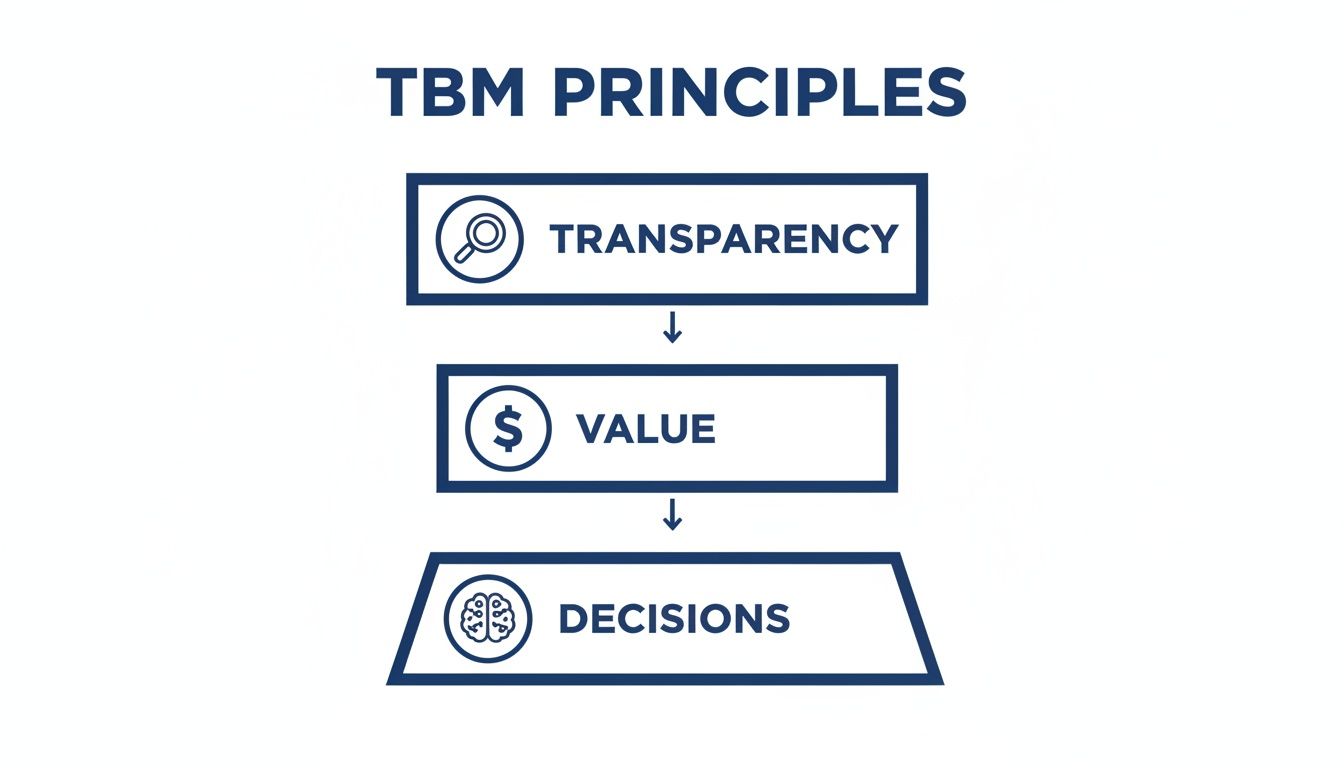
As you can see, cost transparency is the foundation. It’s what lets you connect spending to business value and, in turn, make smarter strategic moves.
Connecting the Taxonomy to Your Cloud Bill
This is where the theory turns into real-world savings. TBM provides the framework that finally shines a light on your cloud spending by mapping what you use directly to business outcomes. It became an essential discipline after the TBM Council formalized it in 2010, right as cloud adoption started to explode.
And that growth is only accelerating. The global cloud computing market is projected to skyrocket from $905.33 billion in 2026 to an incredible $2,904.52 billion by 2034, growing at a compound annual rate of 16.1%.
With the TBM Taxonomy, you can finally take a raw, confusing bill from a provider like AWS or Azure and make it tell a story.
For example, your bill might list "EC2 instances," "EBS volumes," and "S3 storage." Using the TBM Taxonomy, you map these directly to the Compute and Storage IT Towers. This simple act of translation instantly clarifies where your money is going in terms a CFO can understand.
This table breaks down how typical cloud expenses are categorized using the TBM taxonomy, helping you translate your AWS or Azure bill into a business-centric view.
Mapping Cloud Services to the Standard TBM Taxonomy
| TBM IT Tower | Description | Example Cloud Services (AWS/Azure) |
|---|---|---|
| Compute | The processing power for running applications and services. | Amazon EC2, Azure Virtual Machines, AWS Lambda, Azure Functions |
| Storage | The resources used for data persistence and file storage. | Amazon S3, Azure Blob Storage, Amazon EBS, Azure Disk Storage |
| Network | The services that connect resources and deliver content. | Amazon VPC, Azure VNet, AWS Direct Connect, Azure ExpressRoute |
| End User | Tools and services provided directly to employees. | Amazon WorkSpaces, Azure Virtual Desktop, Amazon WorkMail |
| Applications | The platforms that support business applications. | Amazon RDS, Azure SQL Database, AWS Elastic Beanstalk |
By applying this structure, leaders can finally see the true cost of delivering a specific business service. You're no longer just paying for abstract cloud resources; you're investing in the exact capabilities that support sales, marketing, or product development. This clarity is the first step toward running technology like a business.
Understanding the Difference Between TBM and FinOps
Many people hear “Technology Business Management” (TBM) and “FinOps” in the same conversation and mistakenly pit them against each other. The reality is they’re powerful allies, not rivals. Each plays a unique but complementary role in controlling technology spending.Getting their relationship right is the key to a complete financial management strategy.
Think of TBM as the master financial plan for your entire IT organization. It’s the high-level governance, the standardized language, and the enterprise-wide framework for understanding all technology costs, not just the cloud. TBM is about the total cost of ownership and tying every single tech dollar back to its value for the business.
FinOps, on the other hand, is the specialized tactical unit. It’s laser-focused on one specific battleground: the incredibly dynamic and variable spending of the public cloud. It’s an operational discipline that brings real-time, iterative optimization to cloud environments where costs can change by the hour.
Different Scopes, Same Goals
While their scopes are different, TBM and FinOps are working toward the same goals. Both are designed to drive financial accountability, improve efficiency, and make sure technology investments are delivering real business value.
One provides the blueprint; the other executes the ground game.
TBM sets the "what" and the "why" by defining the overall budget and linking spend to business strategy. FinOps delivers the "how" with day-to-day practices that control cloud consumption and optimize costs in real time.
Here’s a practical example. A TBM report might flag that the "Compute" IT Tower is over budget by 15% for the quarter. That’s a strategic insight from 30,000 feet. The FinOps team takes this information and dives in with their tactical toolset. They might discover development environments are running 24/7 and then implement automated shutdown schedules to bring costs back into line.
A Complementary Partnership
TBM gives FinOps the enterprise context it desperately needs to make smart decisions. Without that bigger picture, a FinOps team might aggressively slash costs on a cloud service that is, from a strategic perspective, absolutely critical for a new product launch. They might win the battle but end up losing the war for the company.
Here’s a simple way to see how they work together:
- TBM provides the strategy: It offers the big-picture view of technology spending across every department and platform.
- FinOps provides the tactics: It brings the granular, real-time operational control needed specifically for the cloud.
Ultimately, you don't choose between TBM and FinOps; you use them together. As cloud spending continues to swallow up more of the IT budget, combining the strategic oversight of TBM with the agile control of FinOps is no longer a "nice-to-have," it's essential.
If you want to dive deeper, you can check out our detailed guide on what FinOps is and how it works.
Applying TBM for Practical Cloud Cost Optimization
Alright, let's move from theory to action. This is where Technology Business Management really starts to shine. A TBM framework gives you the strategic view needed to get a handle on one of the biggest headaches for modern businesses: skyrocketing cloud costs.
The first, and often most impactful, target is wiping out idle or "zombie" resources.
Think about it: all those non-production servers left running overnight or on weekends. They silently chew through a huge chunk of your IT budget. The TBM taxonomy helps you hunt down this waste by neatly categorizing compute costs, making it obvious which projects or teams are behind those underused virtual machines. Getting that data-driven clarity is the first real step toward big savings.
From Insight to Action on Idle Cloud Resources
Technology Business Management is completely changing how DevOps and IT Ops teams look at their cloud total cost of ownership. With infrastructure costs getting out of hand, reports show that personnel and governance alone can add 25-30% on top of the raw compute bill.
It gets worse. Real-world stats show that average AWS and Azure users overspend by a staggering 32% just from unmanaged VMs. For a small business with only 50 servers, that’s around $120,000 completely lost to idle resources every single year. You can dig deeper into how these cloud costs are calculated in 2026.
This is exactly where TBM’s strategic insight meets tactical execution. Once your TBM reports flag the idle resources, the next step is to act. But acting isn't always simple. Manually shutting down servers is a tedious chore and wide open to human error, while the native cloud tools are often too complex for most teams to use effectively.
TBM gives organizations the data they need to make smarter decisions about IT spending. This includes looking at practical strategies to reduce software development costs and ensuring every dollar is used efficiently.
Executing TBM Strategy with Automated Scheduling
This is where a solution like CLOUD TOGGLE becomes a game-changer. It serves as the perfect operational tool to execute on the financial insights your TBM framework provides. It directly turns that cost data into real savings without getting in the way of critical work.
CLOUD TOGGLE allows you to:
- Implement automated schedules: Easily set daily or weekly on/off schedules for your non-production resources, like development, testing, and staging environments.
- Empower teams safely: Use role-based access to give teams control over their own server schedules without handing over sensitive credentials or access to the entire cloud account.
- Gain immediate control: Instantly override schedules whenever developers need urgent access, making sure optimization never slows down productivity.
Here’s an example of the CLOUD TOGGLE interface, which makes managing server uptime incredibly simple.
The dashboard gives you a clean, central view for creating and managing schedules across multiple teams and cloud providers. It’s what turns TBM's cost-saving recommendations into reality.
By connecting the high-level financial governance of TBM with a simple, powerful tool for action, organizations can finally close the loop on cloud waste. This synergy ensures that what TBM means for your business is not just better reports, but a healthier bottom line.
If you're ready to take control of your cloud spend, check out our complete guide to cloud cost optimization.
Common Questions About TBM
Whenever we talk about TBM, a few questions always pop up. It’s a powerful framework, but new concepts can bring a little uncertainty. Let's tackle the most common ones head-on.
These answers should help clear things up as you figure out where Technology Business Management fits into your own organization.
Is TBM Only for Large Enterprises?
Not at all. While TBM definitely got its start in huge corporations, the core principles are incredibly scalable. Small and midsize businesses can easily adopt a "TBM-lite" approach to get a much-needed handle on their cloud spending. For many, cloud is a huge chunk of the budget, so visibility is key.
You don't need a massive, complex rollout. Tools like CLOUD TOGGLE make it simple to apply TBM ideas like cost accountability and waste reduction right away. The goal is financial clarity and control, and that’s a win for businesses of any size.
How Long Does It Take to Implement TBM?
A full-blown TBM implementation can take months, sometimes even over a year. But you absolutely do not have to wait that long to see results. The smart move is to score some quick wins. Start with a high-impact area like cloud cost optimization, which almost always delivers the fastest return.
By focusing on a specific pain point first, such as idle compute waste, you can demonstrate the value of TBM principles by delivering tangible savings within weeks, not years. This builds momentum for broader adoption across the organization.
Using a targeted tool helps you prove the concept quickly and show real money being saved. An early victory makes the business case for a more extensive TBM program much, much easier to justify later on.
Can I Use TBM with Multiple Cloud Providers?
Absolutely. In fact, a multi-cloud environment is where TBM truly shines. Its standardized taxonomy gives you a common language to talk about costs, regardless of the provider. This allows you to create a single, unified view of your entire cloud portfolio, something that's nearly impossible otherwise.
This holistic perspective helps you:
- Compare costs between providers like AWS and Azure for similar services.
- Identify the most cost-effective solutions for different workloads.
- Manage all your resources under one cohesive financial framework.
When you implement a solid TBM framework, you can apply all sorts of cloud cost optimization strategies more effectively. This unified approach helps you avoid vendor lock-in and make smarter purchasing decisions across your entire tech stack.
Ready to turn TBM insights into real savings? CLOUD TOGGLE helps you eliminate idle cloud resources and reduce your compute spend by up to 70%. Start your 30-day free trial and see how much you can save at https://cloudtoggle.com.