The variable cost ratio is a crucial financial metric that shows what percentage of your revenue is eaten up by costs that go up and down with sales. In plain English, it tells you how much it costs to produce and sell your product for every dollar you bring in. Getting a handle on this number is the first real step toward building a more agile, profitable business.
What the Variable Cost Ratio Reveals About Your Business

Ever wonder why some businesses seem to scale effortlessly while others get crushed by their own growth? The answer is almost always hiding in their cost structure.
Every business operates with two fundamental types of costs: fixed costs and variable costs. To really understand the variable cost ratio, you have to get the difference between these two. Correctly identifying fixed vs variable costs is a basic but powerful financial skill.
Let's use a simple coffee shop as an example. Your monthly rent is a fixed cost; it’s the same amount whether you sell one latte or a thousand. But the coffee beans, milk, sugar, and paper cups are all variable costs. The more coffee you sell, the more of these supplies you have to buy. It’s a direct relationship.
The variable cost ratio simply measures how much of your revenue is spent on those variable items.
The Core Difference Between Cost Types
Thinking about your costs in these two buckets is fundamental to your company's financial health. They each tell a different story about your operations. To go deeper, check out our guide on the essentials of fixed and variable cost analysis.
For a quick breakdown, here’s a table that lays out the key differences.
| Cost Type | Definition | Business Example (General) | Business Example (Cloud) |
|---|---|---|---|
| Fixed Costs | Expenses that stay the same regardless of your sales or production volume. | Rent, salaried employee pay, insurance, software subscriptions. | A fixed monthly fee for a SaaS tool, a reserved server instance with a 1-year contract. |
| Variable Costs | Expenses that change in direct proportion to your sales or production volume. | Raw materials, sales commissions, shipping fees, packaging. | Pay-as-you-go data storage, CPU usage on virtual machines, data transfer fees. |
As you can see, for modern tech companies, a huge chunk of variable costs comes from cloud computing. Pay-as-you-go cloud services are designed to scale with your demand, but that flexibility can quickly turn into a source of major financial waste if you don't manage it carefully.
Here's a powerful insight we've seen play out time and again: cutting variable costs has a much bigger impact on profit than you might think. A 10% reduction in your variable expenses can easily double the bottom-line impact of an equivalent cut in fixed costs. That's because every dollar you save on variable costs directly boosts the profit margin on every single sale you make.
A low variable cost ratio means you keep more money from each sale. This extra cash is what you use to pay your fixed costs, like rent and salaries, and what’s left over is your profit. The lower the ratio, the faster you get to profitability and the more you have to reinvest in growth.
Calculating Your Variable Cost Ratio Step by Step

Alright, let's move from theory to action. Calculating your variable cost ratio is surprisingly straightforward; no finance degree required. At its heart, the formula is simple but powerful, giving you a crystal-clear snapshot of your operational efficiency.
To get started, you just need two numbers from a specific period, like a month or a quarter: your total variable costs and your total revenue. That's it.
The Variable Cost Ratio Formula
Total Variable Costs / Total Revenue = Variable Cost Ratio
The result is a percentage that tells you exactly what portion of every dollar you earn gets spent on the costs directly tied to making and selling your product or service.
A Practical E-commerce Example
Let’s make this tangible. Imagine you run a small e-commerce store called "Crafty Candles." To find your ratio for the month, you first need to pull together all your variable costs.
Here’s a breakdown of Crafty Candles' variable costs for one month:
- Raw Materials (Wax, Wicks, Scents): $1,500
- Packaging Supplies (Boxes, Labels): $500
- Shipping Fees: $800
- Payment Processing Fees (2.5% of sales): $250
Add those up, and your total variable costs come to $2,800.
In that same month, your store brought in $10,000 in total revenue. Now we just plug those numbers into the formula:
$2,800 (Total Variable Costs) / $10,000 (Total Revenue) = 0.28
To turn this into a percentage, just multiply by 100. That gives you a variable cost ratio of 28%.
What this really means is that for every dollar Crafty Candles earns, 28 cents immediately go out the door to cover the direct costs of making and shipping each candle. This isn't just a random number; it's a foundational piece of your financial puzzle. For a deeper dive into organizing these numbers, check out our guide on effective costs allocation methods.
Understanding Its Link to Contribution Margin
The variable cost ratio has a direct, inverse relationship with another key metric you should know: the contribution margin ratio. In fact, they always add up to 100%.
The contribution margin is what’s left over from your revenue to cover fixed costs and, hopefully, generate a profit after all the variable costs are paid.
Here’s how they connect:
- Contribution Margin Ratio = 100% – Variable Cost Ratio
For our Crafty Candles example, with a 28% variable cost ratio, the contribution margin ratio is 72% (100% – 28%). This tells a powerful story: for every dollar in sales, you have 72 cents left to pay for your rent, salaries, and other fixed expenses. Whatever is left after that is pure profit.
Figuring out this ratio is the first real step toward mastering your unit economics and building a foundation for sustainable growth.
How to Read Your Variable Cost Ratio for Better Decisions
Getting the number for your variable cost ratio is just the first step. The real magic happens when you know how to read it. Think of this metric as a financial compass; it tells you exactly where your business is headed and points you toward smarter strategic moves.
A lower ratio is almost always good news. It means a smaller chunk of your revenue is eaten up by the direct costs of making what you sell. That leaves more money on the table to cover your fixed costs, like rent and salaries, and ultimately, to generate profit. This leftover bit is your contribution margin, and it’s the engine of your profitability.
On the flip side, a high variable cost ratio tells you that your profit margins are razor-thin on every sale. This isn't necessarily a disaster, but it does make your business fragile. A small dip in sales or a surprise increase in material costs could wipe out your profits in a heartbeat.
Using the Ratio to Inform Strategy
Once you understand your ratio, you can make much better decisions about where to put your energy. Should you be chasing aggressive sales growth, or is it time to tighten the belt on costs? The ratio gives you the answer.
Let's look at two different scenarios:
- Low Ratio (e.g., 30%): With a low ratio, every dollar of revenue gives you 70 cents to put toward fixed costs and profit. Your business is running efficiently. The best strategy here is usually to focus on driving more sales, since every new customer adds a healthy chunk to your bottom line.
- High Ratio (e.g., 80%): Here, you only have 20 cents left from each dollar of revenue. Just trying to sell more might not be the answer; it could actually increase your financial risk. Your top priority should be slashing your variable costs through better negotiation, finding efficiencies, or using automation.
A high variable cost ratio means your profit is extremely sensitive to swings in production costs. A low ratio, on the other hand, means your business is more resilient and can hit profitability much faster as sales climb.
Learning From Other Industries
This isn't a new concept. For decades, the hotel industry ran on a high variable cost model. But as hotels added more amenities, their fixed costs grew, shifting the entire structure. The 2020 pandemic laid this weakness bare; when occupancy rates tanked, those high fixed costs didn't go away, and profitability was crushed.
For tech companies, this is a perfect mirror for the risk of paying for idle cloud servers. What should be a variable cost that scales with use becomes a fixed cost that just burns cash. FinOps teams can learn a lot from this, using automated scheduling to kill those idle expenses and get that efficiency back. You can find more historical data on these cost shifts from CBRE.
At the end of the day, your variable cost ratio is more than a number on a spreadsheet. It’s a diagnostic tool. It helps you look under the hood of your business's economic engine and gives you a clear roadmap to drive it toward greater stability and profit.
Proven Strategies to Lower Your Variable Cost Ratio
A high variable cost ratio can feel like you're running on a treadmill. Sure, sales are climbing, but your profits are staying stubbornly flat because every dollar of new revenue brings a new chunk of cost right along with it.
The real key to a healthier bottom line isn’t just about selling more; it’s about making every single sale more profitable. Lowering your variable cost ratio is exactly how you do that. This isn't about slash-and-burn cost-cutting; it’s about building a smarter, more efficient operation.
Negotiate Better Terms With Suppliers
One of the most direct ways to bring down your variable cost ratio is by tackling your cost of goods sold (COGS). Your suppliers are the first place to look. If you have a solid ordering history, don't hesitate to start a conversation about pricing.
Here are a few tactics that work:
- Bulk Discounts: Ask your suppliers for a better per-unit price if you place larger orders. It might require more cash upfront, but the long-term savings can be huge.
- Early Payment Discounts: Many suppliers will offer a small discount, often 1-2%, just for paying your invoices ahead of schedule. Over a year, this really adds up.
- Shop Around: Make a habit of comparing prices from different vendors. Simply letting your current supplier know you’re checking out other options can be enough to get them to offer a better deal.
Optimize Production and Reduce Waste
Every scrap of wasted material, every minute of redundant labor, and every returned product directly bloats your variable costs. Streamlining how you produce goods or deliver services is one of the most powerful moves you can make. This means mapping out every step, from raw material to final delivery, and hunting for bottlenecks and waste.
By focusing on operational efficiency, you do more than just cut costs. You build a stronger, more scalable business model where profitability grows with every sale, rather than staying flat. This is the foundation of sustainable growth.
Improving efficiency could look like reorganizing a workshop to minimize movement, refining a software development process to catch bugs earlier, or improving product quality to reduce costly returns. You can find more ideas by exploring different cloud cost optimization strategies, which apply many of the same principles to digital infrastructure.
Use Technology and Automation
Modern tech gives you countless ways to attack variable costs, especially those tied to labor and manual processes. Automation can take over repetitive tasks, performing them faster and more accurately than a person ever could, which frees up your team for more important work.
Think about where automation can make a difference:
- Automated Billing and Invoicing: Slashes administrative time and cuts down on costly human errors.
- Customer Service Chatbots: Can handle a huge volume of common questions, reducing the need for a large support team.
- Process Automation Tools: These can manage workflows, track inventory, and even control machinery on a production line.
Tackling Cloud Waste to Slash Your Variable Cost Ratio
For any modern company, cloud spending is one of the biggest variable costs on the books. Services from providers like AWS and Azure are built to scale with demand, which is great. But what happens when demand drops? That’s when many businesses watch their variable cost ratio climb for all the wrong reasons.
The main problem is idle resources. We’re talking about the non-production servers, development environments, and staging instances that run 24/7. These are silent profit killers. They bloat your total cloud spend even when they aren’t generating a dime of value, which artificially inflates your variable costs and eats into your margins.
This is a common challenge, but it's also a huge opportunity for optimization.
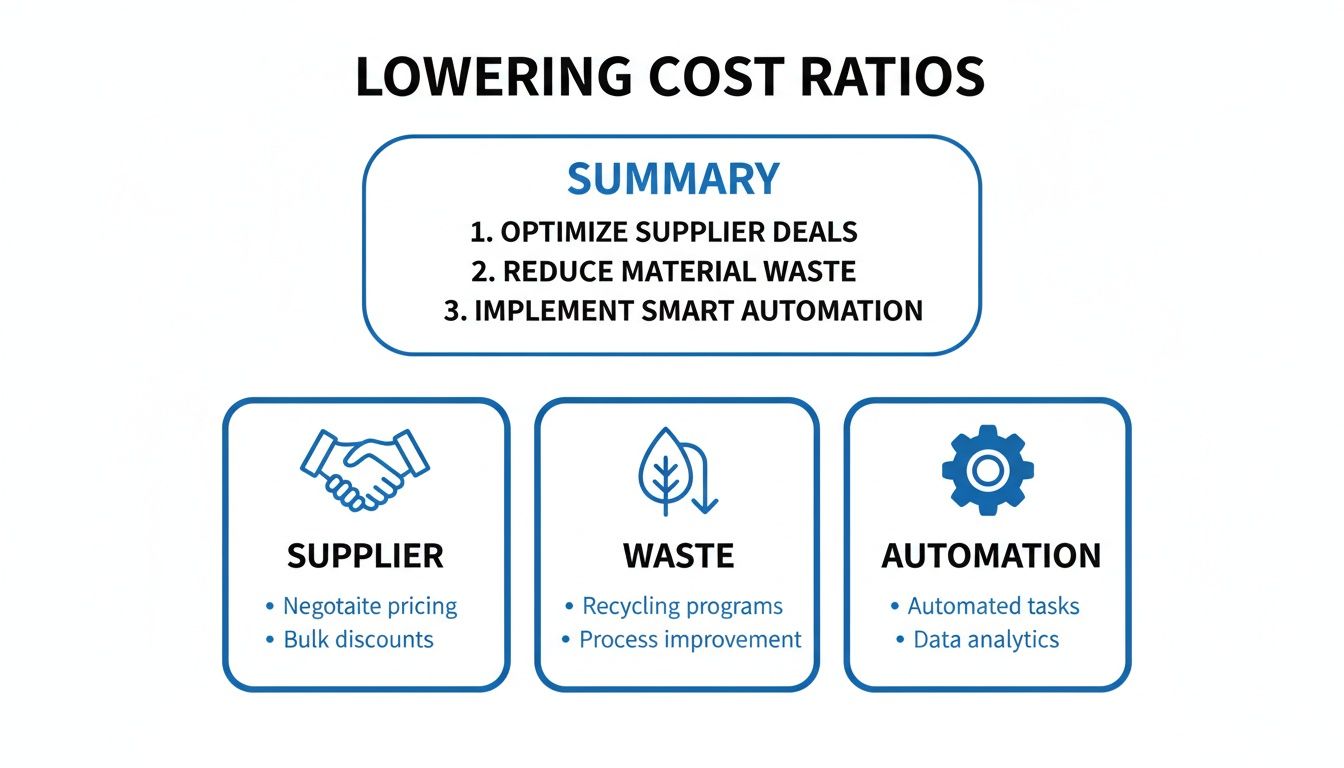
As you can see, getting your variable cost ratio under control comes down to a few key areas: smart supplier deals, cutting out waste, and using automation to your advantage.
The Power of Automated Scheduling
This is where automated scheduling becomes your most powerful tool for cost control. The idea is simple but incredibly effective: you only run your servers when you actually need them.
Think about your development team. They likely work from 9 AM to 5 PM, Monday through Friday. So why are their development servers running all night and on weekends? By automatically shutting these resources down during off-hours, you can wipe out a huge amount of wasted spend.
This simple change can dramatically cut your total cloud spend, instantly lowering your variable cost ratio and boosting profitability without creating any engineering headaches. It turns a lazy, inefficient variable cost into a lean, optimized one.
To get a handle on your cloud expenses and find these pockets of waste, it helps to use a dedicated spend cloud app. These tools give you the visibility you need to see where your money is going, making it much easier to spot idle resources that are perfect candidates for scheduling.
Solving the Idle Resource Problem
The beauty of a tool like CLOUD TOGGLE is that it directly solves this exact problem. It offers a simple, intuitive way for teams to set "on" and "off" schedules for their cloud resources. This means your non-production environments are automatically stopped the moment nobody is using them.
For IT departments, this is a game-changer. According to an analysis from Apptio, nearly 66% of most IT budgets are tied up in fixed costs. The public cloud was supposed to fix that, but idle servers push those costs right back toward a fixed model. A 10% shift from fixed to variable can significantly improve business agility. In one real-world case, a midsize DevOps team cut its variable cost ratio from 40% all the way down to 25% just by automating server shutdowns, a result that CLOUD TOGGLE consistently delivers. You can read more about these fixed-to-variable cost findings and how they impact IT budgets.
Instead of paying for cloud resources 168 hours a week, you might only pay for the 40-50 hours they are actually in use. This directly slashes your variable costs, which in turn causes your variable cost ratio to plummet. The impact on your bottom line is immediate and significant.
Optimizing Cloud Costs With CLOUD TOGGLE vs Native Tools
While cloud providers offer native tools for scheduling, they often come with significant trade-offs in complexity and management overhead. A specialized solution like CLOUD TOGGLE is designed for simplicity and multi-cloud control right out of the box.
Here’s a quick comparison of how CLOUD TOGGLE stacks up against the native schedulers from platforms like AWS and Azure.
| Feature | CLOUD TOGGLE | Native Cloud Schedulers (e.g., AWS Instance Scheduler) |
|---|---|---|
| Ease of Use | Point-and-click interface, no coding needed. Setup in minutes. | Requires scripting, ARM templates, or complex configuration. Steep learning curve. |
| Multi-Cloud Support | Manages AWS, Azure, and GCP from a single dashboard. | Single-provider focused. Requires separate setups for each cloud. |
| Security | Centralized roles and permissions. Vendor-managed security updates. | User is responsible for all security configurations and IAM policies. |
| Maintenance | Zero maintenance. All updates and reliability are handled by the vendor. | Requires ongoing maintenance, troubleshooting, and runbook updates. |
In short, while native tools can get the job done if you have the technical resources to spare, CLOUD TOGGLE offers a much faster, simpler, and more scalable path to controlling your variable cloud costs. It's built for teams who value time and ease of use.
Common Questions About the Variable Cost Ratio
Once you start using a new metric like the variable cost ratio, a few practical questions always pop up. Let's walk through some of the most common ones to make sure you know exactly how to apply this to your own business.
We'll cover what makes a "good" ratio, how it connects to other key metrics, and what it means for your cloud bill.
What Is a Good Variable Cost Ratio?
There’s no magic number that works for every company. The ideal ratio really depends on your industry. A software business, for example, might have a ratio under 20% since its biggest costs, like developer salaries, are fixed.
On the other hand, a retail or manufacturing business could see a variable cost ratio between 60% and 80%. This makes sense when you consider the high cost of raw materials and inventory needed for every sale.
The real goal isn't to hit a universal target. A "good" ratio is one that's either stable or, even better, trending downward over time. You should measure yourself against your own past performance and your industry's benchmarks. It’s a sign your costs are well-managed as you grow.
Focus on progress, not perfection. Shaving even a small, consistent amount off your ratio can have a huge impact on your bottom line.
How Does the Variable Cost Ratio Relate to Contribution Margin?
The variable cost ratio and the contribution margin ratio are two sides of the same coin. They are directly connected and always add up to 100%. Think of it like a pizza; if the variable cost ratio is the slices you ate, the contribution margin is what’s left for everyone else.
The contribution margin ratio shows you what's left from each dollar of revenue after your variable costs are paid.
Here’s a quick example to make it concrete:
- If your variable cost ratio is 40%, your contribution margin ratio has to be 60%.
- This means for every dollar you make, 40 cents immediately goes to cover the variable costs of that specific sale.
- The remaining 60 cents is your contribution margin. That's the money available to pay for all your fixed costs (like rent and salaries) and, eventually, become profit.
Getting this relationship right is absolutely fundamental for things like break-even analysis and smart pricing strategies.
Can a Variable Cost Ratio Ever Be Too Low?
While a low variable cost ratio usually screams "efficiency," an extremely low number can sometimes be a warning sign. You have to look at the "why" behind the number.
For instance, a manufacturing company with a surprisingly low ratio might be cutting corners by using cheap, low-quality materials. It saves cash now, but it can wreck your brand's reputation and lead to expensive product returns later.
In a tech company, a very low ratio might signal underinvestment. Maybe you aren't spending enough on customer support or the cloud infrastructure needed to handle more users. This could create major headaches as your business tries to scale.
Always look at the context. Make sure a low ratio reflects true operational strength, not a risky shortcut.
How Do I Apply This Ratio to My Cloud Spend?
Treating your cloud bill as a variable cost is a core principle of modern FinOps. In a perfect world, your pay-as-you-go cloud services should rise and fall directly with your revenue and user activity.
If your cloud costs are climbing but sales aren't keeping pace, your variable cost ratio is getting worse. This is a clear red flag pointing to inefficiency. A common culprit is idle resources, especially in non-production environments that are left running 24/7.
Using a tool to automate shutdowns directly tackles this waste. By scheduling resources to turn off when they are not needed, you lower your total variable cloud costs and immediately improve your ratio without any complex engineering effort.
Ready to stop wasting money on idle cloud resources? CLOUD TOGGLE makes it easy to automate server shutdowns and instantly lower your variable cost ratio. Start your free 30-day trial and see how much you can save.